What you need to see one
Rainbows need two ingredients: sunlight and water droplets in the air, with the Sun behind you. That is why they often appear when sunshine breaks through after a shower, or in the spray of a fountain, waterfall or garden hose. The bow is always centred on the antisolar point, the spot directly opposite the Sun, which falls where the shadow of your head would be. Because the main bow appears about 42 degrees from that point, rainbows are most common in the morning and late afternoon. When the Sun is higher than 42 degrees above the horizon, the bow would sit entirely below the horizon from flat ground.
Bending and splitting light
White sunlight is a mixture of colours. When light passes from air into water, it slows and changes direction, a process called refraction. Crucially, the amount of bending depends slightly on colour: violet bends a little more than red. This is called dispersion, the same effect that lets a glass prism produce a spectrum. In a raindrop, light refracts as it enters, reflects off the inside of the back surface, and refracts again as it leaves. The combined effect sends light back towards the observer most strongly at around 42 degrees for red and about 40 degrees for violet, which is why red appears on the outside of the bow.
Why it is a circle
Every drop that sits at the right angle from your eye sends you a particular colour. All the drops at 42 degrees from the antisolar point form a cone with your eye at its tip, and that is why a rainbow is circular. From the ground, the horizon usually hides the lower part, leaving an arc. From an aircraft or a high cliff, observers can sometimes see a complete circle. This geometry also means that every person sees their own rainbow, formed by a different set of drops. Two people standing a few metres apart are looking at light from different raindrops, and the bow moves as you move, so you can never reach its end.
Double bows and the dark band
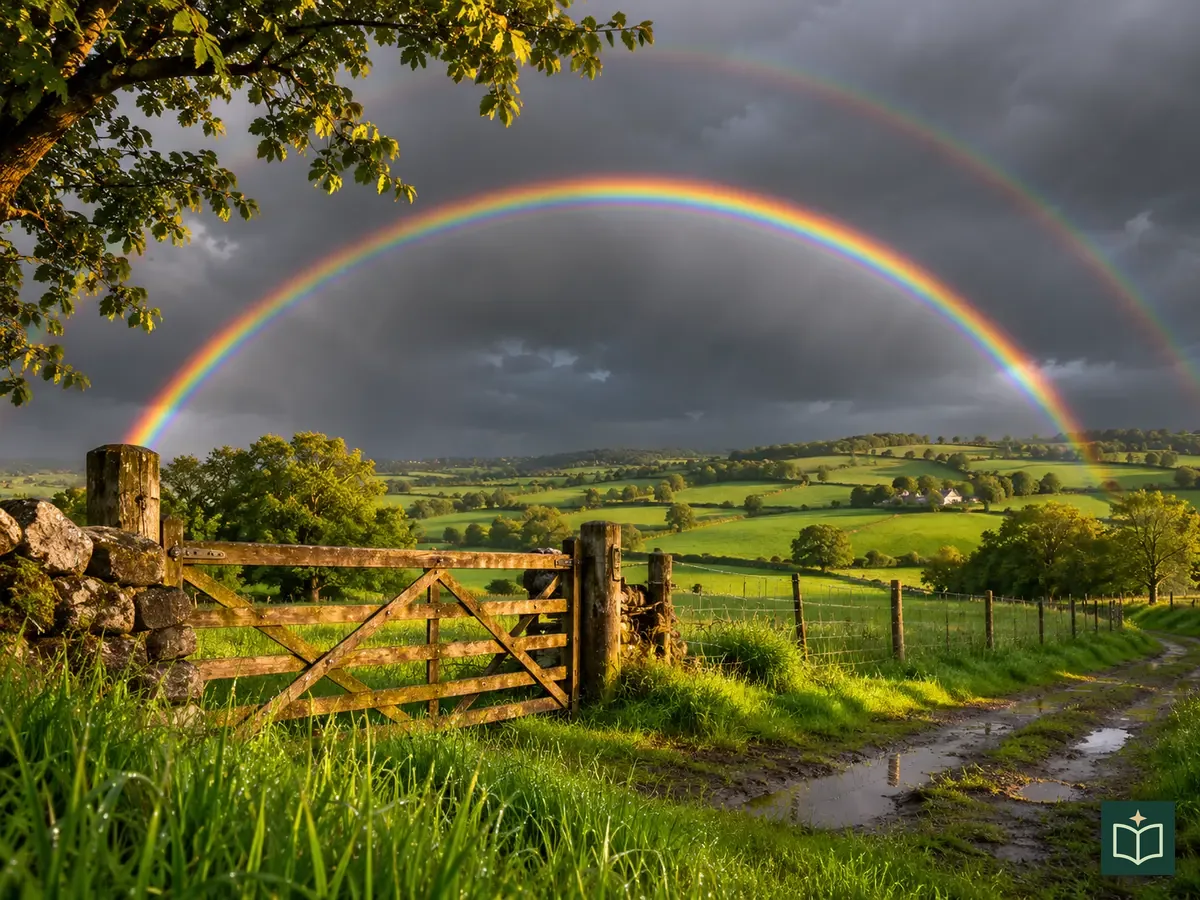
Sometimes a second, fainter rainbow appears outside the first, at about 51 degrees. It is formed by light that reflects twice inside each drop, and because of the extra reflection its colours are reversed, with red on the inside. Between the two bows, the sky often looks noticeably darker. This is Alexander’s dark band, named after Alexander of Aphrodisias, who described it around 200 CE; few drops send light towards the observer from that zone. Inside the main bow, the sky is brighter, and sometimes faint pink and green fringes appear just inside the violet edge. These supernumerary bows are caused by the wave nature of light interfering with itself.
A long scientific story
Explaining the rainbow occupied scholars for centuries. Around 1300, the Persian scientist Kamal al-Din al-Farisi and the German friar Theodoric of Freiberg independently used water-filled glass spheres as model raindrops to show that light is refracted and reflected inside each drop. In 1637, René Descartes calculated the rainbow’s angle. Isaac Newton, experimenting with prisms in the 1660s, showed that white light is made of colours and explained their separation. The traditional list of seven colours owes something to Newton, who chose seven partly by analogy with the musical scale. In reality, the rainbow is a continuous spectrum, and how many colours people name varies between languages and cultures.
Rainbows in the Gulf and beyond
In the UAE and wider Gulf, rainbows are relatively rare simply because rain is infrequent, but they do appear after winter showers and around the spray of fountains and waterfalls on sunny days. The same physics creates related sights. Fogbows form in fog or mist from very small droplets and look almost white, because the tiny drops blur the colours together. Moonbows occur at night when bright moonlight shines on rain, though they usually look pale to the human eye. Halos around the Sun and Moon are a different phenomenon, produced by ice crystals in high cloud rather than by water droplets, and they appear at about 22 degrees from the light source.
Sources & further reading
Figures are rounded and widely published; check the linked organisations for the latest editions. These organisations do not endorse this website.