What current is
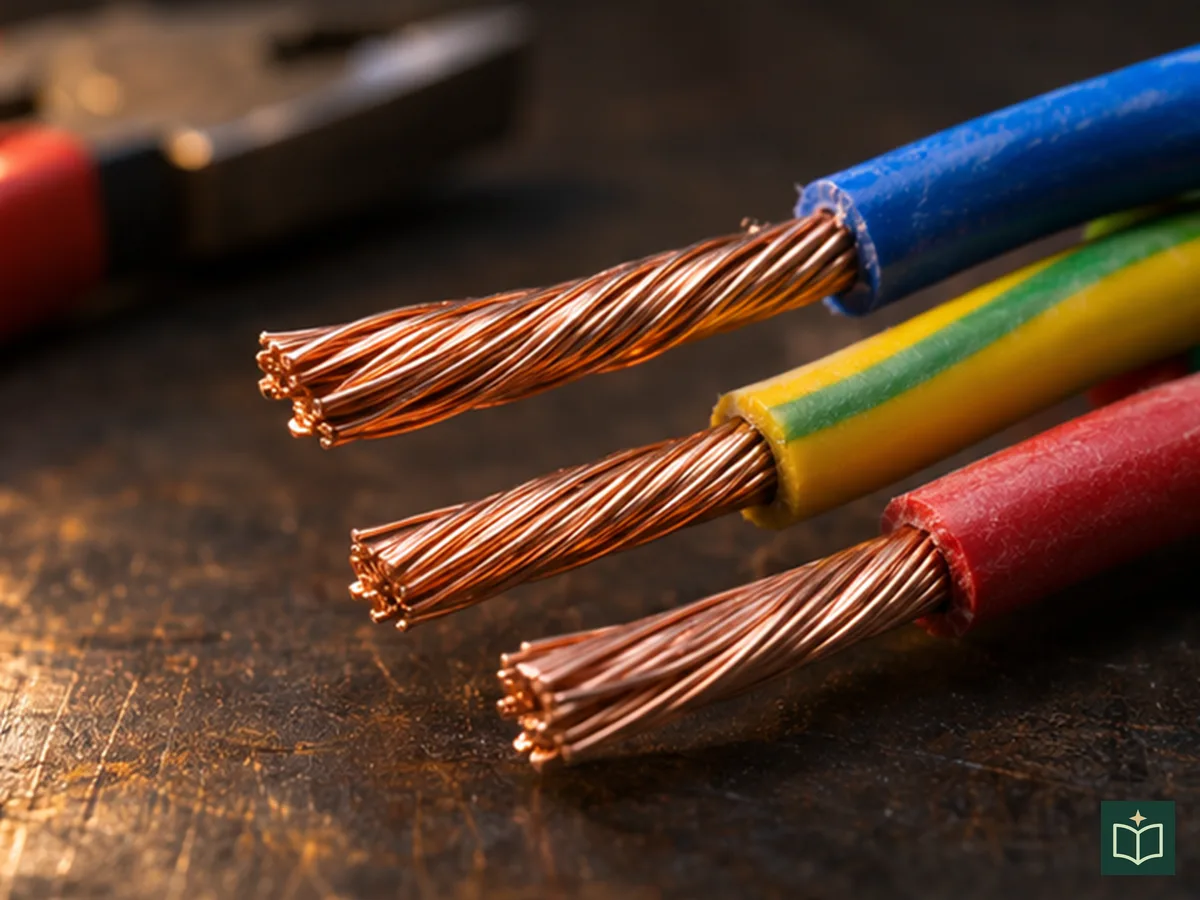
Electric current is a flow of electric charge. In metal wires the charges that move are electrons, which are loosely held by their atoms and can wander through the metal's crystal structure. Current is measured in amperes: one ampere means about 6 million million million electrons passing a point every second. In salt water, batteries and nerve cells, by contrast, the moving charges are ions, atoms that have gained or lost electrons. By a convention set before electrons were discovered, current is said to flow from positive to negative, the opposite direction to the electrons' actual motion. Engineers still use this conventional current, and it gives the right answers.
The drift is slow
Electrons in a metal move very fast at random, at hundreds of kilometres per second, but they zig-zag in every direction and get nowhere on average. Applying a voltage adds a tiny overall bias, so the whole crowd drifts slowly along the wire. Take a copper wire with a cross-section of one square millimetre carrying one ampere. Copper has about 85 thousand billion billion free electrons per cubic centimetre, and the calculation gives a drift speed of only about 0.07 millimetres per second. At that rate an individual electron would need nearly four hours to travel one metre, and in alternating current it simply jiggles back and forth.
The signal is fast
Yet a light comes on the moment a switch is flicked. The reason is that the wire is already full of electrons from end to end. Closing the switch sets up an electric field that travels along the circuit at a large fraction of the speed of light, usually somewhere between half and nearly all of it depending on the cable. That field pushes on all the electrons at almost the same time, so current starts flowing everywhere at once. A useful picture is a garden hose already full of water: turn the tap and water emerges from the far end immediately, even though no individual drop has travelled the length.
Voltage and resistance
Voltage is the push. It measures the energy each unit of charge gains or loses between two points, and is supplied by a battery, generator or solar panel. Household sockets in the UAE supply 230 volts, while a phone battery supplies about 4. Resistance is the opposition. As electrons drift, they collide with vibrating atoms and impurities, losing energy as heat. Thin, long or hot wires resist more; copper and silver resist little. Ohm's law ties the three together for many materials: current equals voltage divided by resistance. Double the voltage across the same resistance and the current doubles; double the resistance and it halves.
Where the energy goes
The energy delivered by a circuit does not travel inside the electrons like water carried in buckets. It is carried by electric and magnetic fields surrounding the wires and is handed over wherever there is resistance or a device to use it. In a kettle element, deliberately high resistance turns electrical energy into heat. In a motor, current interacts with magnets to produce motion. Power, measured in watts, is voltage multiplied by current, so a 2,300-watt kettle on a 230-volt supply draws 10 amperes. The same heating effect is unwanted in power lines, which is why electricity is transmitted at very high voltage and low current.
Common misconceptions
Several intuitive ideas about electricity are wrong. Batteries do not store electrons to be used up; they store chemical energy that pushes electrons around a circuit, and the number of electrons in the circuit stays the same. Current is not consumed by a bulb: the same current flows in and out, while energy is converted. Electricity does not always take only the easiest path; it divides among all available paths in proportion to how easily each conducts. That is why a person touching a live wire can still receive a dangerous current. Finally, high voltage alone is not what harms; it is the current it can drive through the body.
Sources & further reading
Figures are rounded and widely published; check the linked organisations for the latest editions. These organisations do not endorse this website.