What PET is
Most clear bottles for water and soft drinks are made from polyethylene terephthalate, known as PET or PETE. It is a polyester, chemically related to the fibres used in clothing, formed by linking two ingredients derived mostly from oil and gas into long chains. PET was patented in Britain in 1941, and the American engineer Nathaniel Wyeth patented a PET bottle strong enough for fizzy drinks in 1973. The material is light, shatter-resistant and transparent, and it holds carbon dioxide well enough to keep drinks sparkling for months. Its resin code is 1, the number inside the recycling triangle on the base, which helps sorting plants identify it.
The preform
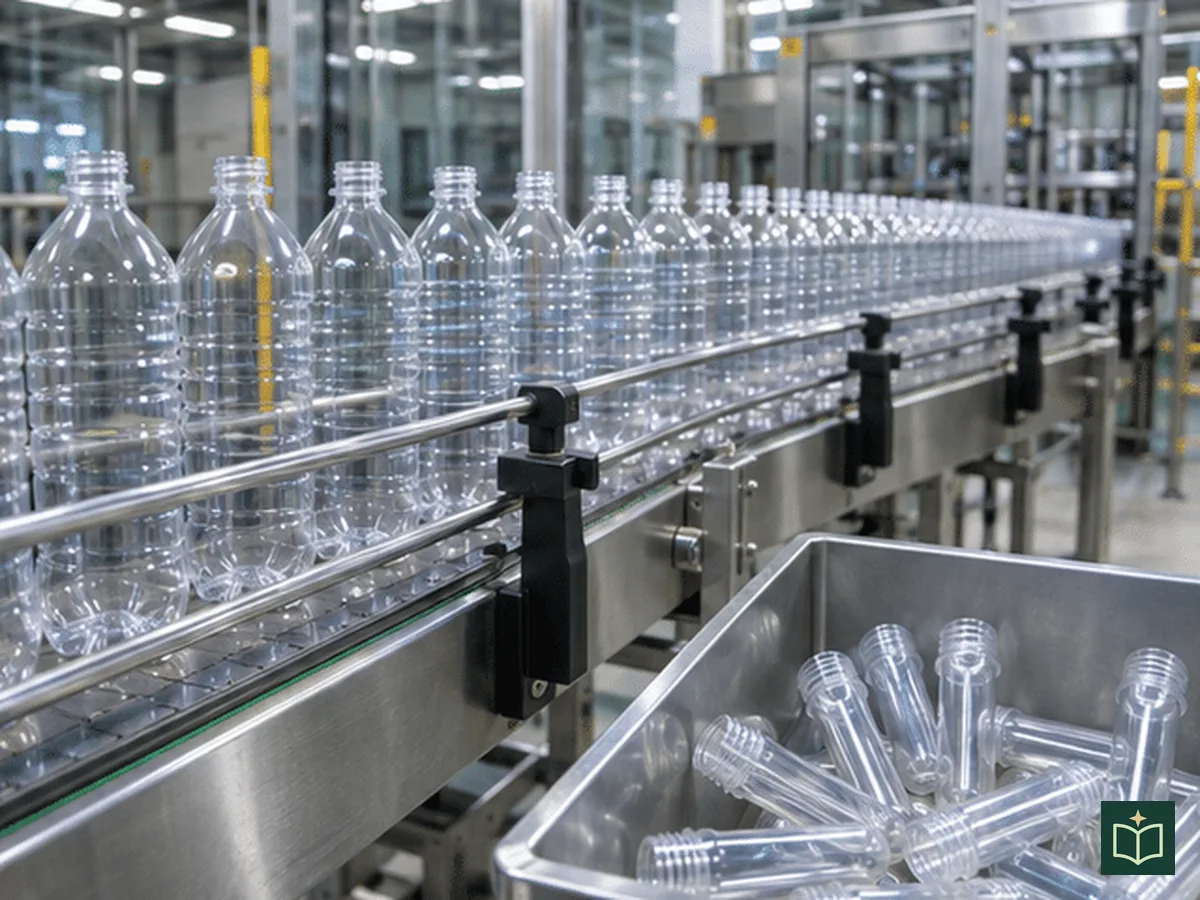
Bottle making begins with small pellets of PET that are dried thoroughly, because moisture weakens the plastic when it melts. The pellets are melted at around 270°C and injected into a mould with many cavities, producing preforms that look like thick test tubes. The neck, with its screw threads and the ring that holds the cap's tamper band, is formed at this stage and never changes again. A preform for a small water bottle typically weighs only a few tens of grams or less. Preforms are compact, so many bottlers buy them from specialist makers and ship them in boxes, which is far cheaper than transporting empty bottles full of air.
Stretch and blow
In the second stage, preforms pass through ovens where infrared lamps heat the body to roughly 100°C, soft enough to shape but not melted. Each one is placed in a split mould shaped like the finished bottle. A steel rod pushes down inside, stretching the plastic lengthways, while air at low pressure and then at high pressure inflates it outwards against the cold mould walls. The whole cycle takes a few seconds. Stretching in two directions lines up the polymer chains, which makes thin walls strong and clear. Large rotary machines with many moulds can produce tens of thousands of bottles an hour, often feeding filling lines directly.
How far the plastic stretches
The stretching is dramatic. Imagine a preform 10 centimetres long and 2.2 centimetres across that becomes a bottle 21 centimetres tall and 6.6 centimetres wide. Lengthways it has stretched 2.1 times; around its circumference, 3 times. Multiplied together, the wall's area grows by about 6.3 times, so the wall becomes roughly six times thinner than the preform. That is why a thick, rigid tube turns into a flexible bottle with walls thinner than a fingernail. Designers balance these ratios carefully. Too little stretch leaves weak, cloudy plastic, while too much can tear the material or leave pearly white patches where the chains have been overstressed.
Lighter bottles, recycled plastic
Over recent decades, bottle makers have steadily cut the weight of plastic in each bottle, a process called lightweighting, by redesigning shapes and using ribs and petal-shaped bases for strength. Recycling is the other big change. Used PET bottles can be collected, sorted, washed, shredded into flakes and remelted. Some flakes become fibres for clothing and carpets; others are cleaned to food-grade standards and turned into new preforms. Many countries and companies have set targets for recycled content in bottles. In the UAE, bottle return and collection schemes have been introduced and single-use plastic bags restricted, reflecting wider pressure to reduce plastic waste.
Common misconceptions
A widespread claim is that PET bottles release dangerous chemicals when left in a hot car. PET does not contain bisphenol A, and food-safety authorities consider approved bottles safe for their intended use, though heat can affect taste and very small amounts of compounds such as antimony can migrate over time, within regulated limits. Reusing a single-use bottle is mainly a hygiene question, since scratches and narrow necks are hard to clean. Another myth is that the recycling triangle means a bottle will definitely be recycled. It only identifies the plastic type. Whether a bottle is recycled depends on local collection, sorting and markets for the recovered material.
Sources & further reading
- Britannica · Polyethylene terephthalate ↗
- US EPA · Plastics: material-specific data ↗
- UNEP · Plastic pollution ↗
Figures are rounded and widely published; check the linked organisations for the latest editions. These organisations do not endorse this website.