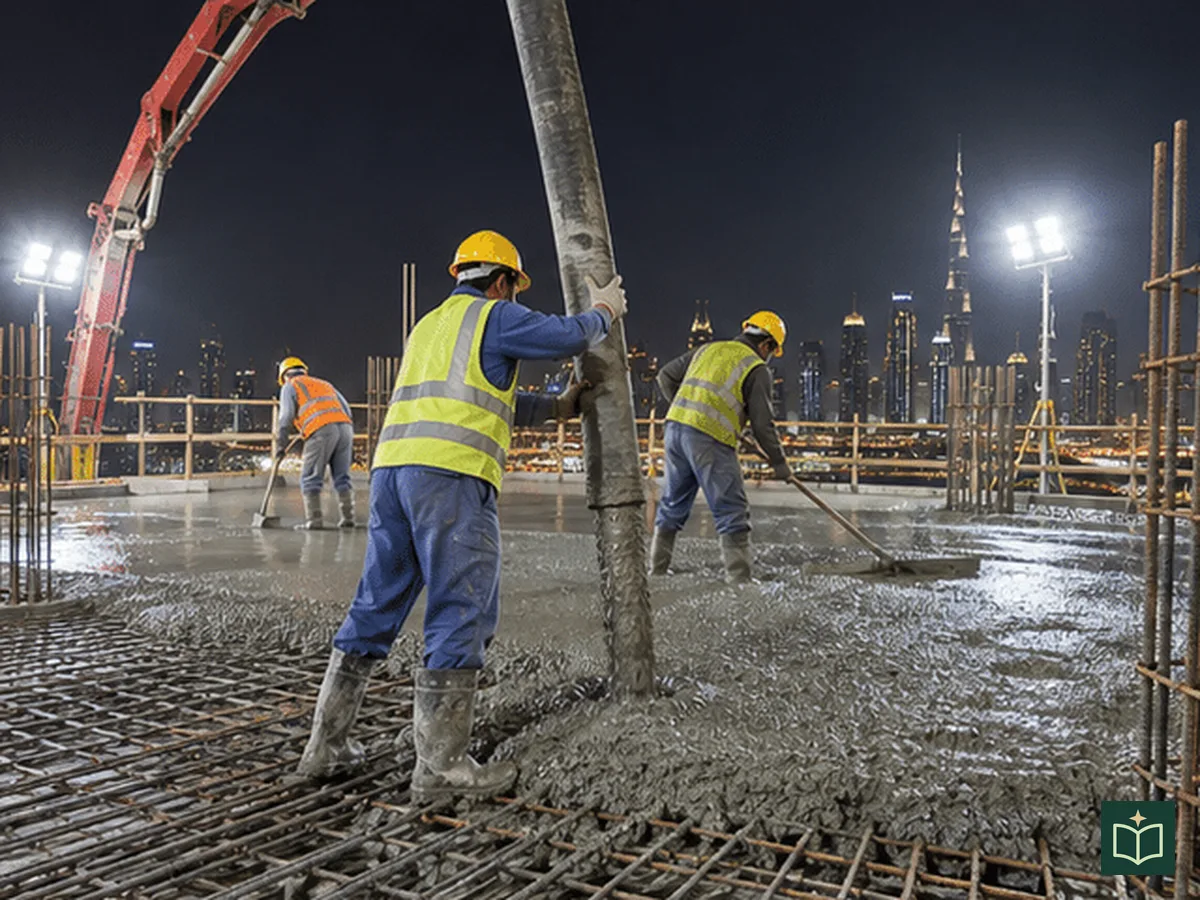
What heat does to concrete
Concrete hardens through a chemical reaction called hydration, in which cement combines with water to form crystals that bind sand and stone together. The reaction itself releases heat. When the mix starts hot, hydration runs faster, so the concrete stiffens before workers can place and finish it properly, and joints between loads can form weak cold seams. Faster early reactions also produce a coarser internal structure, so long-term strength is often lower. At the same time, water evaporates quickly from the surface in hot, dry and windy conditions, causing plastic shrinkage cracks within hours. Engineers call all of this hot-weather concreting, and the Gulf summer is an extreme case.
Cooling the mix
The most effective way to lower concrete temperature is to cool the ingredients. Aggregates make up most of the mix by weight, so batching plants shade stockpiles and sometimes spray them with water. Mixing water is chilled, and crushed or flaked ice often replaces part of it. Ice is especially powerful because melting absorbs a large amount of heat, about 334 kilojoules per kilogram, before its temperature even begins to rise. Plants in the region use ice-making machines and chilled water tanks as standard equipment. Admixtures that slow setting, known as retarders, give extra working time, and some mixes replace part of the cement with fly ash or slag, which generate heat more slowly.
A worked example
Engineers estimate a mix's temperature with a weighted average of its ingredients. Take one cubic metre with 1,900 kilograms of aggregate at 38°C, 350 kilograms of cement at 45°C and 160 kilograms of water at 30°C. Using a standard formula, the fresh concrete comes out at about 37°C, too hot for most specifications. Now replace half the water with 80 kilograms of ice and chill the remaining 80 kilograms to 5°C. The same calculation, including the heat needed to melt the ice, gives roughly 20°C. That 17-degree drop shows why ice is so valued, and why the amount added is carefully controlled so all of it melts during mixing.
Night pours and big structures
Timing matters as much as ingredients. Air temperatures, sunlit steel formwork and reinforcement bars can all be far hotter by afternoon, so large pours are usually done at night or early morning. For Burj Khalifa, concrete for the tower was mixed with ice and much of it was pumped at night, when cooler conditions helped it travel hundreds of metres up the building without stiffening. Very thick foundations and rafts raise another problem: heat generated inside the mass cannot escape quickly, so the core can become much hotter than the surface. Engineers limit that difference with cooled mixes, embedded temperature sensors and sometimes pipes carrying cold water through the concrete.
Curing in the heat
Once concrete is placed, it must stay moist and reasonably cool for days while hydration continues. Curing methods include wet hessian sheets kept damp, plastic covers, ponding water on slabs, fine sprays and liquid curing compounds that form a seal over the surface. Windbreaks and sunshades reduce evaporation on exposed decks. Contractors take sample cubes or cylinders from each pour and crush them in a laboratory after 7 and 28 days to confirm strength. If curing is neglected, the surface can become dusty, weak and permeable, letting salts and moisture reach the steel reinforcement sooner, which matters in coastal Gulf cities where corrosion is a major threat to durability.
Myths and limits
A common misunderstanding is that concrete dries hard. It actually hardens by reacting with water, so drying out too early stops the process and leaves it weaker. Adding extra water on site to make a stiffening mix easier to pour is another tempting mistake: it raises the water-to-cement ratio and reduces strength, which is why many specifications ban it. Cooling is not free, either. Ice plants, chillers and night shifts add cost and energy use, and very cold concrete can also cause problems with setting time. The aim is a controlled, predictable temperature. Regulations in the UAE also restrict outdoor work during the hottest summer hours, which further shapes construction schedules.
Sources & further reading
- Portland Cement Association · Hot weather concreting ↗
- American Concrete Institute ↗
- Britannica · Concrete ↗
Figures are rounded and widely published; check the linked organisations for the latest editions. These organisations do not endorse this website.