Water that never arrives
Every drop that a utility treats, desalinates or pumps has a cost, but not all of it reaches a customer's meter. The difference is called non-revenue water. Part of it is physical loss from leaking pipes, joints and tanks. Part is apparent loss: water that is used but not recorded, because of inaccurate meters, data errors or illegal connections. A smaller part is authorised but unbilled, such as water for firefighting or flushing mains. In many cities around the world, non-revenue water is between a quarter and a half of everything supplied. A handful of utilities, including Dubai's, report losses in single digits, which is among the lowest levels anywhere.
Finding the problem zones
A network of thousands of kilometres of pipes cannot be searched all at once. Utilities therefore divide it into district metered areas, each typically serving a few thousand properties and fed through a small number of metered inlets. Engineers watch the flow into each area, especially between about 2 and 4 in the morning, when most people are asleep and legitimate use is at its lowest. This is called the minimum night flow. If an area's night flow creeps up week after week, a new leak is probably running. Crews can then focus on that district rather than the whole city, saving time and digging.
A night-flow example
Imagine a district of 2,000 homes where the meters show a minimum night flow of 12 cubic metres an hour. From experience and sample metering, the utility estimates that genuine night use, such as toilets, irrigation timers and night-shift workers, accounts for about 4 cubic metres an hour. The remaining 8 cubic metres an hour is likely leakage. Over a full day, that is about 192 cubic metres, enough to fill several road tankers, lost from a single neighbourhood. Leakage often runs higher during the day because pressure is greater, so this method gives a conservative estimate. The figure guides where crews go next and helps prioritise repairs.
Listening for leaks
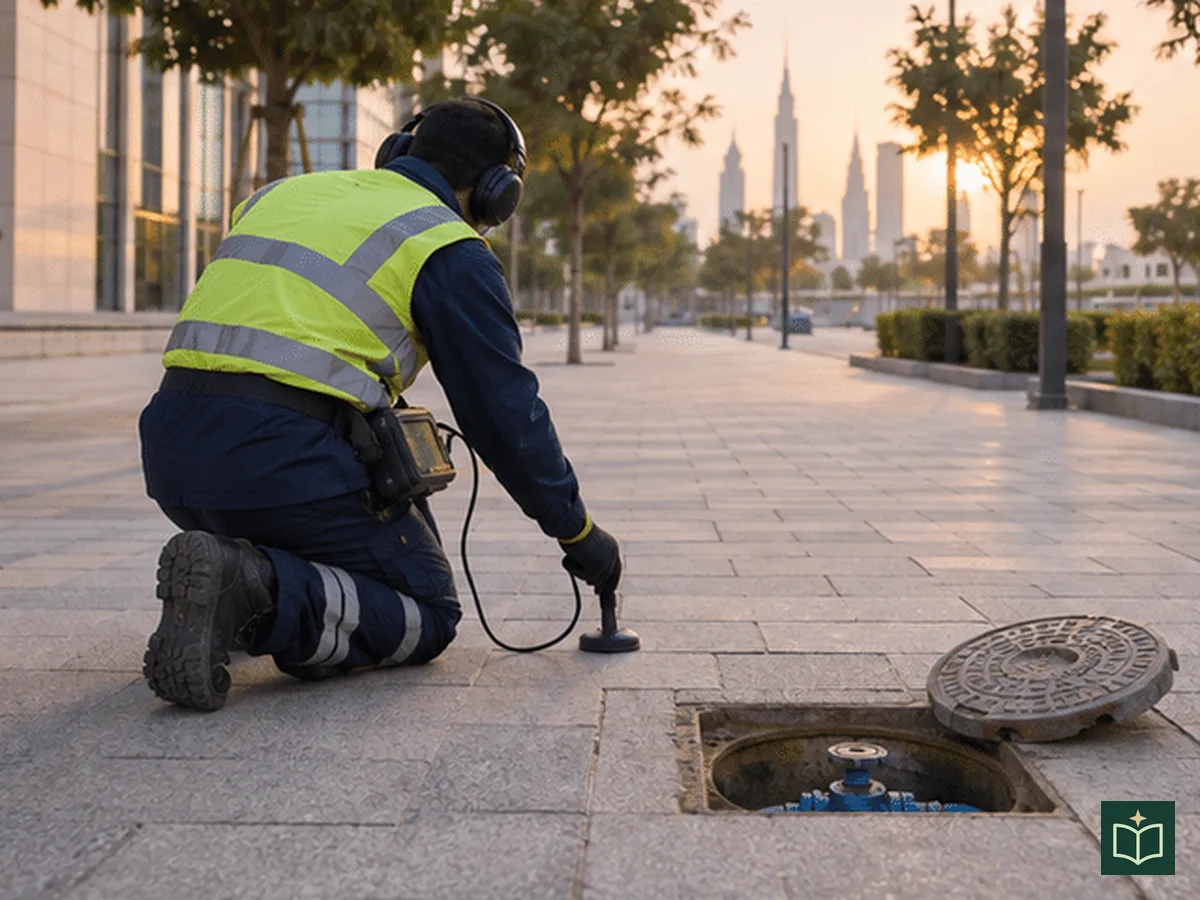
Pressurised water escaping from a pipe makes a characteristic hiss that travels along the pipe wall. Utilities attach acoustic loggers to valves and hydrants, recording sound at night and flagging noise that looks like a leak. To pinpoint it, technicians use a correlator, which places sensors on either side of the suspected leak. Sound reaches the nearer sensor first. If the sensors are 200 metres apart, sound travels at 1,200 metres a second in the pipe, and it arrives 0.05 seconds earlier at one sensor, the leak is 70 metres from that sensor. Ground microphones, tracer gas and small cameras inside pipes then confirm the exact spot before excavation.
Pressure and satellites
Finding leaks is only half the work; preventing them matters too. High pressure makes leaks flow faster and causes more pipes to burst, so many utilities install valves that lower pressure at night, when demand falls. Smart meters at homes reveal continuous flow that suggests a leak on the customer's side. A newer technique uses satellites carrying radar that can sense moisture in the top layer of soil. Analysts look for patches matching the signature of treated drinking water, narrowing the search to small areas that ground teams then investigate. Fibre-optic cables and permanent sensors installed alongside large pipes can also detect leaks and bursts as they happen.
Why it matters
In water-scarce countries, leakage is costly twice over: the water itself is expensive to produce, especially from desalination, and the energy used to treat and pump it is wasted. Reducing losses can delay the need for new plants. Yet it can never reach zero. Every network has small background leaks too faint to detect economically, and finding the last few per cent can cost more than the water is worth. Engineers therefore aim for an economic level of leakage. A useful misconception to drop is that leaks always show at the surface. In sandy soils, water can drain away unseen for months, which is why active searching matters.
Sources & further reading
- World Bank · Non-revenue water ↗
- International Water Association ↗
- Dubai Electricity and Water Authority ↗
Figures are rounded and widely published; check the linked organisations for the latest editions. These organisations do not endorse this website.