Flying blind
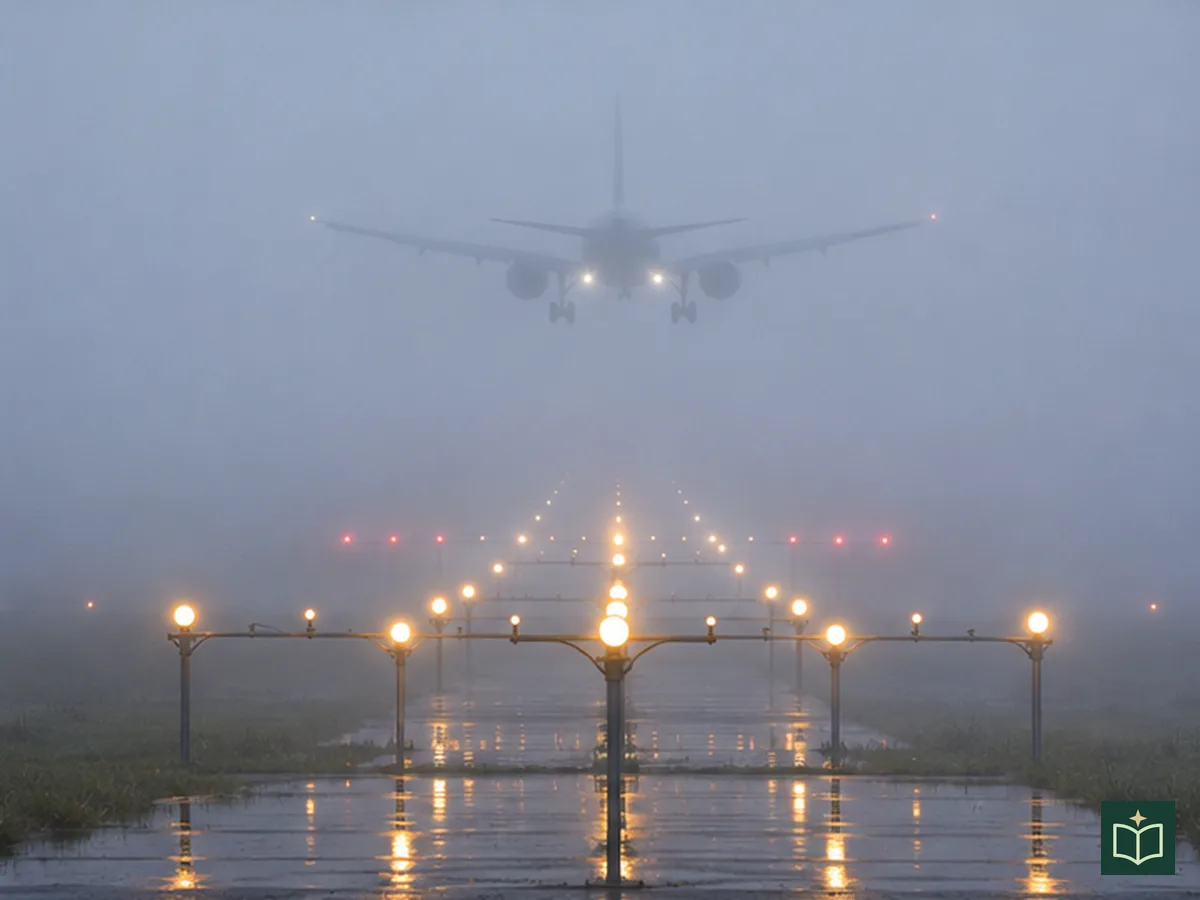
Pilots can fly through cloud using instruments, but landing is different: the aircraft must arrive at a precise spot on a strip of tarmac at well over 200 kilometres per hour. When fog hides the runway, pilots need guidance that does not depend on sight. The instrument landing system, or ILS, has provided it since the 1940s and remains standard at major airports worldwide. In the Gulf, winter fog regularly forms overnight and in the early morning, sometimes reducing visibility to a few hundred metres or less. Airports such as Dubai and Abu Dhabi rely heavily on instrument landings during these events to keep flights arriving safely.
Two radio beams
An ILS uses two radio transmitters beside the runway. The localiser, placed beyond the far end, sends signals that tell the aircraft whether it is left or right of the runway's centreline. The glide slope, placed beside the touchdown zone, sends signals that tell the aircraft whether it is above or below a descent path, usually about three degrees. Each transmitter radiates two overlapping signals, and the aircraft's receiver compares their strength: when they are equal, the aircraft is exactly on track. Cockpit displays show the deviation, and the autopilot can follow the beams automatically. Distance-measuring equipment or marker beacons tell the crew how far they are from the runway.
The landing categories
Rules divide instrument landings into categories according to visibility. In Category I, the most basic, pilots must see the runway or its approach lights by a decision height of about 60 metres, with visibility along the runway of roughly 550 metres or more. Category II lowers the decision height to about 30 metres and the required visibility to around 300 metres. Category III allows landings with even lower or no decision height and very short visibility, the most demanding levels permitting landings in visibility of only tens of metres. If the crew cannot see what they need at the decision height, they must abort the landing, climb away and divert or try again.
Autoland and protection
Category II and III landings require more than a radio signal. The aircraft must have certified automatic landing systems, often with duplicated or triplicated autopilots, so a single failure cannot cause an accident. In the lowest visibility, the autopilot flies the approach, lifts the nose for touchdown, known as the flare, and steers along the centreline after landing. Pilots must be specially trained and current. The airport must also meet stricter standards: backup power for lights and transmitters, extra runway lighting and protection of the areas around the ILS antennas, because a taxiing aircraft or vehicle in the wrong place can distort the beams. These measures are called low-visibility procedures.
Why fog still causes delays
Even with excellent technology, fog reduces how many aircraft an airport can handle. During low-visibility procedures, controllers increase the spacing between arrivals so that each aircraft clears the sensitive areas before the next one approaches, and ground movements slow because drivers and pilots cannot see far. A runway that handles dozens of landings an hour in clear weather may manage noticeably fewer in thick fog. Departures are affected too. Not every aircraft or crew is certified for the lowest categories, and some may need to divert. That is why a foggy morning at a busy hub can cause delays that ripple across its network for the rest of the day.
What comes next
The ILS has been refined for decades, but satellite navigation is increasingly used alongside it. Approaches based on GPS and other satellite systems can guide aircraft precisely without ground transmitters at every runway end, and ground-based augmentation systems correct satellite signals to achieve accuracy suitable for low-visibility landings at some airports. These systems can offer curved approaches and serve several runways from one station. However, because satellite signals can be jammed or degraded, the traditional ILS is expected to remain a key backup for many years. For passengers, the main lesson is reassuring: landing in fog is routine, tightly regulated and backed by several layers of protection.
Sources & further reading
Figures are rounded and widely published; check the linked organisations for the latest editions. These organisations do not endorse this website.