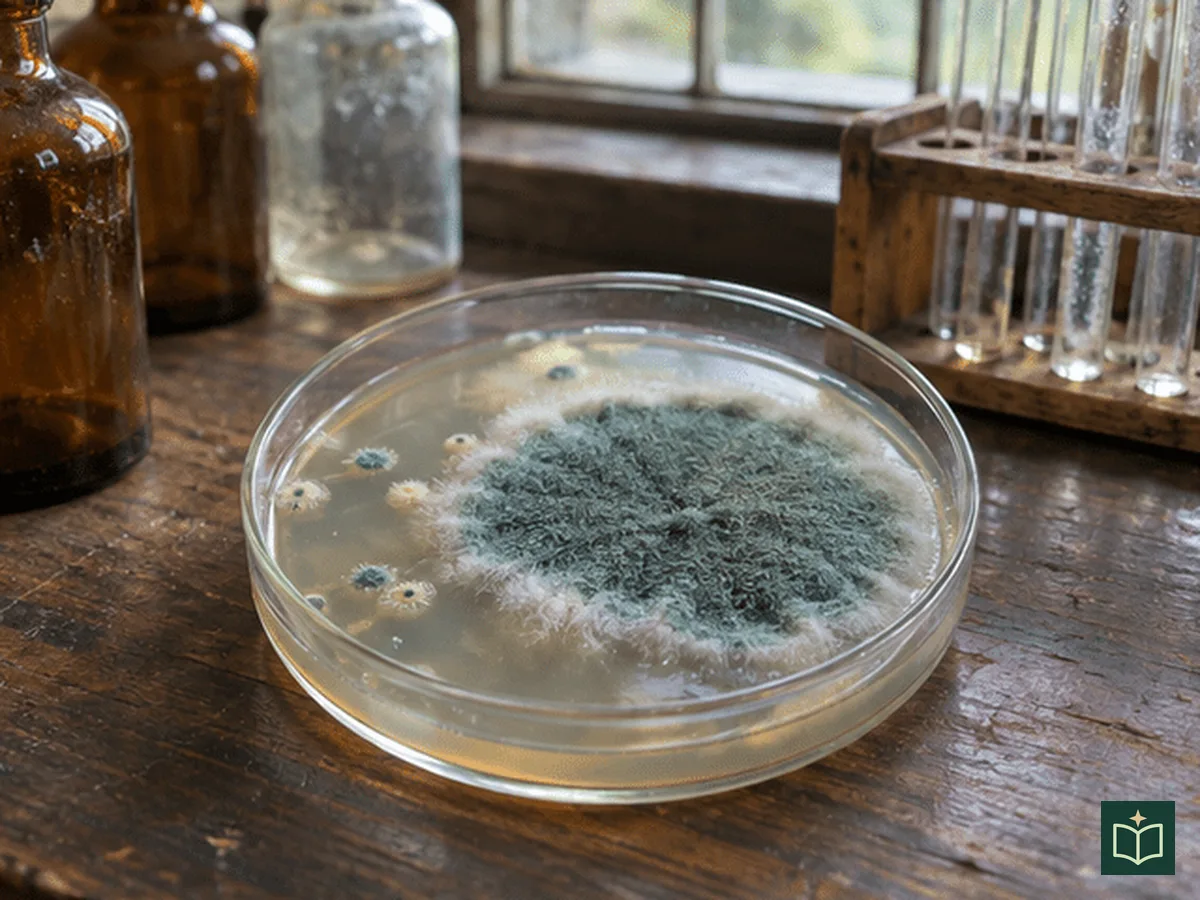
A contaminated plate
In September 1928 Alexander Fleming, a Scottish bacteriologist at St Mary’s Hospital in London, returned from a summer holiday to his cluttered laboratory. Among the stacked culture dishes of Staphylococcus bacteria he had left behind, he noticed one contaminated by a blue-green mould. Around the mould was a clear ring where the bacteria had died. Fleming realised the mould must be releasing something that killed them. He identified it as a species of Penicillium and called the active substance penicillin. Luck played a part: the spore probably drifted in from another laboratory, and cool weather followed by warmth may have favoured the mould’s growth before the bacteria spread.
A discovery left on the shelf
Fleming published his findings in 1929. He showed that penicillin killed many disease-causing bacteria and seemed harmless to white blood cells, and he used it to help identify bacteria in the laboratory. But he and his colleagues found it very difficult to extract and purify. The substance was unstable, present in tiny amounts in the mould broth, and lost its activity quickly. Fleming did not run the animal experiments that might have shown its full medical promise, and he did not have chemists able to solve the purification problem. For about a decade, penicillin remained mainly a laboratory curiosity rather than a treatment for patients.
The Oxford team
In 1939, at the University of Oxford’s Sir William Dunn School of Pathology, the Australian pathologist Howard Florey and the German-born biochemist Ernst Chain began investigating antibacterial substances, including penicillin. Their colleague Norman Heatley devised ingenious ways to grow the mould and extract the drug, using improvised equipment such as bedpans, milk churns and custom ceramic vessels. On 25 May 1940 they infected eight mice with deadly streptococcal bacteria; the four given penicillin survived, while the four untreated mice died. In early 1941 they treated a police officer, Albert Alexander, with a severe infection. He improved dramatically, but supplies ran out and he died.
Mass production in America
With Britain at war and its industry stretched, Florey and Heatley flew to the United States in 1941 to seek help. At a government laboratory in Peoria, Illinois, scientists found that adding corn steep liquor, a by-product of maize processing, greatly increased yields. A search for better strains turned up a highly productive mould on a cantaloupe melon from a local market. Pharmaceutical companies, including Pfizer, developed deep-tank fermentation, growing the mould in huge vats. Production soared. By the Allied landings in Normandy in June 1944, millions of doses were available for wounded soldiers, and penicillin was soon reaching civilian patients as well.
How penicillin works
Penicillin attacks bacteria by blocking the enzymes they use to build their cell walls, a mesh-like layer outside the cell membrane. Without a strong wall, growing bacteria burst. Human cells have no such wall, which is why penicillin is generally safe for people, though some patients have serious allergies. Its chemical structure, including a four-membered ring called the beta-lactam ring, was worked out by Dorothy Hodgkin and colleagues in Oxford using X-ray crystallography in 1945. That knowledge helped chemists create many related antibiotics. Penicillin was effective against pneumonia, syphilis, blood poisoning and many wound infections that had been frequently fatal before.
A warning from the start
In his Nobel lecture in 1945, Fleming warned that bacteria could become resistant if penicillin was used in doses too small or for too short a time. He was right. Some bacteria produce enzymes that break the beta-lactam ring, and resistant strains spread quickly in hospitals. Today antimicrobial resistance is recognised by the World Health Organization as one of the major global threats to public health. Penicillin and its relatives remain among the most widely used antibiotics, but they work only against bacteria, not viruses. Anyone with an infection should seek advice from a doctor or pharmacist rather than use leftover antibiotics.
Sources & further reading
- The Nobel Prize · Physiology or Medicine 1945 ↗
- American Chemical Society · Discovery and Development of Penicillin ↗
Figures are rounded and widely published; check the linked organisations for the latest editions. These organisations do not endorse this website.