A mirror in the sky
Satellite television is a relay. A broadcaster sends its channels to a ground station, often called a teleport, where a dish several metres wide beams them upward. A communications satellite receives the signal, changes it to a different frequency so outgoing and incoming signals do not interfere, amplifies it and sends it back down. The returning beam covers a wide area, called a footprint, which can stretch across the Middle East and North Africa or much of Europe. Every dish inside that footprint receives the same signal at the same moment, which is why one satellite can serve millions of homes without any cable running to them.
Why the satellite seems still
The trick depends on a special orbit. A satellite about 35,800 kilometres above the equator takes exactly as long to circle Earth as Earth takes to spin once. Seen from the ground it hangs at a fixed point in the sky. Broadcasting satellites are parked in a ring along this orbit, each assigned a slot described by its longitude, such as 26 degrees east. Because they never appear to move, home dishes can be bolted in place and left alone. Satellites lower down would race across the sky and need tracking antennas, which is impractical and far too expensive for an ordinary household.
Aiming the dish
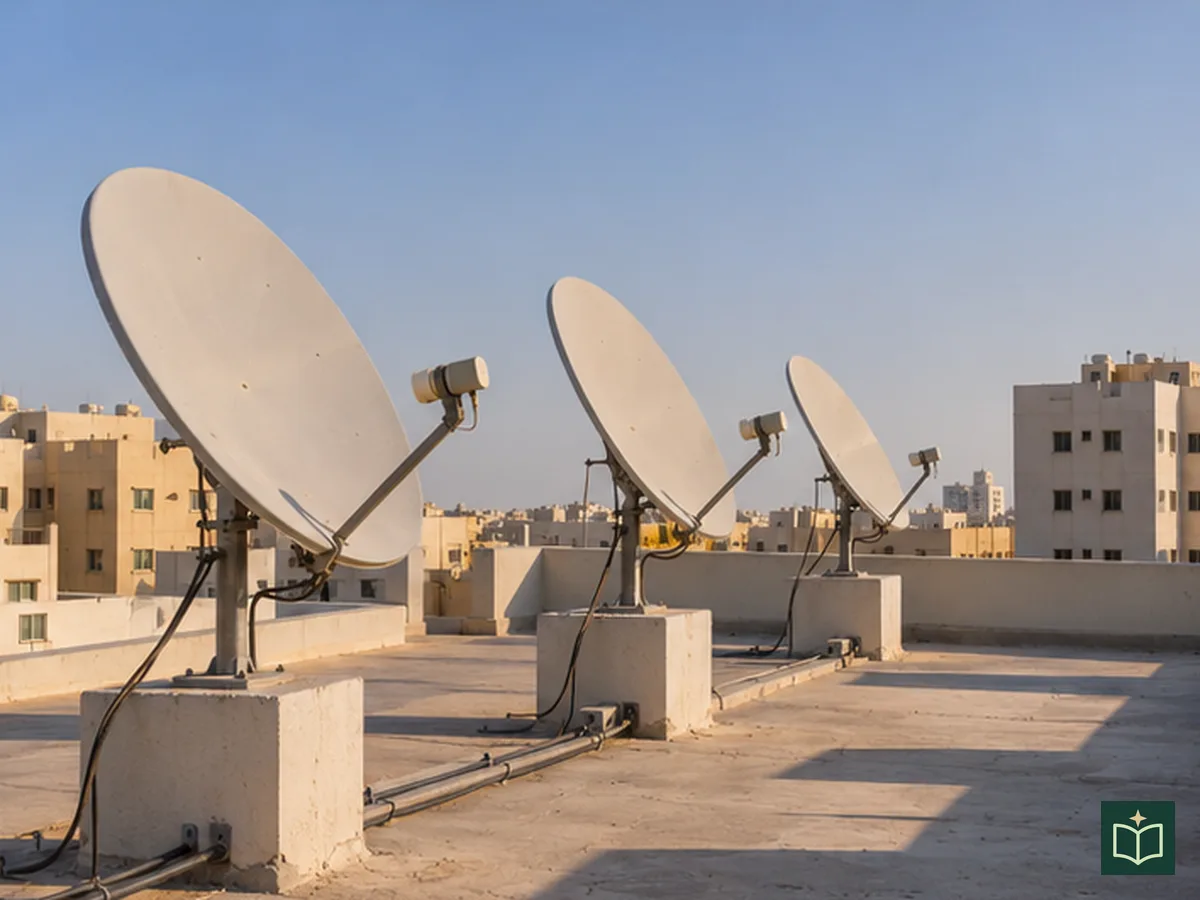
A typical home dish is a curved reflector that collects a very weak signal and focuses it onto a small device on an arm, the low-noise block downconverter. This unit amplifies the signal and lowers its frequency so it can travel along a coaxial cable to the receiver. Pointing matters because the ring of satellites is crowded, with neighbours just a few degrees apart. A dish set even slightly off can lose picture quality or pick up the wrong satellite. Installers set two angles: the compass direction, called azimuth, and the tilt above the horizon, called elevation, both worked out from the viewer's location and the satellite's slot.
A Gulf rooftop example
From the UAE, which lies north of the equator, satellites in the geostationary ring are always found towards the southern half of the sky. A dish aimed at a satellite at 26 degrees east, a slot used for Arab broadcasting, points a little west of south. One aimed at a slot further west, over Africa, swings round towards the south-west and sits lower. The signal itself makes a long trip: about 36,000 kilometres up and a similar distance down. Even at the speed of light that takes roughly a quarter of a second, which is one reason live satellite feeds lag slightly behind the same programme carried over terrestrial networks.
Rain fade and other limits
Most direct-to-home television uses the Ku band, radio frequencies of roughly 11 to 12 gigahertz. Signals at these frequencies are absorbed by heavy rain, so a fierce downpour can freeze the picture for a few minutes, an effect called rain fade. Larger dishes collect more signal and cope better, which is why viewers at the edge of a footprint need bigger reflectors. Obstructions also matter: a new building or a tree in the line of sight can block reception completely. And because the beam spills across national borders, channels are often encrypted, with a smart card or module in the receiver deciding which programmes a subscriber may watch.
Why it endures
Streaming over the internet has drawn viewers away from dishes in many countries, yet satellite broadcasting remains important. One transmission reaches every home in a region at no extra cost per viewer, which suits live sport and news watched by millions at once. It works in deserts, mountains and remote islands where fibre or mobile networks are thin. Satellites also feed signals to cable networks and terrestrial transmitters behind the scenes. The basic arrangement has barely changed since direct-to-home services spread in the 1980s and 1990s: a fixed satellite, a fixed dish and a signal that does not care how many people are watching.
Sources & further reading
- NASA Earth Observatory · Catalog of Earth satellite orbits ↗
- Britannica · Communications satellite ↗
- ITU · Radiocommunication Sector ↗
Figures are rounded and widely published; check the linked organisations for the latest editions. These organisations do not endorse this website.