An ancient puzzle
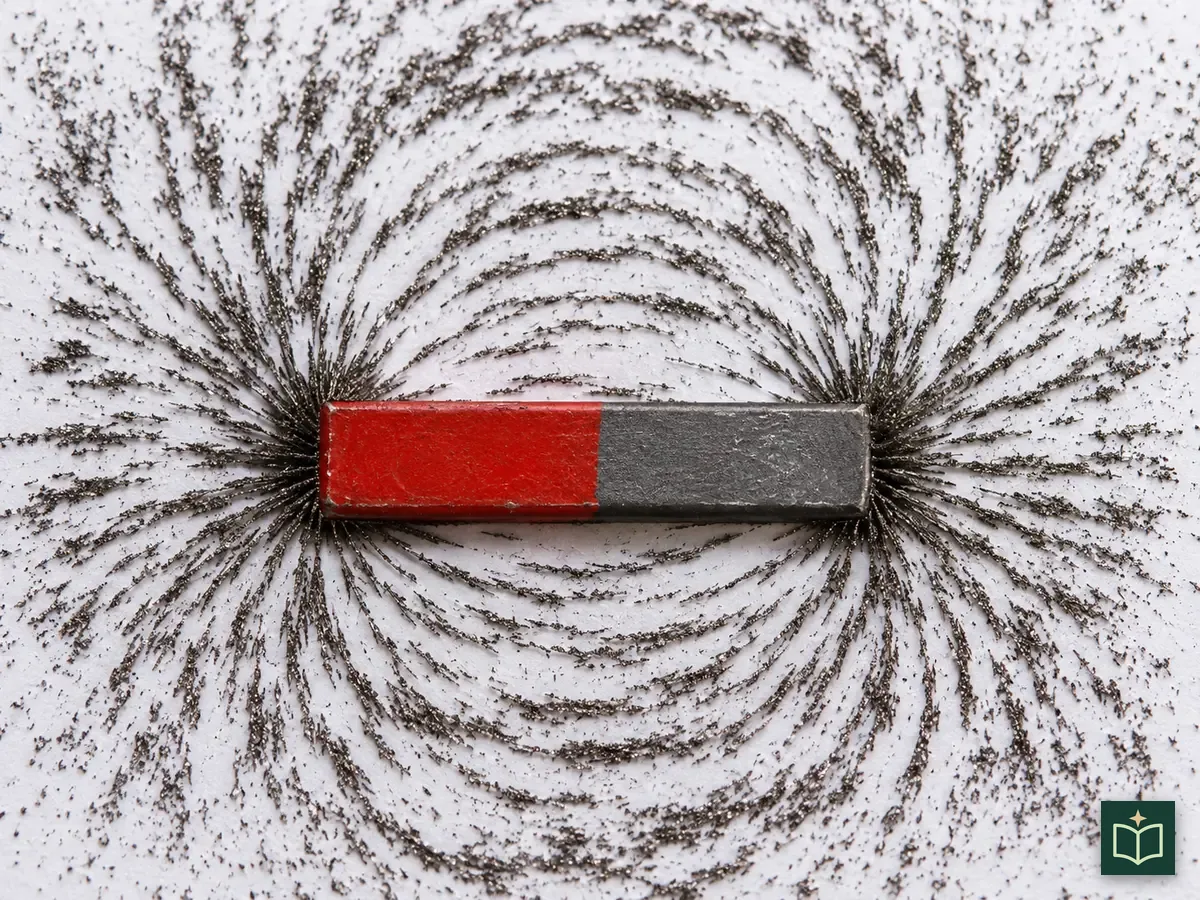
People noticed magnetism thousands of years ago in lodestone, a naturally magnetised form of the iron mineral magnetite. Greek writers described stones that attracted iron, and the word magnet is linked to Magnesia, a region where such stones were found. Chinese scholars were using magnetised needles to indicate direction by around the 11th century, and the magnetic compass later became essential to navigation across the Indian Ocean and the Mediterranean. Yet explaining why magnets work took until the 20th century and the development of quantum physics. The answer lies inside atoms, in the behaviour of electrons, the same particles that carry electric current through wires.
Electricity and magnetism are one
In 1820, the Danish physicist Hans Christian Ørsted noticed that a wire carrying electric current deflected a nearby compass needle. Moving electric charge creates a magnetic field. Michael Faraday then showed the reverse: a moving magnet can push current through a wire. James Clerk Maxwell united these ideas in the 1860s into a single theory of electromagnetism. This link is the basis of electric motors, generators, transformers and loudspeakers. An electromagnet, a coil of wire wrapped around an iron core, becomes magnetic when current flows and stops when it is switched off, which is why scrapyard cranes can pick up and release cars.
Inside the atom
Each electron behaves like an extremely small magnet, a property linked to its quantum spin and, to a lesser extent, its motion around the nucleus. In most atoms, electrons pair up with opposite spins, so their magnetism cancels out. In iron, nickel, cobalt and some rare-earth metals, atoms have unpaired electrons, and a quantum effect encourages neighbouring atoms to align their magnetic directions. This produces ferromagnetism, the strong magnetism we notice in everyday life. Other materials respond only weakly. Aluminium is very slightly attracted to strong magnets, while water and many organic materials are very slightly repelled, effects too small to notice without powerful equipment.
Domains and permanent magnets
Even in iron, the aligned regions are limited in size. A piece of iron consists of many small magnetic domains, each with atoms pointing the same way but domains pointing in different directions. Overall, their effects cancel, which is why an ordinary iron nail is not a magnet. Place it near a strong magnet and the domains grow and swing into line, and the nail becomes temporarily magnetic. In hard magnetic materials, such as certain steels and alloys of neodymium, iron and boron, the domains stay aligned after the outside field is removed, producing a permanent magnet. Heating, hammering or dropping a magnet can jostle domains out of line and weaken it.
Why it works on some metals only
A common misconception is that magnets attract all metals. Copper, aluminium, gold and silver are not noticeably attracted. Many stainless steels used in kitchens are only weakly magnetic or not magnetic at all, depending on their crystal structure; this is why some fridge doors will not hold magnets. Another misconception is that breaking a magnet separates its north and south poles. In fact, each fragment becomes a smaller magnet with both poles, because the magnetism comes from every atom. No isolated magnetic pole has ever been observed. Heat matters too: above its Curie temperature, about 770°C for iron, thermal motion destroys the alignment.
Magnets in modern life
Magnets are everywhere in modern technology. Powerful neodymium magnets sit inside electric car motors, wind turbine generators, headphones and phone speakers, making demand for rare-earth elements a matter of economic and strategic interest. Hard drives store data as tiny magnetised regions. Hospital MRI scanners use very strong magnetic fields, typically produced by superconducting coils, to image soft tissue without X-rays. On a planetary scale, Earth itself behaves like a giant magnet, its field generated by moving molten iron in the outer core. That field guides compasses, helps migrating animals navigate and deflects much of the charged particle stream from the Sun.
Sources & further reading
Figures are rounded and widely published; check the linked organisations for the latest editions. These organisations do not endorse this website.