A hard thing to prove
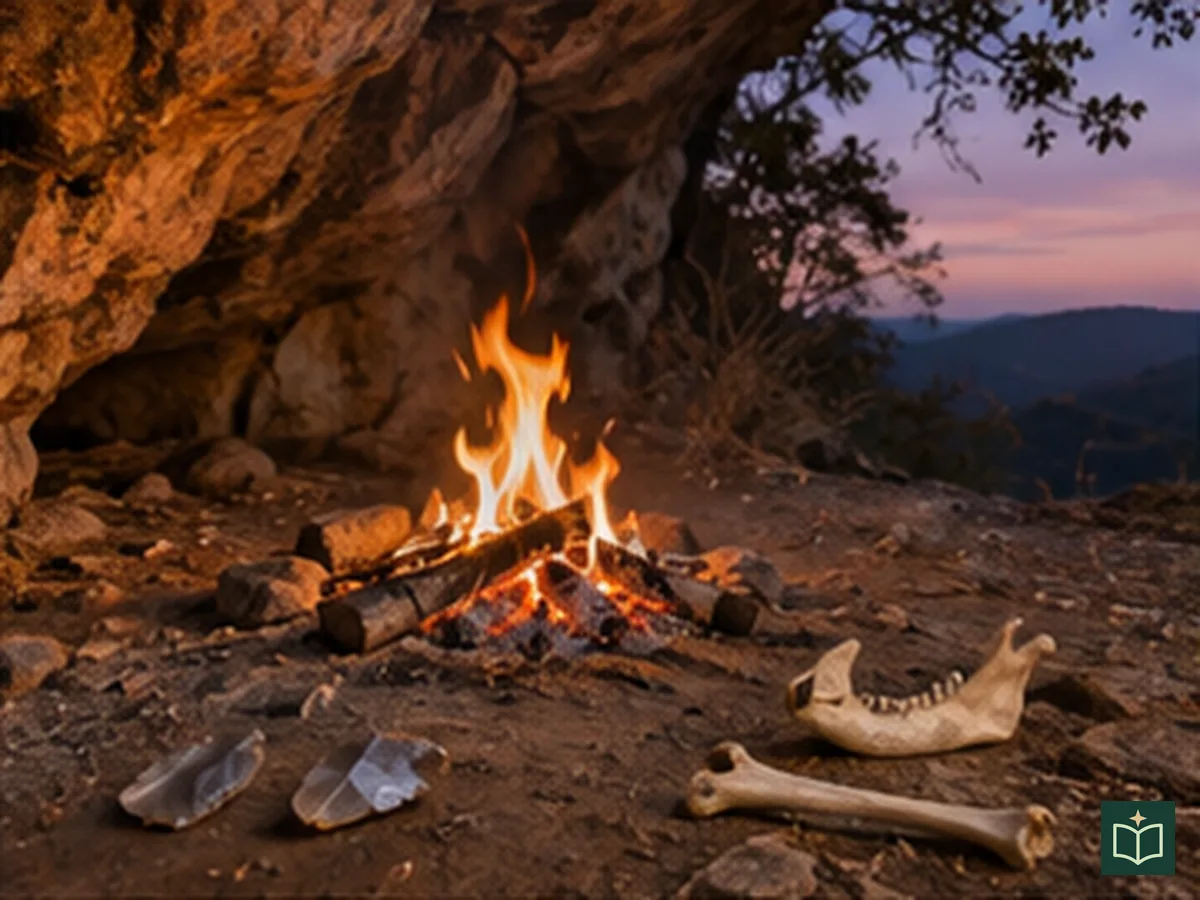
Fire is one of the defining features of human life, yet finding firm evidence of when it began is difficult. Wildfires burn landscapes naturally, so a scatter of charcoal near old bones does not prove that anyone controlled the flames. Ash blows away, and burned patches can be washed out by rain. Archaeologists therefore look for clusters of evidence in one place: burned bone, heated stone tools, ash layers and reddened sediment, ideally inside caves where natural fires are unlikely. Microscopic techniques can show how hot a piece of flint or bone became. Even with these methods, many proposed early sites remain disputed, and researchers distinguish carefully between occasional use and habitual, everyday control.
The earliest traces
Claims for fire use around 1.5 million years ago come from sites in Kenya, such as Koobi Fora and Chesowanja, where patches of baked earth occur near stone tools, though natural causes cannot be ruled out. Stronger evidence comes from Wonderwerk Cave in South Africa, where researchers reported in 2012 microscopic plant ash and burned bone about one million years old, deep inside the cave, alongside tools made by early humans, probably Homo erectus. At Gesher Benot Ya’aqov in Israel, about 780,000 years ago, burned flint and seeds cluster in specific spots, suggesting hearths. From around 400,000 years ago, hearths appear regularly at sites in Europe and the Middle East.
Making fire, not just keeping it
Using fire is not the same as making it. Early groups may have collected burning branches from wildfires and kept embers alive for as long as possible, a fragile arrangement. Learning to start a fire at will, by striking a mineral such as pyrite against flint to throw sparks or by rubbing wood to create friction, freed people from depending on chance. Microscopic wear on some Neanderthal hand axes from France, about 50,000 years old, has been interpreted as the marks of striking pyrite for sparks. Wooden fire drills rarely survive, so the true start of fire-making may be much older, and it may have been invented more than once.
Cooking and the brain
The anthropologist Richard Wrangham has argued that cooking was central to human evolution. Heat breaks down tough fibres and starches and kills many parasites and bacteria, so cooked food yields more usable energy with less chewing and digestion. Homo erectus, appearing about two million years ago, had smaller teeth and jaws and probably a smaller gut than earlier species, together with a larger brain. Wrangham suggests that cooking made this possible, because the brain is an energy-hungry organ. The idea is influential but debated, mainly because firm evidence of regular fire use comes later than the anatomical changes. Some researchers think meat-eating and food processing with tools played the bigger early role.
Warmth, light and company
Fire did more than cook. It offered warmth that let people survive in colder regions and through Ice Age winters, protection from predators at night, and light that extended the working day after sunset. Researchers have suggested that evening firelight created time for talking, storytelling and teaching, strengthening social bonds. Fire also became a tool for making tools. Spear points were hardened in heat, birch bark was heated to produce glue, and at Pinnacle Point in South Africa, about 160,000 years ago, people heat-treated stone to make it easier to flake. Later still, controlled burning shaped whole landscapes, as Aboriginal Australians used it to manage vegetation and game.
From the hearth to the furnace
Once mastered, fire led to almost every later technology. Pottery depends on firing clay; metallurgy depends on reaching temperatures high enough to smelt copper and iron; glass, lime plaster and bricks all need kilns. Steam engines, power stations and internal combustion engines are, at heart, ways of harnessing controlled burning. That long chain began with groups of early humans tending flames in caves and open camps. The evidence remains patchy, and dates may shift as new methods are applied to old sites. What is clear is that by several hundred thousand years ago fire had become an ordinary part of human life, and our ancestors could no longer easily live without it.
Sources & further reading
Figures are rounded and widely published; check the linked organisations for the latest editions. These organisations do not endorse this website.