An ancient craft
Silk comes from the cocoons of a moth caterpillar, Bombyx mori, domesticated in China from a wild relative. Chemical traces of silk protein found in tombs at Jiahu, in Henan province, suggest people were using silk around 8,500 years ago, and fragments of woven silk survive from about 2700 BC. Chinese tradition credits Leizu, wife of the legendary Yellow Emperor, with discovering how to unwind a cocoon after one fell into her tea. Whatever its origins, silk became deeply woven into Chinese life, used for clothing, ritual, paper-like writing surfaces and payment. Under the Han dynasty, bolts of silk served as currency and as diplomatic gifts to neighbouring peoples.
How sericulture works
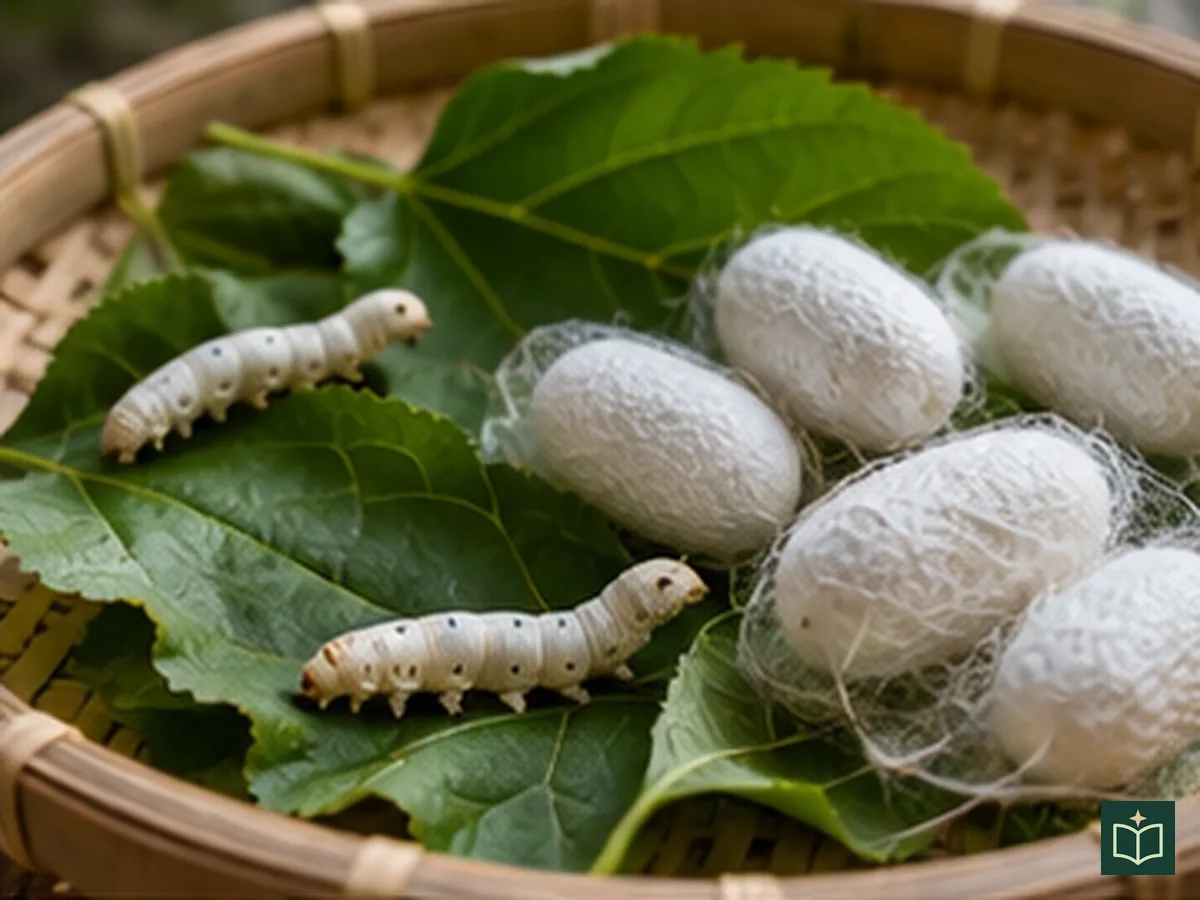
Silk farming, or sericulture, is labour-intensive and depends on careful timing. Eggs are hatched in spring, when mulberry trees come into leaf. For about a month the caterpillars do little but eat chopped mulberry leaves, increasing their weight many thousands of times. They then spin cocoons over two or three days from a single continuous filament, glued together with a natural gum called sericin. To stop the moth breaking through and cutting the thread, cocoons are heated or steamed, killing the pupa inside. They are then soaked in hot water to soften the gum, and workers find the loose ends and reel filaments from several cocoons together into one thread.
Why the secret held
Silk travelled west along the trade routes of Central Asia, reaching Rome by the first century BC, where it was prized and expensive. Yet for centuries the knowledge of how to produce it stayed in China. Part of the reason was practical. Raising silkworms needed living eggs, a supply of mulberry trees, a suitable climate and skilled hands, especially women’s, passed down within households. Merchants along the routes usually handled finished cloth, not eggs. The domesticated silkworm also cannot survive in the wild. Chinese rulers valued the trade and discouraged the export of silkworms, although stories of a formal death penalty for smuggling are hard to confirm from contemporary sources.
Eggs in a headdress
The secret leaked slowly. Sericulture had spread to Korea and Japan by the early centuries AD. A story recorded by the Chinese monk Xuanzang in the seventh century tells of a Chinese princess, married to the king of Khotan in Central Asia, who hid silkworm eggs and mulberry seeds in her headdress so that she could continue to wear silk in her new home. Whether literal or not, archaeology confirms that Khotan became a silk-producing centre. Persia, which sat between China and Byzantium, also developed its own production and earned large profits as a middleman, which gave the Byzantine emperors strong reasons to find another source.
The monks and the canes
According to the Byzantine historian Procopius, around AD 552 some monks who had lived in a region he called Serinda approached the emperor Justinian. They explained how silk was made and offered to fetch the eggs. Returning from their journey, they carried silkworm eggs hidden in hollow canes, and they hatched them in the empire, raising the larvae on mulberry leaves. Historians debate the details and the exact location of Serinda, but the outcome is clear. The Byzantine Empire developed its own silk industry, centred on Constantinople, Syria and Greece, and the state controlled high-quality production through imperial workshops and strict regulations on the finest purple cloth.
What changed, and what did not
Breaking the monopoly did not end China’s place in the silk trade. Chinese silk remained admired for its quality, and silk later spread to Islamic Spain, Sicily and then Italian cities such as Lucca, Florence and Venice, which became major producers in the Middle Ages. The story is a classic case of how technical knowledge travels: not through a single blueprint but through living materials, skilled people and the right environment. Today China remains by far the world’s largest silk producer, and India is second. Sericulture still involves the same basic stages of feeding, spinning and reeling, although modern machinery has replaced much of the work once done by hand.
Sources & further reading
Figures are rounded and widely published; check the linked organisations for the latest editions. These organisations do not endorse this website.