Two caves, two discoveries
In September 1940 four teenagers in the Dordogne region of south-west France followed their dog towards a hole near the village of Montignac and squeezed into a cave whose walls were covered with horses, bulls and deer. This was Lascaux. More than fifty years later, in December 1994, three cave explorers led by Jean-Marie Chauvet felt a draught from rubble in the Ardèche gorge and dug through to galleries containing hundreds of animal images. Chauvet’s art proved far older than anyone expected. Both caves are now UNESCO World Heritage Sites, Lascaux as part of the Vézère Valley listing in 1979 and Chauvet in 2014.
What the walls show
Lascaux holds roughly 600 painted and drawn figures and around 1,500 engravings, dated to about 17,000 years ago. Its most famous chamber, the Hall of the Bulls, has aurochs more than five metres long. Horses are the most common animal, alongside deer, bison and ibex, and there are many abstract signs such as dots and grids. Chauvet, at around 36,000 years old, shows a different emphasis, with many dangerous animals: lions, cave bears, woolly rhinoceroses and mammoths. Human figures are rare in both caves. The animals are shown with great accuracy of posture and movement, which suggests artists who watched them closely and had trained their skills over years.
Pigments and tools
The painters used colours from the earth. Red and yellow came from ochre, an iron-rich clay, which could also be heated to shift its shade. Black came from charcoal and from manganese oxide minerals. These were ground on stones and mixed with water, sometimes with mineral extenders that helped the paint spread and stick. Artists applied colour with fingers, pads of fur or moss, and probably simple brushes. Some pigment was blown through hollow bones or directly from the mouth, creating sprayed outlines and hand stencils. Engraving with flint tools added fine lines. At Chauvet, artists scraped the wall clean first, creating a pale surface that made black outlines stand out.
Working in darkness
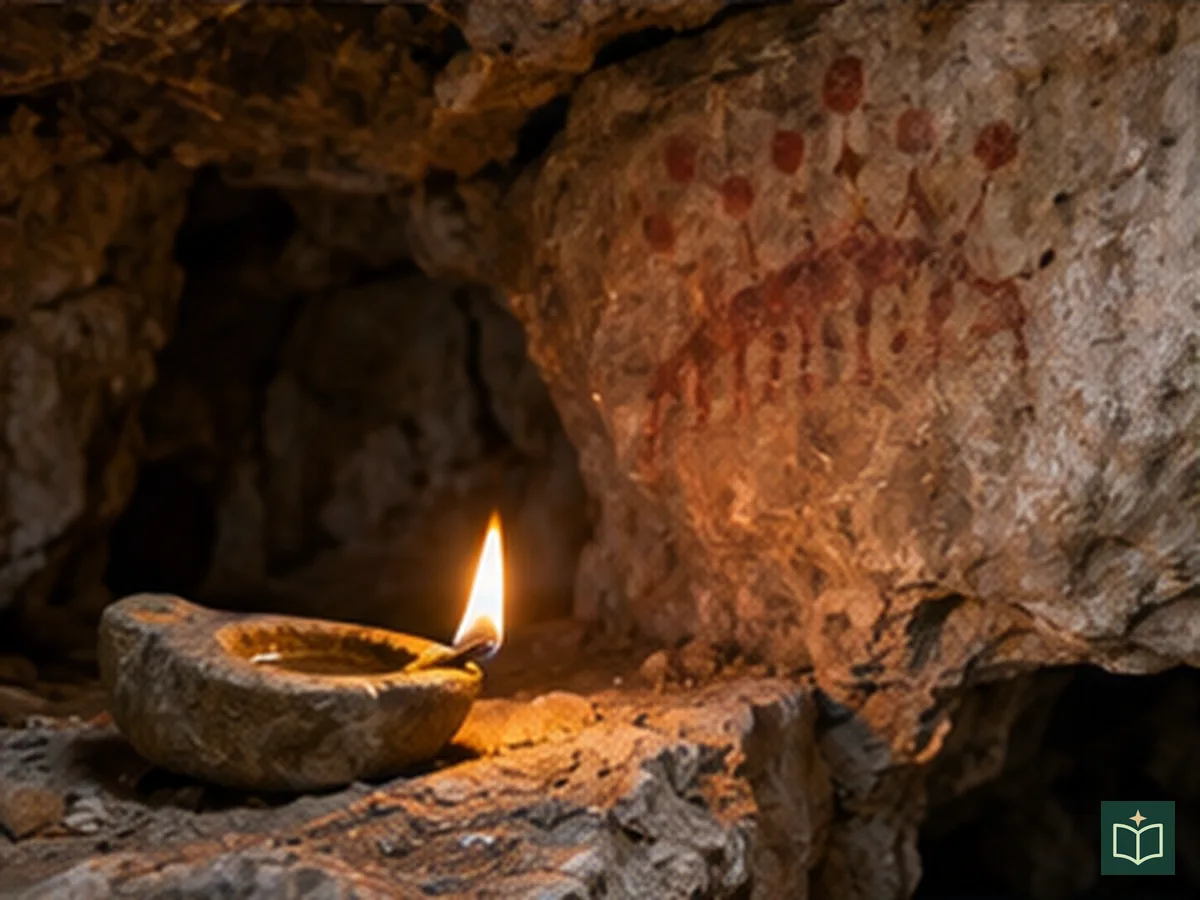
The deep chambers receive no daylight, so every image depended on artificial light. Excavations at Lascaux found more than a hundred stone lamps, mostly simple hollowed stones, and one finely shaped sandstone lamp with a handle. Burning animal fat with a wick of plant material, such lamps gave a steady, smoky glow. Torches, made from resinous wood, produced brighter but shorter-lived light, and their soot marks survive on cave walls. In some places, sockets in the rock suggest artists built wooden scaffolds to reach high ceilings. Flickering light also brings the images to life: animals painted over bulges in the rock seem to move as a flame shifts.
Why they were made
No one knows for certain why people painted in these caves, and they left no writing to explain. Most of the art lies away from living areas, in deep chambers that would have been visited rarely, which suggests special purposes rather than decoration. Early theories proposed hunting magic, but the animals painted do not closely match the animals eaten, according to bones found at nearby camps. Other researchers point to ritual, initiation, storytelling or attempts to communicate with a spirit world. Acoustic studies suggest some painted spots resonate unusually well. The art may have served different purposes at different times, since the sites span thousands of years.
Protecting fragile art
Lascaux opened to the public in 1948 and soon drew over a thousand visitors a day. Their breath, body heat and moisture changed the cave’s climate, and algae and crystal deposits began to spread across the walls. The cave was closed in 1963, and scientists still monitor it closely. Visitors now see replicas: Lascaux II opened in 1983 and a complete facsimile, Lascaux IV, in 2016. Chauvet was sealed from the start and a replica opened nearby in 2015. Meanwhile, dating of paintings in Indonesia, including animal images on Sulawesi more than 45,000 years old, shows that cave art was not a European invention but a widespread human practice.
Sources & further reading
- UNESCO World Heritage · Decorated Caves of the Vézère Valley ↗
- UNESCO World Heritage · Chauvet-Pont d’Arc Cave ↗
Figures are rounded and widely published; check the linked organisations for the latest editions. These organisations do not endorse this website.