Shedding orbital speed
A spacecraft returning from low Earth orbit is travelling at about 7.8 kilometres per second. To land, it must lose almost all of that speed, and the cheapest brake is the atmosphere itself. The air does the work for free, but the energy has to go somewhere, and it becomes heat. In the thin, cold upper atmosphere, where the speed of sound is about 300 metres per second, a capsule is moving at roughly 25 times that speed. Returning from the Moon is harder still, at about 11 kilometres per second. Without protection, the heat would destroy any spacecraft, as it does to most meteors and to old satellites deliberately brought down.
Plasma, not friction
It is often said that re-entry heat comes from friction with the air. In fact most of it comes from compression. The craft rams into air so quickly that the gas cannot move aside, forming a shock wave just ahead of the surface. Air squeezed through that shock heats to thousands of degrees, so hot that its molecules break apart and electrons are stripped away, creating a glowing plasma. That plasma surrounds the capsule and blocks radio signals for several minutes, the famous communications blackout. The shield’s job is to survive sitting just behind this layer of incandescent gas while keeping the crew cabin at a comfortable temperature.
Why capsules are blunt
Early missile designers assumed a sharp, streamlined nose would be best. In the early 1950s, the American engineer H. Julian Allen showed the opposite. A blunt, rounded body pushes the shock wave further away from its surface, so much of the heat stays in the surrounding air and is carried off in the wake rather than soaked into the vehicle. This blunt-body principle explains why Mercury, Apollo, Soyuz, Shenzhou, Crew Dragon and Orion all meet the atmosphere base first, with a broad, gently curved heat shield facing forwards. The shape also creates drag that slows the capsule efficiently, with parachutes taking over once it has fallen to much lower speeds.
Shields that burn on purpose
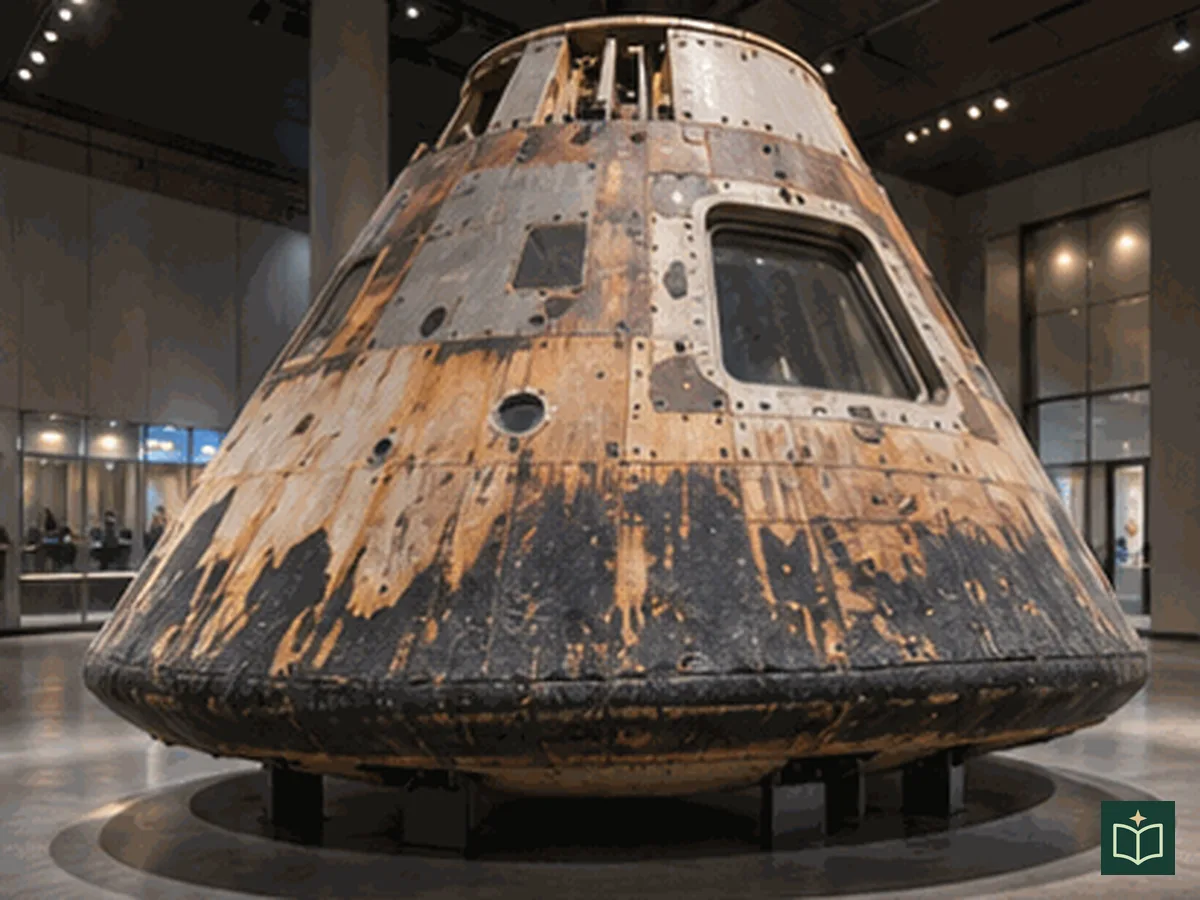
Most capsules use ablative heat shields, designed to char, melt and vaporise gradually. As the outer layer heats, the resin binding it breaks down into gases that flow out across the surface, carrying heat away and thickening a protective boundary layer. The charred crust left behind insulates the material beneath. Apollo’s shield used a material called Avcoat, packed by hand into a honeycomb; NASA’s Orion uses an updated version and faces temperatures approaching 2,800°C on a lunar return. SpaceX’s Dragon uses a carbon-based material called PICA-X. Ablative shields work superbly, but are mostly consumed or damaged in one flight, so they must be replaced or refurbished.
The narrow corridor
Survival also depends on the angle at which a capsule meets the atmosphere. Enter too steeply and it decelerates too violently, exposing crew to crushing forces and the shield to more heat than it was built for. Enter too shallowly and the capsule can skim off the upper air like a stone skipping on water, or spend too long heating up. For Apollo, the safe entry corridor was only a few degrees wide. Modern capsules also shift their centre of mass so that they fly at a slight angle, producing some lift. Rolling that lift left or right lets them steer, softening deceleration and guiding them to a precise splashdown point.
Reusable alternatives and failures
The Space Shuttle took a different approach. Instead of an ablative shield, it was covered in more than 20,000 silica tiles that radiated heat away and could be reused, with reinforced carbon panels on the hottest edges. They were fragile and required intense inspection between flights. In 2003, Columbia broke apart during re-entry after foam debris had damaged a wing’s leading edge at launch, killing its seven crew. Today, engineers are testing reusable materials, inflatable shields for landing heavy cargo on Mars and stainless-steel spacecraft cooled in other ways. Every new design returns to the same physics: convert speed into heat, then keep that heat away from the people inside.
Sources & further reading
Figures are rounded and widely published; check the linked organisations for the latest editions. These organisations do not endorse this website.