Pascal’s insight
In the seventeenth century, the French scientist Blaise Pascal described a simple rule: pressure applied to a liquid in a closed container is transmitted undiminished to every part of it. Pressure is force divided by area. So if a small piston pushes on trapped liquid, the pressure it creates also acts on any other piston connected to the same fluid. If that second piston is larger, the same pressure acting over a bigger area produces a bigger force. This is the foundation of hydraulics. The liquid acts like a solid rod that can bend round corners, travel through flexible hoses and split to drive several machines at once.
The arithmetic of a jack
Imagine a jack with a small piston 2 centimetres across and a large one 20 centimetres across. The diameter is ten times greater, so the area is a hundred times greater. A push of 100 newtons, about the weight of a 10-kilogram bag, on the small piston produces 10,000 newtons on the large one, enough to lift about a tonne. There is no free energy. To raise the large piston by 1 millimetre, the small one must move 10 centimetres, because the same volume of oil has to shift. Real jacks pump the small piston repeatedly, with valves that stop the oil flowing back, so many short strokes add up to a useful lift.
Why oil, not air
Hydraulic systems rely on liquids because they barely compress. Squeezing air would mostly shrink its volume rather than transmit force, making controls spongy, which is why air in car brake lines is dangerous and has to be bled out. Early hydraulic machines used water, but modern systems use specially formulated oils that lubricate moving parts, resist corrosion and work across wide temperature ranges, important in both Arctic winters and Gulf summers. A typical system has a pump driven by an engine or electric motor, a reservoir of fluid, valves that direct its flow, pipes or hoses, and actuators: cylinders that push and pull, or motors that turn.
From presses to diggers
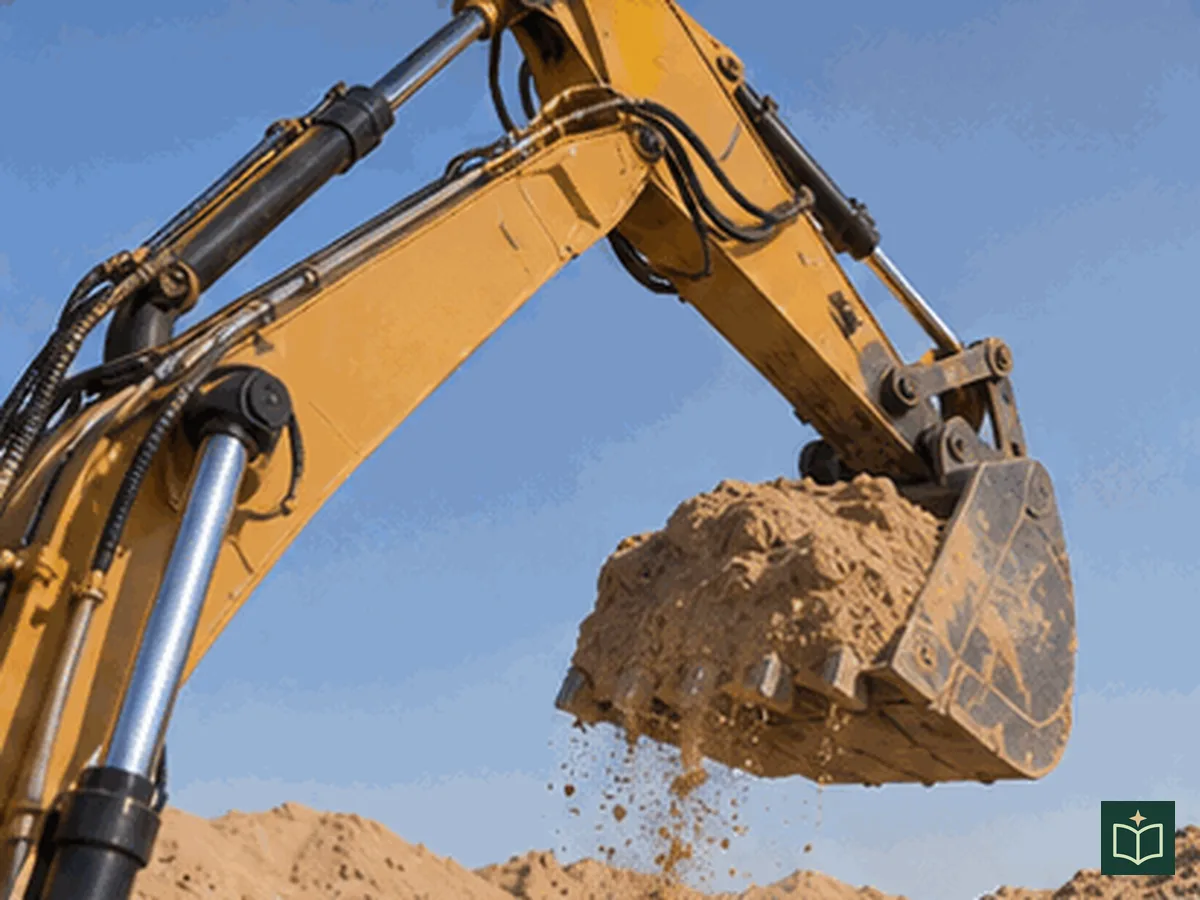
The English inventor Joseph Bramah patented a hydraulic press in 1795, and by the nineteenth century cities such as London had networks of high-pressure water pipes powering cranes, lifts and bridges. Tower Bridge’s original lifting machinery was hydraulic. Today, hydraulics are everywhere heavy force must be controlled precisely. Excavators on construction sites across the region use pressures of hundreds of bar to swing booms and drive buckets into compacted ground. Car brakes are hydraulic: a light press on the pedal is multiplied into strong clamping at each wheel. Lifts in low-rise buildings, rubbish trucks, injection-moulding machines and the presses that shape car bodies all use the same principle.
Flying on fluid
Large aircraft depend on hydraulics. Moving the control surfaces on the wings and tail of an airliner at high speed takes far more force than pilots could supply by hand, so hydraulic actuators do the work, along with raising the landing gear and operating the brakes. Systems typically run at about 3,000 pounds per square inch, roughly 207 bar, and some newer large aircraft use about 5,000 psi to save weight with smaller components. Because failure would be catastrophic, airliners carry two or three independent hydraulic systems, so the loss of one leaves the others able to fly the aircraft. Some newer designs add electrically powered actuators as further backup.
Limits and maintenance
Hydraulics have drawbacks. Leaks waste fluid, create slippery hazards and can pollute soil and water, so seals and hoses need regular inspection. Fluid under very high pressure is dangerous: a pinhole leak can inject oil through skin, a serious medical emergency. Pumps and valves lose some energy as heat, and systems must be kept clean, because grit wears precision parts. Electric actuators are replacing hydraulics in some roles, especially where efficiency and clean operation matter, such as in electric vehicles and some aircraft. But for packing great force into a compact space, controlling it smoothly and holding loads steady, a trapped liquid remains hard to beat.
Sources & further reading
- Britannica · Pascal’s principle ↗
- NASA Glenn Research Center · Pressure ↗
- Federal Aviation Administration · Aviation Maintenance Technician Handbook ↗
Figures are rounded and widely published; check the linked organisations for the latest editions. These organisations do not endorse this website.