Where the edge is
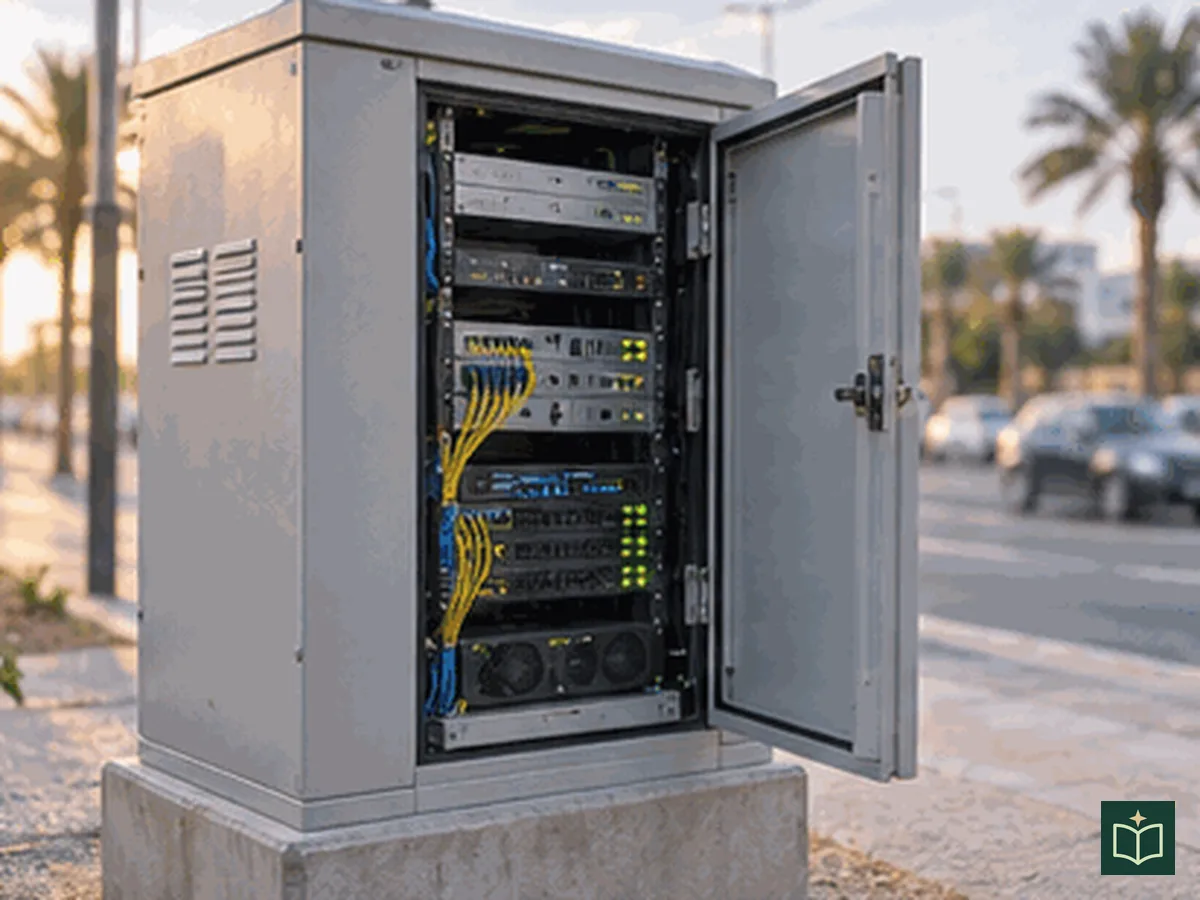
Cloud computing concentrates processing in huge data centres, often hundreds or thousands of kilometres from users. That brings economies of scale but adds distance. Edge computing moves some of the work outward, towards the ‘edge’ of the network where data is created and used. The edge is not one place. It can be a small server room at a mobile operator’s local exchange, a rack inside a factory, a cabinet beside a motorway or the processor inside a phone, car or security camera. What these locations share is proximity. They handle tasks that need an answer quickly, produce too much data to send, or must keep working even if the connection drops.
The physics of delay
Nothing on the internet travels faster than light, and in optical fibre light covers about 200,000 kilometres a second, roughly 5 microseconds per kilometre. A round trip to a data centre 100 kilometres away therefore costs at least one millisecond. Consider a user in Dubai and a server in Frankfurt, about 4,800 kilometres apart in a straight line. Even along an ideal fibre route, the round trip would take around 48 milliseconds; real cables wander and every router adds time, so measured delays are larger. For loading a web page that hardly matters. For a robot arm, a multiplayer game or a voice assistant, tens of milliseconds are noticeable.
Bandwidth and privacy
Delay is only part of the case. A single high-definition security camera can produce many gigabytes of video a day, and a busy airport or mall may have thousands. Sending every frame to a distant cloud would be expensive and wasteful when the useful output is a short alert. Processing at the edge lets a camera or local server analyse the footage and transmit only events. Keeping data local also helps with privacy and with rules that require certain information to stay within a country, a growing concern for governments and companies across the Gulf. On phones, on-device processing allows features such as voice typing and photo search to work without uploading everything.
Examples in daily life
Many people already rely on edge computing without noticing. A modern car processes camera and radar data on board to brake in an emergency, because waiting for a remote server would be dangerous. Phones run speech and image recognition on dedicated chips. Factories use local servers to monitor machines and stop a production line within milliseconds when something goes wrong. Mobile operators place computing inside their 5G networks so that services such as cloud gaming or live video analysis can run close to customers. Content delivery networks, which store copies of popular files near users, are a related idea, although edge computing runs live calculations rather than simply serving stored copies.
The trade-offs
Spreading computers across thousands of small sites is harder than running a few giant ones. Each site needs power, cooling, physical security and maintenance, often in cramped or hot places such as roadside cabinets in a Gulf summer. Small sites lack the economies of scale that make large data centres efficient, so the same calculation may cost more at the edge. Software must be updated and secured across a scattered fleet, which widens the area attackers can target. Devices themselves have limited battery and processing power. For these reasons, engineers usually split workloads: urgent or bulky processing near the user, with storage, analysis and model training kept in central data centres.
What to watch
The rise of artificial intelligence is reshaping the edge. Running a trained model to answer a question or recognise an image, known as inference, increasingly happens on phones, laptops and local servers, while training stays in large data centres. Chips designed for efficient AI processing are now common in consumer devices. Telecommunications companies are building edge sites into their networks, and countries are investing in local data centres to keep services fast and data at home. The likely future is not a choice between cloud and edge but a continuum, with each task placed wherever the balance of delay, cost, privacy and reliability works best.
Sources & further reading
- IBM · What is edge computing? ↗
- European Telecommunications Standards Institute · Multi-access edge computing ↗
- Britannica · Cloud computing ↗
Figures are rounded and widely published; check the linked organisations for the latest editions. These organisations do not endorse this website.