Ice from a summer storm
Hail is solid ice that falls from thunderstorms, usually as balls or irregular lumps ranging from the size of a pea to, rarely, that of a grapefruit. It is different from sleet or snow, which form in cold winter clouds. Hail typically falls in the warm season, often on afternoons when the ground is hot, because it needs the violent rising air of a strong thunderstorm. That puzzles many people: how can lumps of ice fall on a hot day? The answer lies in the height of the cloud. A tall thunderstorm can tower 10 to 15 kilometres up, where temperatures fall far below freezing, even while the ground below is baking.
Supercooled water
The key ingredient is supercooled water: liquid droplets that remain unfrozen well below 0°C. Tiny, pure droplets have nothing to freeze onto and can stay liquid down to about minus 40°C, and the middle levels of a thunderstorm are full of them. A hailstone begins as an embryo, a small ice particle such as a frozen raindrop or a soft pellet of rime called graupel. Carried upward by the storm's updraft, the embryo collides with supercooled droplets, which freeze onto its surface on contact. The stone grows as long as it stays in this zone. Larger stones sweep up more droplets, so growth speeds up as the stone gets bigger.
Held up by rising air
A hailstone can grow only while the updraft supports its weight. Updrafts in severe thunderstorms can exceed 100 kilometres an hour, strong enough to keep large stones aloft for many minutes. When a stone becomes too heavy, or drifts out of the strongest updraft, it falls. Small hail may melt on the way down and arrive as heavy rain; larger stones fall too fast to melt completely. The biggest hailstones need the most powerful storms, typically supercells with long-lived rotating updrafts, so forecasters treat large hail as a sign of an exceptionally strong storm. A stone about 5 centimetres across can strike the ground at around 100 kilometres an hour or more.
Reading the layers
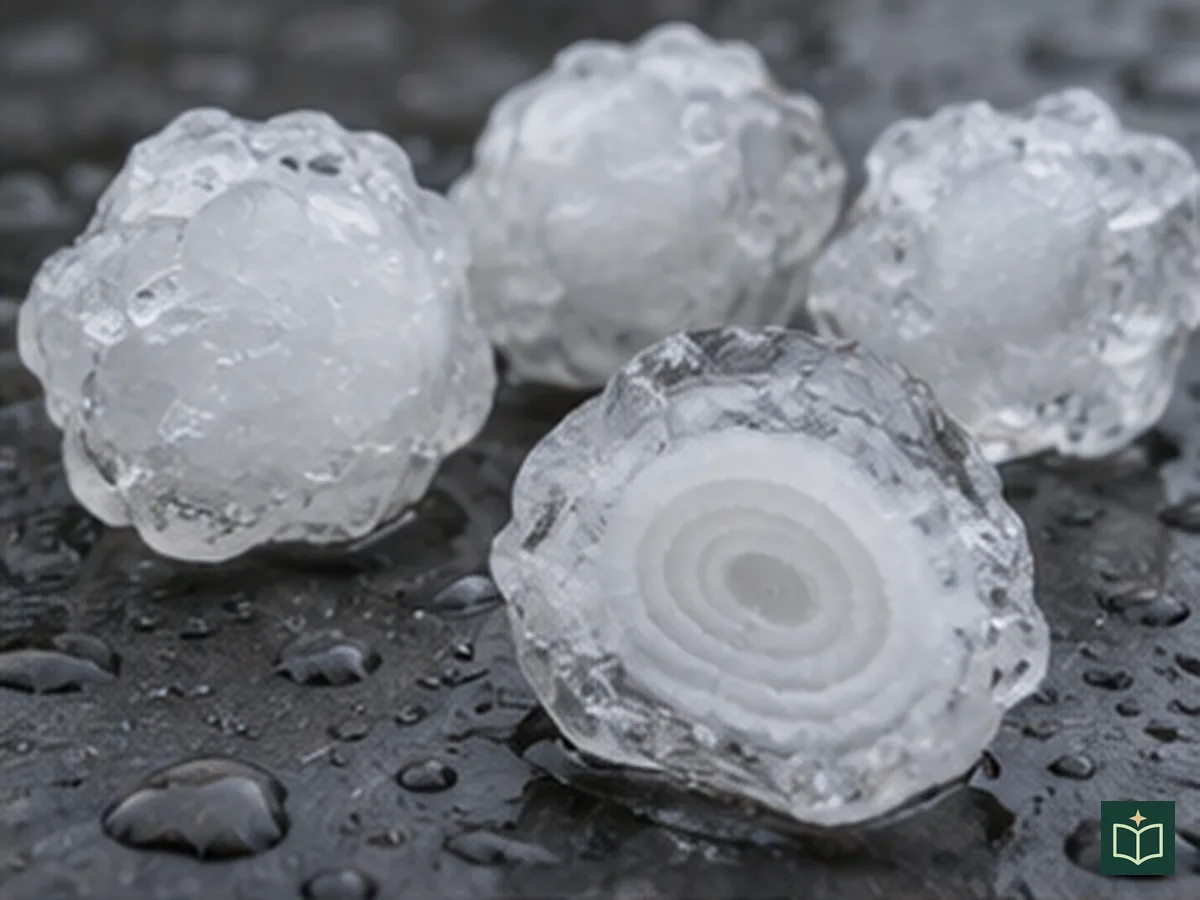
Cut a large hailstone in half and you often see rings, like those of an onion. They record the stone's journey. Where it grew slowly in colder, drier parts of the cloud, droplets froze instantly and trapped tiny air bubbles, leaving cloudy, milky layers. Where it collected water rapidly in warmer, wetter parts, a film of water spread over the surface before freezing, forming clear ice. For years the rings were taken as proof that stones bounce up and down many times. Modern radar studies and computer models suggest that many hailstones make just one or two long trips through the growth zone, with the layers recording changing conditions along the way.
Hail in the desert
Hot desert regions are not immune. Across the Arabian Peninsula, hail falls mainly during unsettled spells in winter and spring and in summer storms over mountains, when intense heating drives air upward and moist air flows in. In the UAE, the Hajar Mountains around Al Ain and Ras Al Khaimah regularly spawn afternoon storms in summer, and hail has also fallen on coastal cities during unsettled weather, sometimes leaving streets white with ice. Because hail needs a deep cold layer aloft and must survive the fall, it is relatively uncommon at ground level in the humid tropics. Mid-latitude plains, such as the American Midwest and parts of Argentina, see some of the world's largest stones.
Damage and forecasting
Hail is one of the costliest weather hazards for property. Stones a few centimetres wide dent cars, shatter windows and solar panels, and strip crops in minutes, and insured losses in some countries reach billions of dollars in a bad year. Forecasters use Doppler radar to spot the strong updrafts and intense echoes that signal large hail, and dual-polarisation radar can distinguish ice from rain by the shape of what it detects. Warnings, even with minutes to spare, let people move cars under cover and keep away from windows. For anyone caught outside, the advice is simple: get indoors, because large hailstones falling at high speed can cause serious injuries.
Sources & further reading
Figures are rounded and widely published; check the linked organisations for the latest editions. These organisations do not endorse this website.