Two clocks in the sky
Calendars are built on two natural clocks that do not fit neatly together. The Sun sets the year: Earth takes about 365.24 days to orbit it, and that cycle drives the seasons. The Moon sets the month: from one new moon to the next takes on average about 29.53 days. Twelve of these months add up to about 354.37 days, roughly 11 days short of a solar year. Calendar makers have handled the mismatch in three ways. Solar calendars, like the Gregorian, ignore the Moon. Lunisolar calendars, like the Hebrew and traditional Chinese ones, add an extra month every few years. The Islamic calendar follows the Moon alone.
A purely lunar calendar
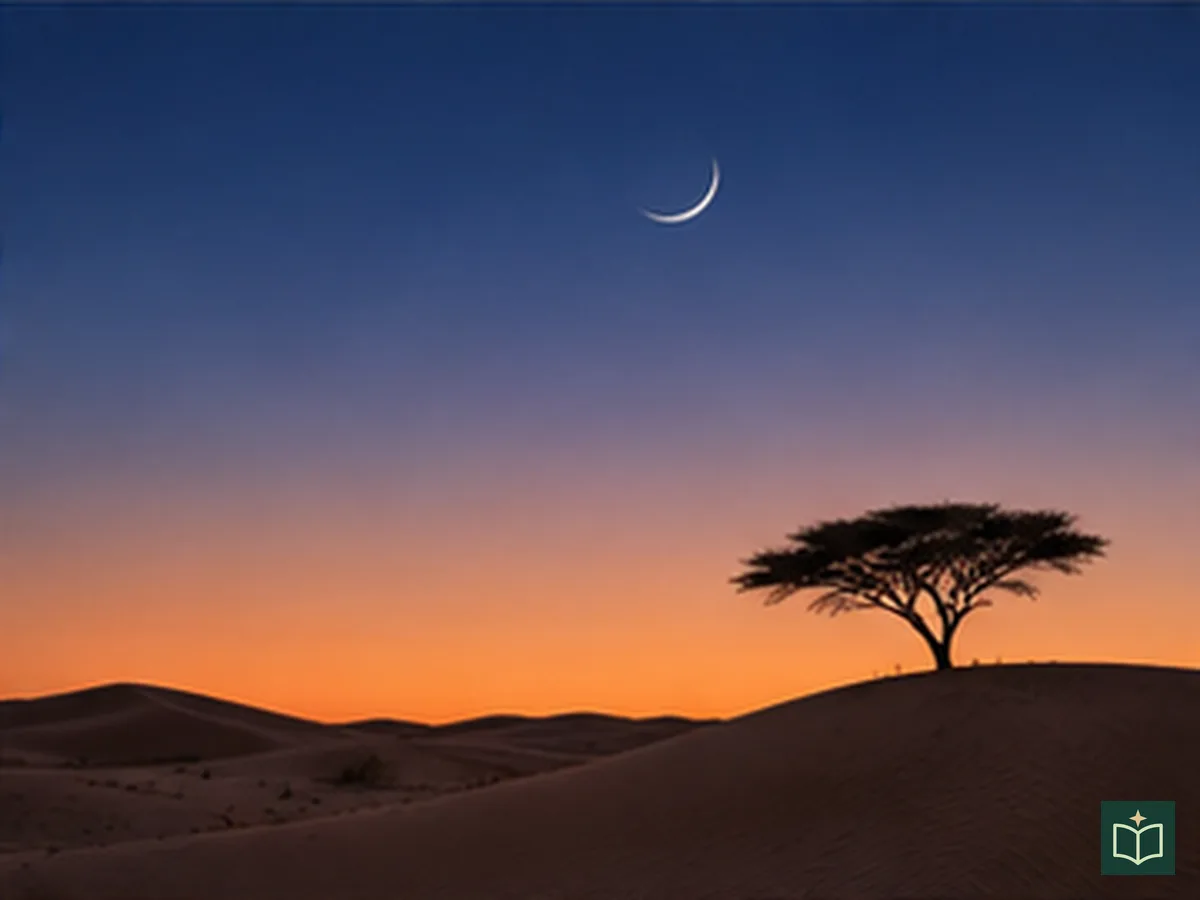
The Islamic, or Hijri, calendar counts years from the Prophet Muhammad's migration from Mecca to Medina in 622 CE. It has twelve months of 29 or 30 days, each traditionally beginning when the thin new crescent is first sighted after sunset. Ramadan is the ninth month. The Quran describes a year of twelve months, and the older Arabian practice of inserting extra months to keep pace with the seasons was abandoned early in Islamic history. As a result, the months are tied to the Moon rather than to the agricultural year. A common year has 354 days, and calculated versions of the calendar add a day in some years, giving 355.
Working out the drift
The arithmetic is simple. A solar year of about 365.24 days minus a lunar year of about 354.37 days leaves a gap of about 10.88 days. So if Ramadan begins on a given date one year, it will typically begin about 11 days earlier on the Gregorian calendar the next, sometimes 10 or 12 depending on when the crescent is seen. To return to the same point in the solar year, the drift must add up to a whole year: 365.24 divided by 10.88 gives about 33.6. In other words, 34 Islamic years fit into roughly 33 solar years, after which Ramadan comes back to the same season.
From summer to winter and back
The drift has a striking effect on daily life. In the late 2010s, Ramadan fell in May and June, when Gulf temperatures often exceeded 40°C and fasts in the UAE lasted around 15 hours. Moving back through spring, Ramadan in 2026 began in mid-February, with milder weather and fasts of about 13 hours. Around 2030 it will reach midwinter, bringing shorter days and cool afternoons. Then, more than three decades on, the cycle will return to summer. Anyone who observes the fast over a lifetime experiences it in every season. The same is true of Eid al-Fitr, Eid al-Adha and the Hajj, whose dates drift in step.
Latitude matters too
How long a fast lasts depends not only on the season but on where you are, because fasting runs from dawn to sunset. Near the equator, day length barely changes through the year, so fasts last about the same number of hours in any season. In the Gulf, at around 24 to 25 degrees north, the difference between a winter and a summer Ramadan is two to three hours. At high latitudes the effect is far larger. A summer Ramadan in northern Europe can mean fasting for 18 hours or more, while a winter one may be under 10 hours. In the Southern Hemisphere the pattern is reversed, so a June Ramadan brings short days in Australia.
Predictable, yet sighted
Because each month depends on the Moon, the start of Ramadan is not fixed years ahead in the way Gregorian holidays are. Many communities still begin the month when the crescent is seen by eye, which can shift the start by a day between countries. Others rely on astronomical calculations, which predict the Moon's position precisely, and some combine both approaches. The underlying cycle, however, is entirely predictable. Astronomers can say with confidence where Ramadan will fall decades from now, to within a day or so. The drift is a reminder that the Islamic calendar is tied directly to the sky: each month is one complete cycle of the Moon, visible to anyone who looks up.
Sources & further reading
Figures are rounded and widely published; check the linked organisations for the latest editions. These organisations do not endorse this website.