Why glass needs cleaning
Glass towers are designed to look sleek and reflective, but their facades gather dust, salt, pollution and bird droppings. Dirty glass looks shabby, lets in less daylight and can hide damage to seals or panels. In the Gulf, the challenge is unusual. Rain is rare, so the natural rinsing that helps in wetter climates seldom happens, while fine desert dust settles constantly and sandstorms can coat a facade in hours. High humidity and morning dew can turn dust into muddy streaks. As a result, many towers in the region are cleaned on a regular cycle, and their owners plan facade access from the start of design rather than adding it later.
Building maintenance units
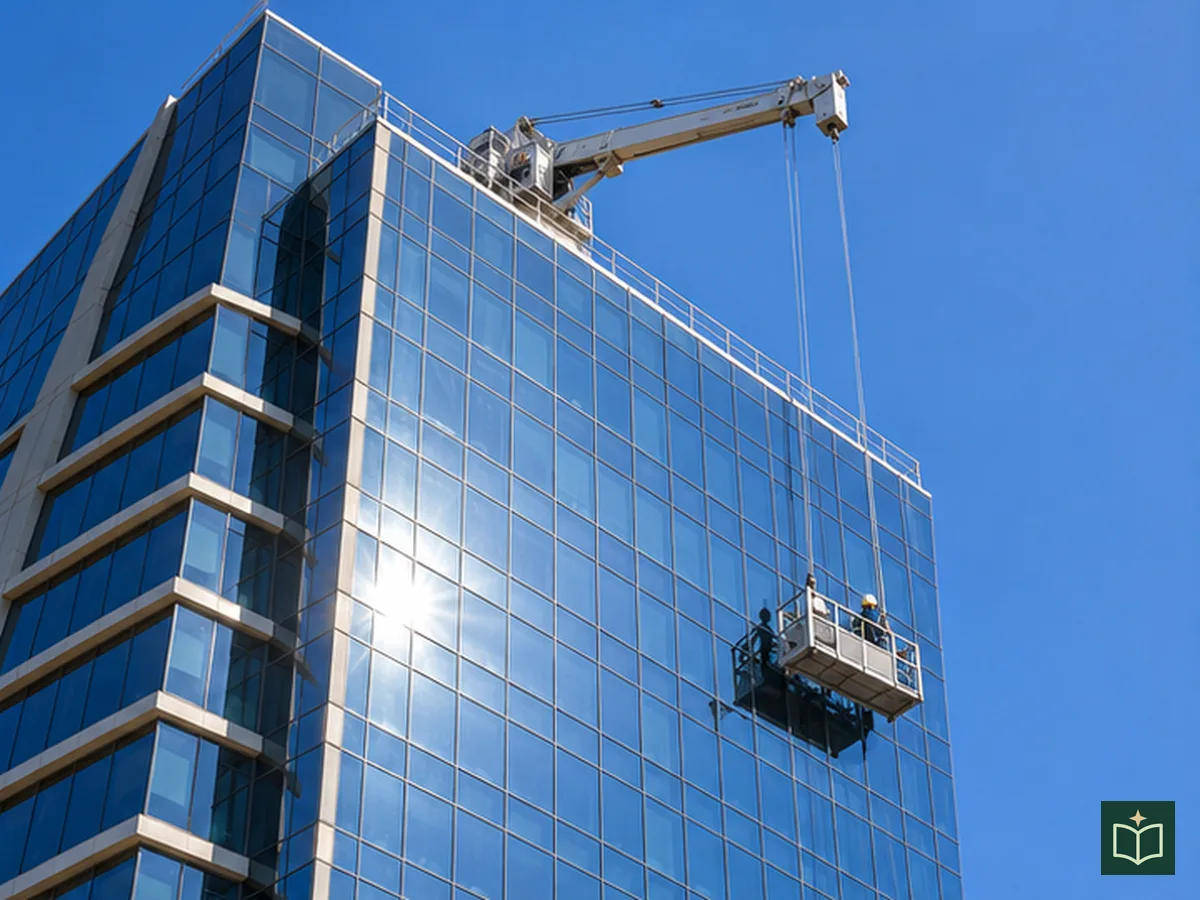
The main tool is the building maintenance unit, or BMU, a permanent machine mounted on the roof or on terraces along the tower. It works like a small crane: a jib or telescopic arm reaches over the edge and lowers a cradle, or gondola, on steel cables. Workers in the cradle wash the glass as it moves down the facade, then the machine travels along rails or a track to position the cradle for the next strip. On tall or complex towers, several BMUs may be needed, some hidden in garages that open in the roof or setbacks. Each cradle has backup cables, brakes and limits on load and wind speed.
Rope access
Where machines cannot reach, such as curved surfaces, spires and awkward corners, specialist rope-access technicians take over. They abseil down the building on two independent ropes, one carrying their weight and a second acting as a backup, each attached to certified anchor points on the roof. The technicians carry buckets, squeegees and water-fed poles and work in teams under strict rules, with a supervisor on the roof and rescue plans in place. Rope access is also used for inspections, sealant repairs and replacing damaged panels. It requires formal training and certification, and work stops when wind exceeds set limits, because gusts can swing a worker into the glass.
The biggest example
Burj Khalifa, the world's tallest building, shows the scale of the task. Its facade has roughly 24,000 glass panels, and cleaning all of them takes a team of workers several months, using BMUs housed at different levels of the tower. By the time the cleaners reach the bottom, the top may already need attention again, so cleaning is effectively continuous. Workers start early to avoid the worst of the heat, and operations pause during strong winds or dust storms. Similar programmes run on towers across Dubai, Abu Dhabi and Doha, where glass facades dominate the skyline and must withstand intense sun as well as dust.
Robots and coatings
Robotic cleaning systems are increasingly used, particularly on flat, repetitive facades. Some travel up and down the glass on tracks or suction, spraying water and brushing as they go, guided by the same roof equipment as manual cradles. Drones that spray water have also been trialled for lower buildings and hard-to-reach panels, though they face limits on wind, weight and safety over busy streets. Self-cleaning glass, coated with a thin layer of titanium dioxide, uses sunlight to break down organic dirt and makes water spread in a sheet that washes it away. In dry climates, that coating helps less, because it depends on rain to rinse the surface.
Why it matters
Facade cleaning is one of the most visible forms of building maintenance, and one of the most hazardous if done badly. Work at height is strictly regulated in most countries, with requirements for training, equipment inspection, anchor certification and rescue planning. For building owners, access design affects running costs for decades: a tower without good BMU coverage may need expensive rope-access work for every clean. Clean glass also matters for energy, because dirt can affect how coatings reflect solar heat. As cities build taller and more complex shapes, engineers increasingly design cleaning systems alongside the architecture, ensuring every pane can be reached safely for the life of the building.
Sources & further reading
- Burj Khalifa · Official site ↗
- UK Health and Safety Executive · Work at height ↗
- Britannica · Skyscraper ↗
Figures are rounded and widely published; check the linked organisations for the latest editions. These organisations do not endorse this website.