Why remove the barrier
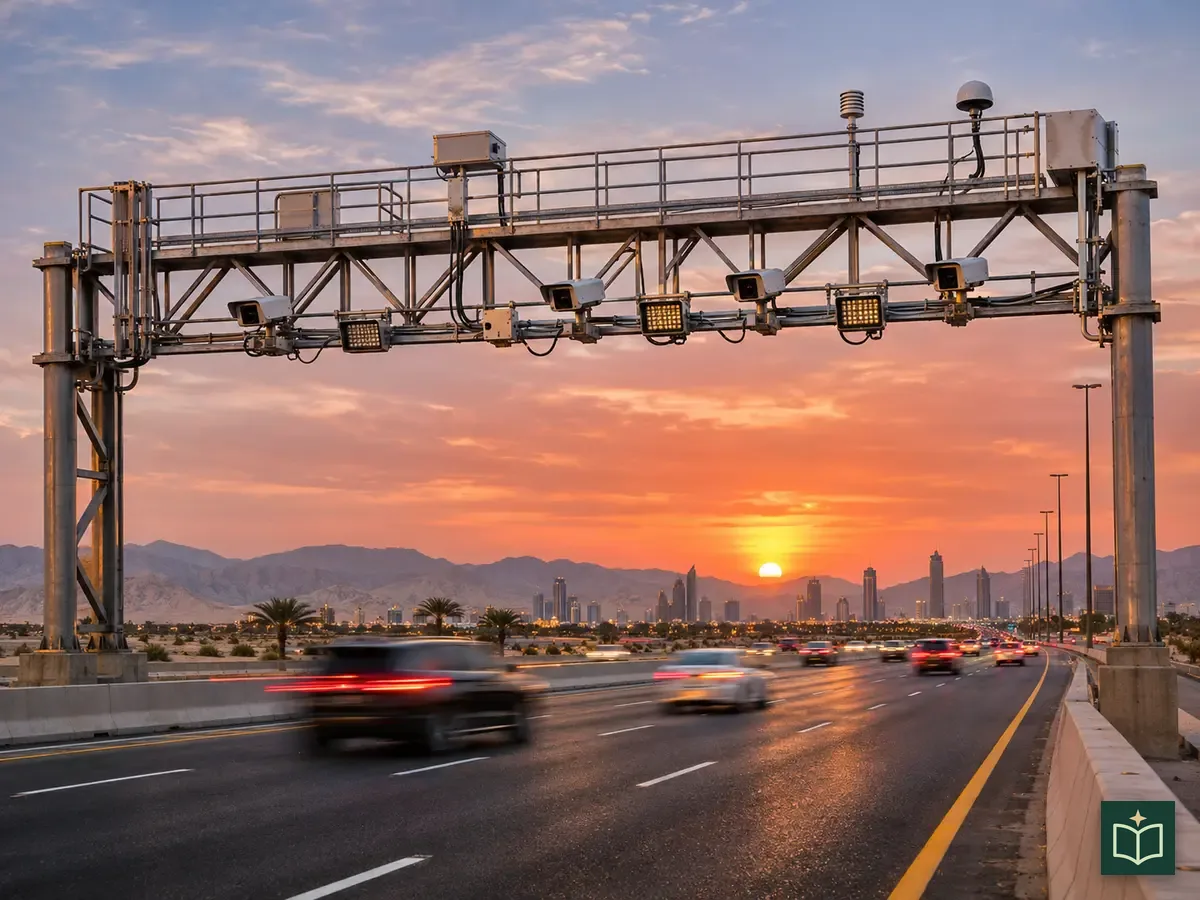
Traditional toll roads use plazas with booths and barriers, where drivers slow down, stop and pay. These create queues, take up land and cost money to staff. Free-flow tolling removes the barrier entirely. Vehicles drive beneath an overhead gantry at normal speed, and the system identifies them and charges the toll electronically. There is no slowing down, no lane change and no cash. Dubai introduced its free-flow system, Salik, in July 2007, and the toll gantries along major roads such as Sheikh Zayed Road became familiar parts of the city. Abu Dhabi launched its own system, Darb, in 2021, and many other countries use similar technology.
Tags and cameras
Most free-flow systems combine two identification methods. The first is an electronic tag, typically a sticker or small device mounted on the windscreen, containing a radio-frequency chip with a unique identifier. As the vehicle passes, a reader on the gantry communicates with the tag in a fraction of a second. The second is automatic number plate recognition: cameras photograph the front and rear plates, and software reads the characters. Cameras provide a backup if a tag is missing or faulty and are essential for enforcement. Some systems rely on cameras alone, especially where registering all vehicles with tags would be impractical or where many foreign vehicles use the road.
From gantry to account
When a gantry identifies a vehicle, the system records the time, location and identifier, then deducts the toll from the account linked to the tag or plate, usually a prepaid balance topped up online, through apps or at shops. Some systems vary charges by time of day, charging more in peak hours to manage congestion; Dubai introduced variable Salik pricing by time of day in 2025. If an account has insufficient balance or a vehicle has no tag, the owner may receive a reminder and a period to settle before fines apply. Rental car companies usually pass toll charges on to customers, sometimes with an administration fee.
Tolls, congestion and funding
Road tolls serve several purposes. Some fund the construction and maintenance of specific roads, bridges or tunnels. Others are primarily congestion charges, designed to discourage driving on busy routes or into city centres at peak times and to encourage public transport. Singapore introduced an early area licensing scheme in 1975 and later electronic road pricing; London introduced a congestion charge in 2003, and Stockholm made its own permanent in 2007 after a trial. Research on these schemes has generally found that pricing reduces traffic and travel times on charged routes, although effects depend on the availability of alternatives. Revenue is often reinvested in transport, but how it is spent varies by city.
Privacy and fairness
Free-flow tolling generates a detailed record of when and where vehicles travel, which raises privacy questions. Operators are typically bound by data protection rules on how long records are kept and who can access them, though rules differ between countries. Critics also argue that tolls can weigh more heavily on lower-income drivers who have no practical alternative route or transport option. Supporters reply that road space is scarce and pricing allocates it more efficiently than queues, and that discounts or exemptions can address fairness. Disputes over incorrect charges, such as misread plates, are handled through complaints procedures, so checking your account statements periodically is sensible.
What to watch
Satellite-based road charging, which calculates distance travelled using a vehicle’s positioning system rather than fixed gantries, is already used for lorries in several European countries. As electric vehicles reduce fuel tax revenues, some governments are considering charging drivers by distance to fund roads. Number plate recognition continues to improve, and some cities are moving to camera-only systems that require no tags at all. Interoperability, allowing one tag or account to work across different toll systems, is a growing goal in Europe and the United States. For drivers, the trend is clear: paying for roads is becoming invisible, automatic and increasingly tied to when and where they drive.
Sources & further reading
Figures are rounded and widely published; check the linked organisations for the latest editions. These organisations do not endorse this website.