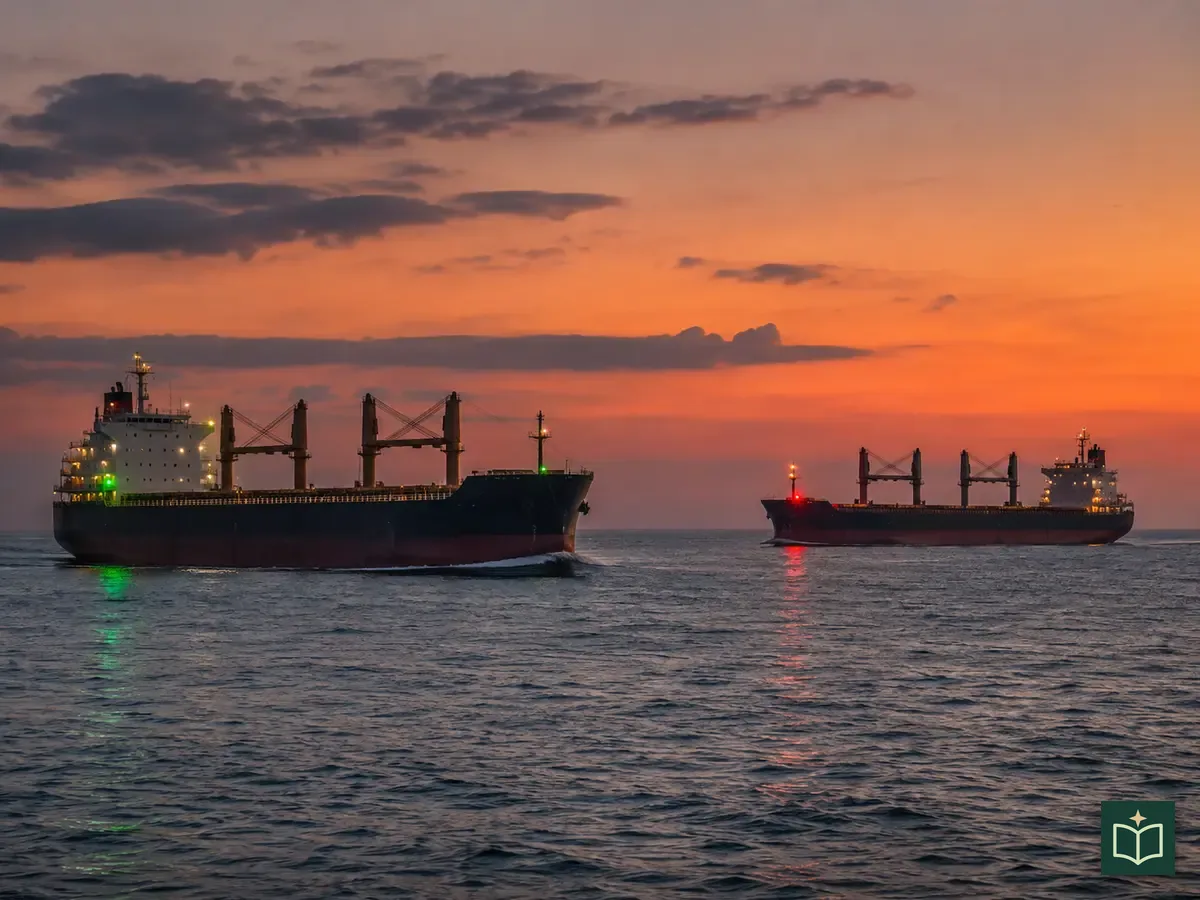
A road with no lanes
A large cargo ship can take several kilometres to stop and minutes to complete a significant turn. It has no brakes in the everyday sense and, on the open sea, no painted lanes or traffic lights. Yet tens of thousands of vessels share the oceans, often converging in narrow straits and busy port approaches. What keeps them apart is a shared rulebook, the International Regulations for Preventing Collisions at Sea, often called COLREGs. Adopted in 1972 under the International Maritime Organization and in force since 1977, the rules apply to vessels of all sizes on the high seas and connected waters, from supertankers to fishing boats and private yachts.
Who gives way
The core of the rules is simple: in any encounter where there is a risk of collision, one vessel must keep out of the way and the other should hold its course and speed. When two power-driven vessels meet head-on, both turn to starboard, the right-hand side, so that they pass port to port. When their courses cross, the vessel that has the other on its own starboard side must give way. A vessel overtaking another must keep clear. Power-driven vessels generally give way to sailing vessels, fishing vessels and ships restricted in their ability to manoeuvre. The rules also require a proper lookout and a safe speed at all times.
Lights, shapes and sounds
At night, ships reveal their direction through coloured navigation lights. A red light is shown on the port side and a green light on the starboard side, with white masthead lights indicating a power-driven vessel and, by their arrangement, its heading. If you see a ship’s red and green lights together, it is heading straight towards you. Additional lights and daytime shapes signal special situations, such as a vessel at anchor, aground, fishing or constrained by its draught. In fog, ships sound prescribed patterns of horn blasts. Sound signals also communicate intentions in sight of each other: one short blast means I am altering my course to starboard.
Radar, AIS and routing
Modern bridges combine human watchkeeping with electronics. Radar detects other ships and, with automatic plotting aids, calculates their closest point of approach. The Automatic Identification System, or AIS, required on most large ships under international rules, broadcasts each vessel’s identity, position, course and speed by radio, so that nearby ships and shore stations can see them on screen. In congested areas, traffic separation schemes act like dual carriageways, with ships travelling in opposite directions in separate lanes. The first was introduced in the Dover Strait, and schemes now operate in many busy waterways, including the Strait of Hormuz, through which a large share of Gulf shipping passes.
When things go wrong
Collisions still happen, and investigations usually find human factors rather than unknown rules: a poor lookout, misinterpreting another vessel’s intentions, fatigue, overreliance on electronics or a late, small manoeuvre that the other ship could not detect. The rules demand that action to avoid collision be positive, made in good time and large enough to be readily apparent. Talking by VHF radio can help, but agreements made over the radio have caused accidents when ships misidentified each other. Even a vessel with the right to stand on must act if the give-way vessel fails to do so, because the rules never allow a crew to sail knowingly into a collision.
What to watch
Shipping is introducing more automation, from advanced collision warning software to trials of remotely operated and autonomous vessels. The International Maritime Organization has been developing rules for such ships, which raises the question of how a machine should interpret rules written for human judgement, such as good seamanship. Larger vessels, crowded anchorages and growing leisure boating add pressure in busy coastal waters, including around Gulf ports. GPS interference in some regions has highlighted the importance of traditional skills like visual bearings and radar plotting. Whatever the technology, the principle established by the collision rules remains: every vessel must know, early and without doubt, what it should do.
Sources & further reading
- IMO · International Maritime Organization ↗
- IALA · International Association of Marine Aids to Navigation ↗
Figures are rounded and widely published; check the linked organisations for the latest editions. These organisations do not endorse this website.