What counts as a fossil
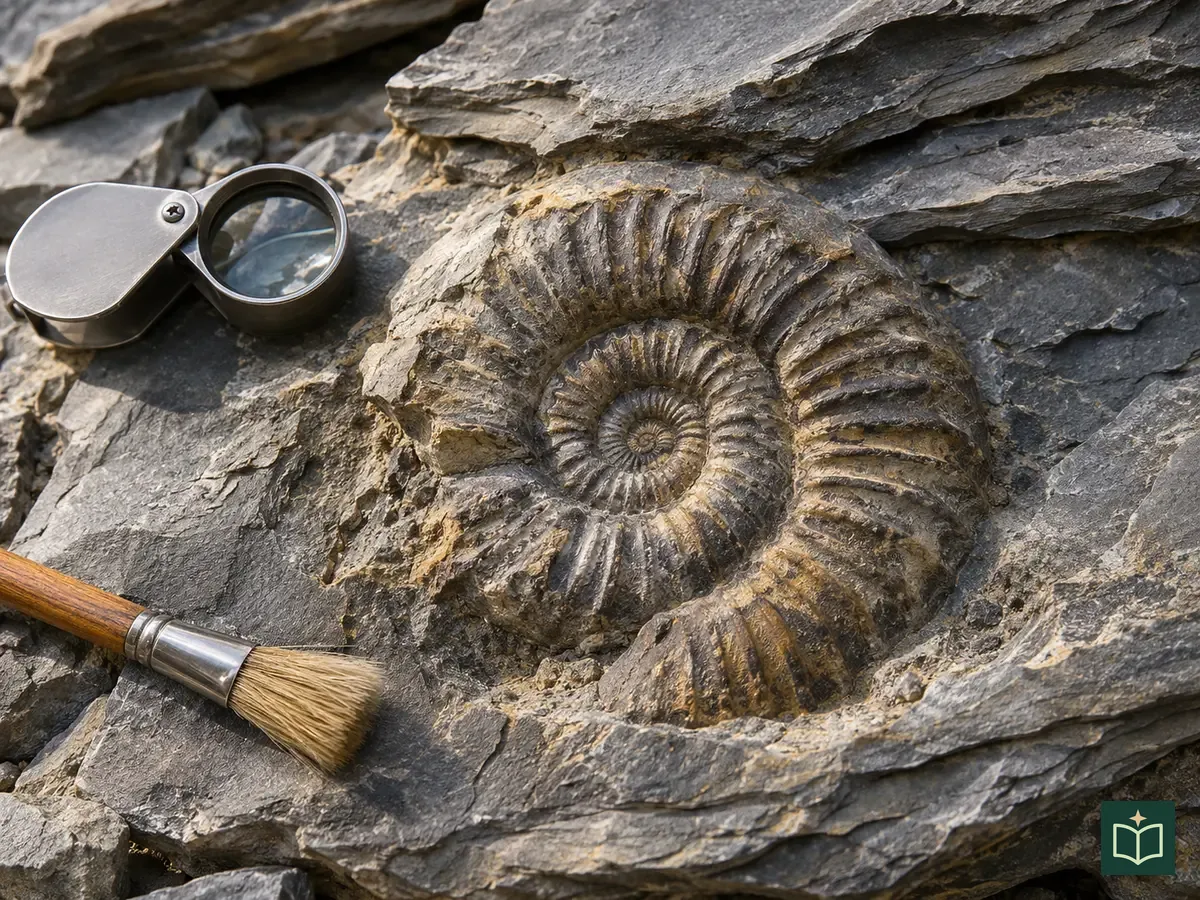
A fossil is any preserved evidence of past life, generally more than about 10,000 years old. The most familiar are body fossils: bones, teeth, shells and wood turned to stone. But fossils also include traces of behaviour, such as footprints, burrows, nests and even fossilised dung, which can reveal how animals moved, lived and ate. Some fossils are not stone at all. Insects trapped in amber, mammoths frozen in Siberian permafrost and animals preserved in tar pits retain original material. Microscopic fossils of plankton, pollen and bacteria are among the most abundant of all and are widely used by geologists, including in oil and gas exploration.
The odds against preservation
Most living things never become fossils. When an organism dies, scavengers, bacteria, weather and water usually destroy it quickly. Soft tissues decay first; hard parts such as bones and shells last longer but are also eventually broken down. Fossilisation requires rapid burial, typically by sediment on a riverbed, lake floor, sea floor or delta, or by volcanic ash. Burial cuts off oxygen and protects remains from scavengers. Animals with shells or bones that lived in water are therefore much better represented than soft-bodied creatures or those living in mountains or forests. As a result, the fossil record is rich in some groups and places, and almost silent on others.
From bone to stone
After burial, layers of sediment build up and slowly compress into rock. Groundwater carrying dissolved minerals, such as silica, calcite or iron compounds, seeps through. In permineralisation, these minerals fill the tiny pores of bone or wood, making them heavy and stone-like while keeping fine detail. In replacement, the original material dissolves and is replaced molecule by molecule. Sometimes the original dissolves entirely, leaving a hollow mould, which may later fill with minerals to form a cast. The process usually takes thousands to millions of years, though under unusual conditions some mineralisation can begin much faster. Finally, erosion or uplift must expose the fossil before it is destroyed.
Arabia’s fossil record
The UAE has a notable fossil heritage that reveals a very different landscape. In Abu Dhabi’s Al Dhafra region, rocks of the Baynunah Formation, roughly six to eight million years old, have yielded fossils of ancient elephants, hippopotamuses, giraffe relatives, crocodiles and turtles, evidence of rivers and woodland where desert now lies. At Mleisa, a remarkable set of fossil trackways records a herd of ancient elephants walking together around seven million years ago, one of the earliest known records of herd behaviour in elephants. Older marine fossils in the mountains of Ras Al Khaimah and Fujairah record times when the region lay beneath ancient seas.
A science with a history
People have found fossils for thousands of years, sometimes interpreting them as remains of mythical creatures. Scientific study began in earnest in the 17th to 19th centuries. The English fossil collector Mary Anning, working on the cliffs of Lyme Regis in the early 1800s, uncovered marine reptiles that helped establish that species could become extinct, a controversial idea at the time. Fossils later provided key evidence for evolution, showing sequences of change over time. Today, palaeontologists use CT scanning, chemical analysis and radiometric dating of surrounding rocks to extract far more information, including clues about the colour of some dinosaur feathers and the diets of ancient animals.
Limits and lessons
Fossils have important limits. The record is incomplete and biased towards hard-bodied, water-dwelling organisms. Dating usually relies on the surrounding rock layers rather than the fossil itself; radiocarbon dating works only for material younger than about 50,000 years. A common misconception is that fossils are simply old bones; most fossil bones are stone that preserves the bone’s shape, and many museum skeletons are casts. Fossils still offer powerful lessons. They document past mass extinctions, track how life responded to earlier climate shifts and show how places such as Arabia have changed dramatically over geological time. Protecting fossil sites helps preserve that evidence for future research.
Sources & further reading
Figures are rounded and widely published; check the linked organisations for the latest editions. These organisations do not endorse this website.