Light and geometry
The Moon produces no light of its own. It shines by reflecting sunlight, and at any moment the Sun illuminates exactly half of it, just as it lights half of Earth to create day and night. The phases arise because the Moon orbits Earth, so our viewing angle on that sunlit half changes through the month. When the Moon lies roughly in the direction of the Sun, its lit side faces away and we see almost nothing: the new moon. When it is on the opposite side of Earth from the Sun, we see the entire lit face: the full moon. Every phase in between is a partial view.
The monthly sequence
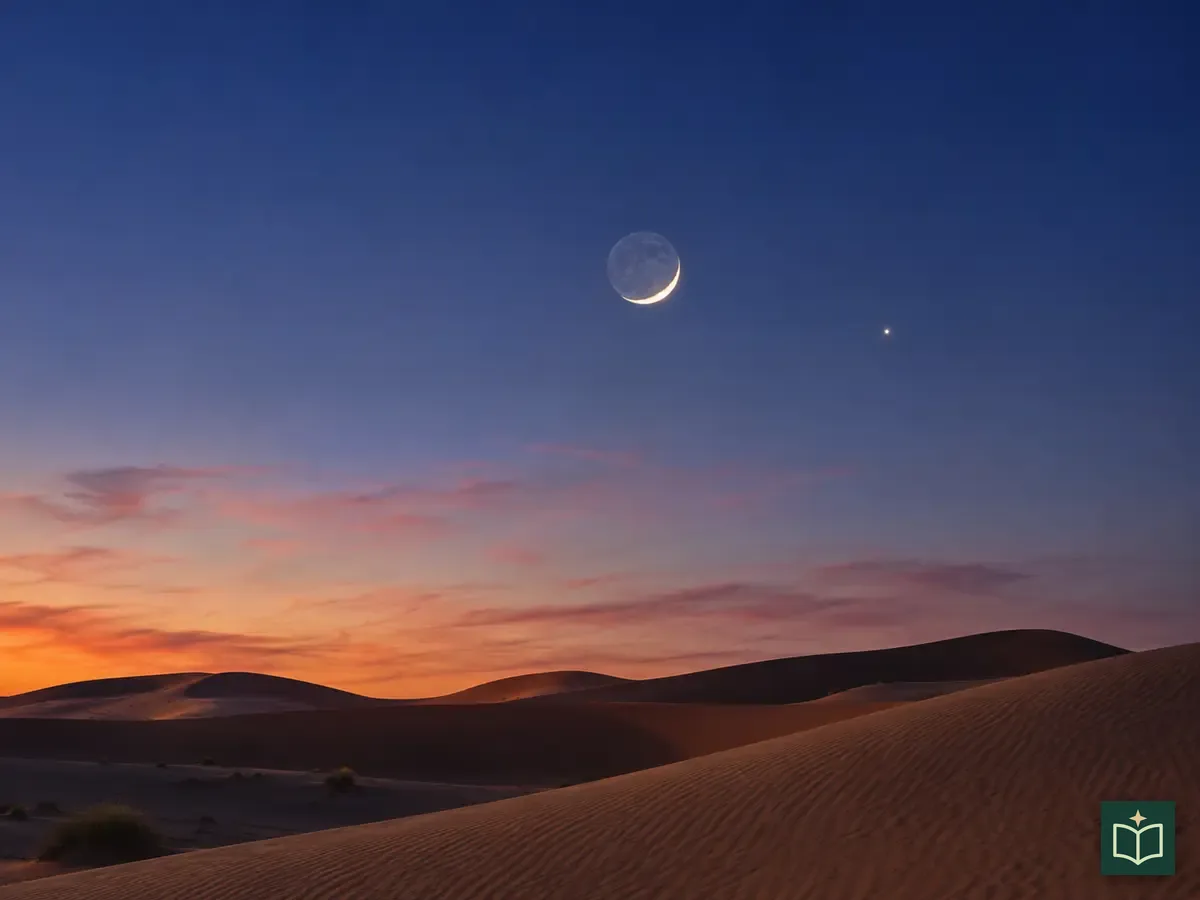
After new moon, a thin crescent appears in the western sky shortly after sunset. Night by night it grows, or waxes, becoming a first-quarter moon, half lit, about a week later. It then becomes gibbous, more than half lit, and reaches full moon after about two weeks, rising around sunset and visible all night. The sequence then reverses as the Moon wanes, through a last-quarter half moon to a thin crescent seen before dawn. The full cycle, called the synodic month, lasts about 29.5 days. That is longer than the Moon’s 27.3-day orbit relative to the stars, because Earth is also moving around the Sun.
Always the same face
The Moon rotates once on its axis in exactly the time it takes to orbit Earth. As a result, it always shows us the same face. This is called tidal locking. Over billions of years, gravitational interactions between Earth and the Moon slowed the Moon’s spin until it matched its orbital period. A common misconception is that the Moon has a permanently ‘dark side’. In fact, it receives just as much sunlight as the near side; at new moon, the far side is fully lit. It is better described as the far side, which humans first saw in photographs from a Soviet spacecraft in 1959.
Not Earth’s shadow
One of the most widespread misunderstandings is that the phases are caused by Earth’s shadow falling on the Moon. They are not. Earth’s shadow reaches the Moon only during a lunar eclipse, which can happen only at full moon and does not occur every month, because the Moon’s orbit is tilted by about five degrees relative to Earth’s. The curved boundary between light and dark on the Moon, known as the terminator, is simply the line between lunar day and night. During a thin crescent, you can sometimes see the dark part faintly glowing. This is earthshine: sunlight reflected from Earth onto the Moon and back to our eyes.
A clock for calendars
The regular cycle of phases made the Moon one of humanity’s earliest timekeepers. The Islamic Hijri calendar is purely lunar: each month begins with the first sighting of the thin crescent after new moon, and months have 29 or 30 days. Twelve lunar months total about 354 days, around 11 days shorter than the solar year, so Ramadan and Eid move earlier through the seasons each year, cycling through the whole solar calendar in roughly 33 years. In the UAE and other countries, crescent-sighting committees, increasingly supported by astronomical calculations and telescopes, confirm the start of key months. Chinese and Hebrew calendars combine lunar months with adjustments to stay aligned with the seasons.
Myths and real effects
The full moon has long been linked in folklore to strange behaviour, sleeplessness and busy hospital wards. Large studies of hospital admissions, crime and births have generally found no reliable effect of lunar phase on such outcomes, though research on sleep has produced mixed results. The Moon’s influence on the ocean is real, however. Its gravity, combined with the Sun’s, drives the tides, and the largest tidal ranges, called spring tides, occur near new and full moon, when the Sun and Moon line up. Many marine animals, including some corals and fish, time their spawning to the lunar cycle, an example of nature using the Moon as a clock.
Sources & further reading
Figures are rounded and widely published; check the linked organisations for the latest editions. These organisations do not endorse this website.