Two kinds of eclipse
An eclipse is a shadow event. In a solar eclipse, the Moon passes between the Sun and Earth, blocking some or all of the Sun’s light for observers in a particular region. It can occur only at new moon. In a lunar eclipse, Earth passes between the Sun and Moon, and Earth’s shadow falls on the Moon. It can occur only at full moon. Lunar eclipses are visible from anywhere on the night side of Earth, so many more people see them. Solar eclipses are visible only along a narrow path, which is why a total solar eclipse at any given place is a rare event.
Why not every month
If the Moon’s orbit lay in exactly the same plane as Earth’s orbit around the Sun, there would be a solar eclipse at every new moon and a lunar eclipse at every full moon. In fact, the Moon’s orbit is tilted by about five degrees. Most months, the Moon passes slightly above or below the line between Earth and Sun, and no eclipse occurs. Eclipses are possible only when new or full moon happens near the two points where the Moon’s orbit crosses Earth’s orbital plane. These windows, called eclipse seasons, come around roughly twice a year, and each produces at least one solar eclipse and often a lunar eclipse too.
A cosmic coincidence
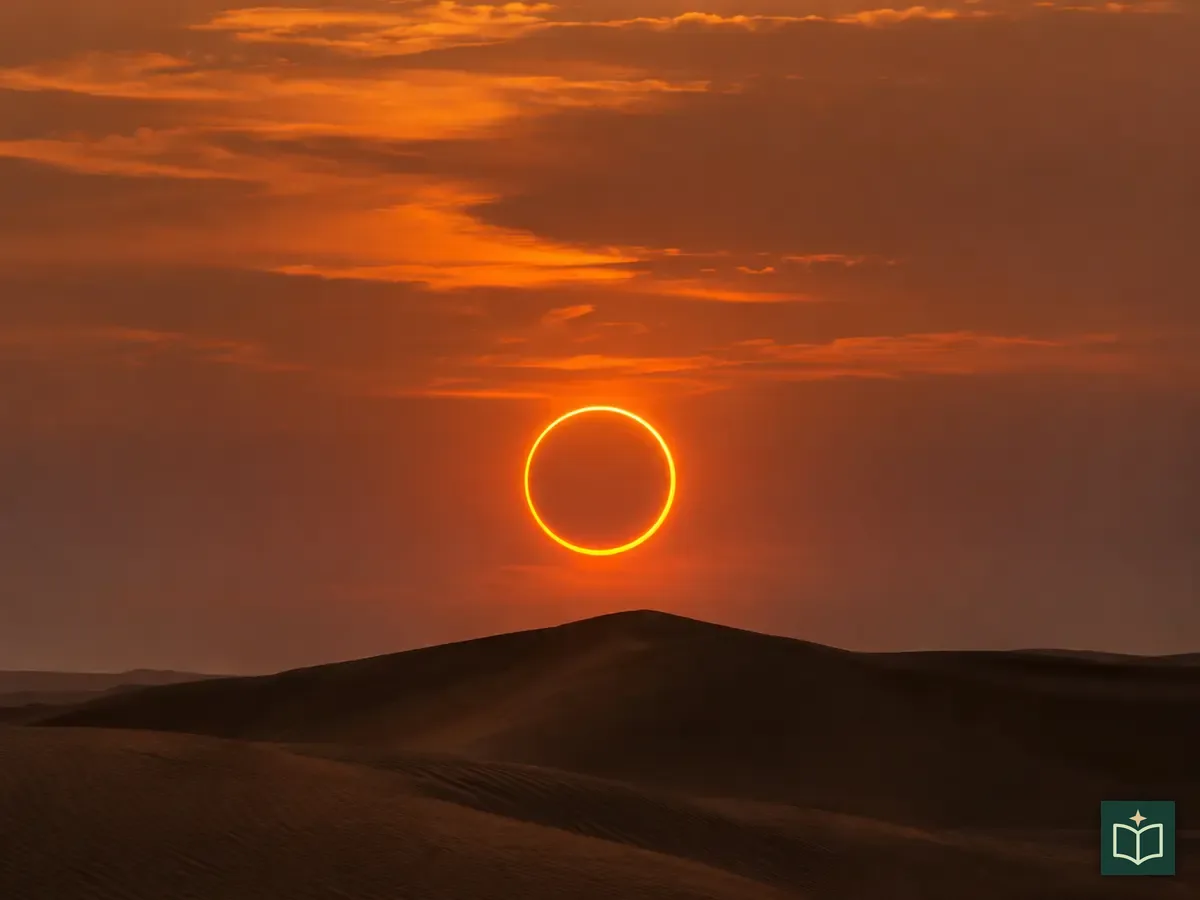
The Sun’s diameter is about 400 times that of the Moon, but it is also about 400 times further away. As a result, the two appear almost exactly the same size in our sky. This coincidence makes total solar eclipses possible: the Moon can just cover the bright disc of the Sun, revealing the faint, pearly outer atmosphere called the corona. Totality never lasts more than about seven and a half minutes at any location. Because the Moon’s orbit is elliptical, it sometimes appears slightly smaller than the Sun. Then it cannot cover the Sun completely, leaving a bright ring of sunlight. This is an annular eclipse.
Eclipses seen from the UAE
On 26 December 2019, an annular solar eclipse was visible from parts of the UAE, including the Liwa area in Abu Dhabi, where the Moon’s silhouette sat inside a ring of sunlight shortly after sunrise. Many people across the Gulf watched with certified eclipse glasses and solar filters. Lunar eclipses are more frequently visible from the region. During a total lunar eclipse, the Moon does not vanish but often turns a deep copper red. This happens because Earth’s atmosphere bends some sunlight into the shadow, and, as at sunset, it scatters away blue light first, so the light that reaches the Moon is mostly red and orange.
Safety and science
Looking directly at the Sun during a partial or annular eclipse can cause permanent eye damage, because enough intense light remains to burn the retina even when much of the Sun is covered. Ordinary sunglasses are not safe. Viewers need certified solar eclipse glasses or indirect methods such as pinhole projection. Lunar eclipses, by contrast, are completely safe to watch with the naked eye. Eclipses have also been scientifically important. Observations during the 1919 total solar eclipse measured starlight bending around the Sun and supported Einstein’s general theory of relativity. Astronomers still use eclipses to study the corona, which is otherwise hard to observe.
Predictable, and changing
Eclipses follow patterns that ancient astronomers learned to anticipate. The Saros cycle, about 18 years and 11 days, describes how similar eclipses repeat; Babylonian astronomers knew of such cycles. Today, NASA and other agencies publish eclipse predictions centuries ahead with great precision. The coincidence that allows total eclipses is also temporary. The Moon is moving away from Earth by about 3.8 centimetres a year, measured by bouncing lasers off reflectors left by Apollo astronauts. In the distant future, perhaps hundreds of millions of years from now, the Moon will appear too small to cover the Sun fully, and total solar eclipses will no longer occur.
Sources & further reading
Figures are rounded and widely published; check the linked organisations for the latest editions. These organisations do not endorse this website.