Two kinds of card
Public transport networks charge fares in two broad ways. The older approach, used by stored-value cards such as Dubai's Nol, Hong Kong's Octopus and London's Oyster, keeps the balance and recent journey details on a chip inside the card. The reader does the sums on the spot and writes the new balance back to the chip. The newer approach, called account-based ticketing, treats the card or phone simply as an identifier. Readers send the tap details to a central system, which calculates the fare later, often at the end of the day, and charges a linked account or bank card. Many cities now run both side by side.
A conversation in a fraction of a second
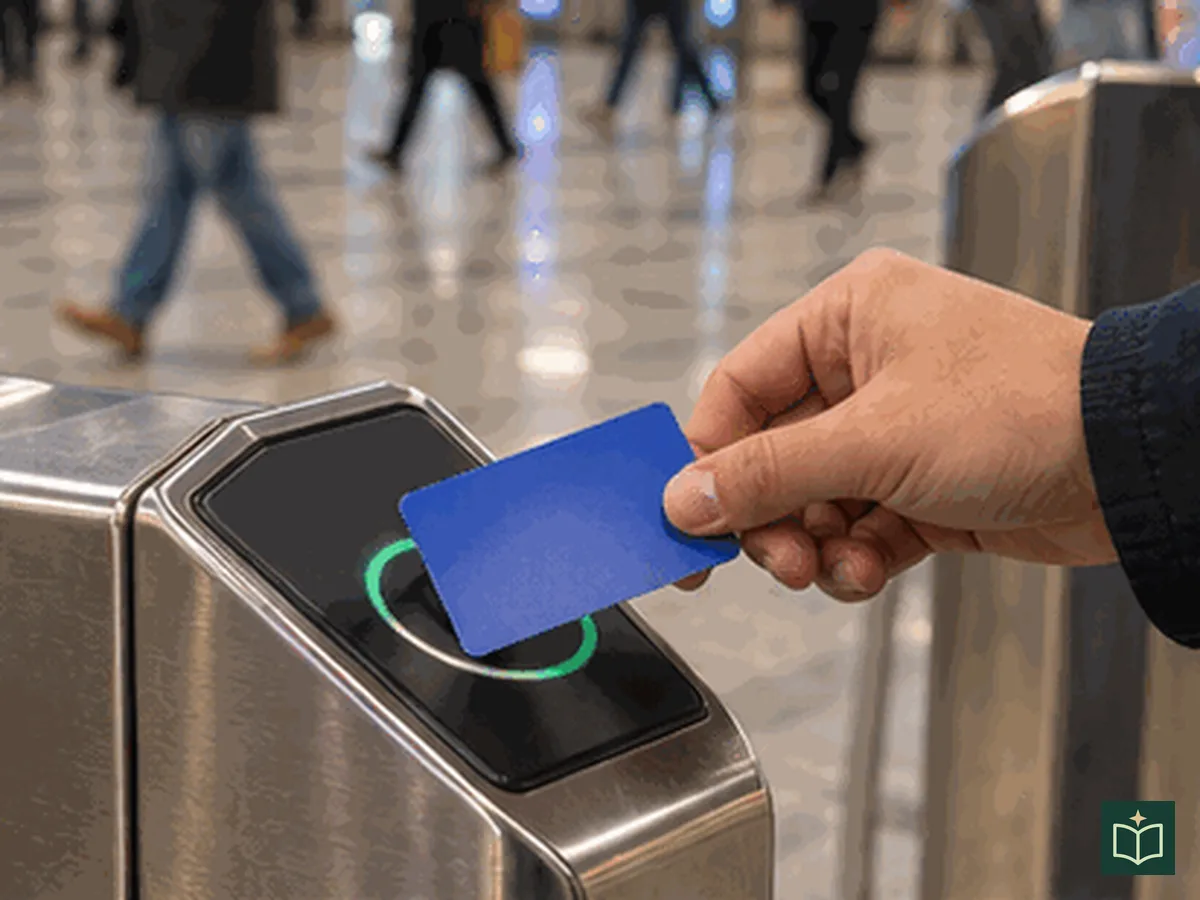
When a card touches a reader, a short-range radio link powers the chip and the two exchange encrypted messages. The reader checks that the card is genuine and not blocked, reads its balance and recent history, and writes a new record. All of this must happen quickly, typically within a few hundred milliseconds, so that queues keep moving at rush hour. Gates are designed to work even if their network connection drops: they carry lists of blocked cards and fare tables locally and upload transactions when the link returns. Removing the card too early can interrupt the write, which is why readers beep or flash only once it is complete.
How the fare is calculated
Distance-based systems divide the network into zones or measure the distance between stations. On a typical zonal system, the gate at entry records where the journey began. At exit, the reader looks up how many zones were crossed and deducts the matching fare. As an illustration, imagine fares of AED 3 for one zone, AED 5 for two and AED 7.50 for three or more. A rider with AED 20 on a card who makes a two-zone trip to work and back pays AED 10 and keeps AED 10. Bus systems may charge a flat amount at boarding, or ask riders to tap out too, so the distance can be calculated.
Forgetting to tap out
Because the fare depends on both ends of the trip, a missing exit tap creates a problem. Many systems handle it by charging a maximum fare at entry, or by deducting it if no exit is recorded within a set time, then refunding the difference when the rider taps out. Some networks require a minimum balance to enter the paid area for the same reason. Transfers are usually priced as one continuous journey if the rider changes lines or modes within a time limit. Premium classes, such as Gold Class carriages on the Dubai Metro, are charged at a higher rate, and inspectors can check cards with handheld readers on board.
Capping and bank cards
Account-based systems make it easy to offer fare capping, where riders never pay more than a daily or weekly maximum. Suppose a city set an illustrative daily cap of AED 20. A rider making four trips at AED 7.50 would otherwise pay AED 30, but the system stops charging once the cap is reached. London popularised open-loop payments, accepting ordinary contactless bank cards on buses in 2012 and on the Underground in 2014, and many cities have followed. With a bank card, the same tap that opens a gate becomes an aggregated card payment, usually settled once a day so that a dozen small fares do not create a dozen separate charges.
Privacy, data and what to watch
Every tap creates a record of where and when a card was used. Operators use this data, usually anonymised and aggregated, to plan timetables, size trains and decide where new routes are needed. Registered cards and bank cards make it possible to recover a lost balance or review journeys, but they also link travel to a person, so data protection rules govern how long records are kept. The direction of travel is towards phones and watches as tickets, and towards systems that integrate metro, bus, taxi and parking payments in one account. The underlying logic remains a simple pair of questions: where did the trip start, and where did it end?
Sources & further reading
Figures are rounded and widely published; check the linked organisations for the latest editions. These organisations do not endorse this website.