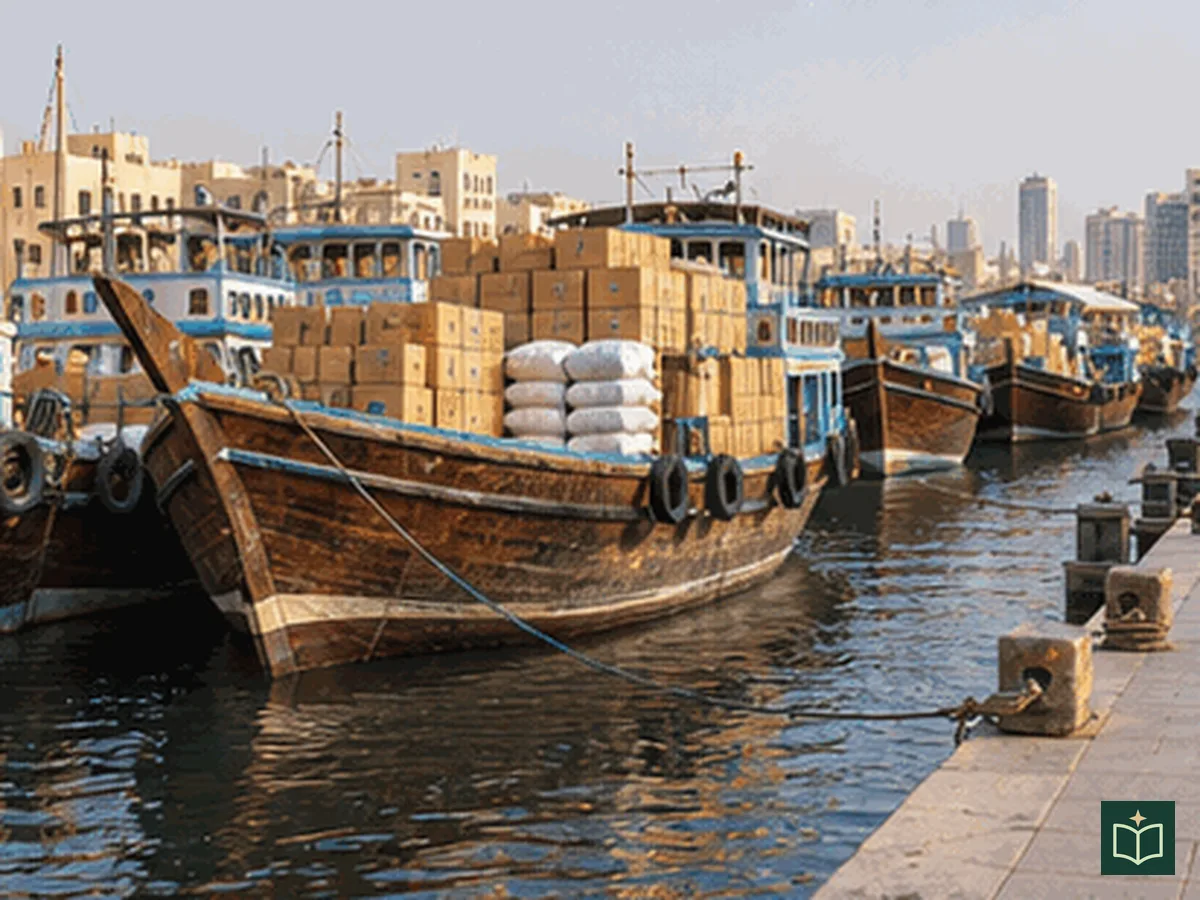
A familiar sight on the Creek
Along the Deira side of Dubai Creek, wooden ships still line the wharves, their decks stacked with fridges, tyres, mattresses, sacks of rice and even cars. These are dhows, a family of traditional sailing vessels that have traded around the Arabian Sea and the western Indian Ocean for many centuries. Today most run on diesel engines rather than sails, and their crews use GPS and mobile phones, but the hulls are still built largely of timber, often in yards on the western coast of India. They sail to ports in Iran, Somalia, Yemen, Sudan, Pakistan and India, linking the Gulf's trading hubs to smaller markets around the region.
Riding the monsoon
The trade was built on the monsoon. For much of the year, the winds of the Arabian Sea blow in predictable seasonal directions. Sailors learned to ride the northeast monsoon towards East Africa in winter and return with the southwest monsoon in summer, carrying dates, cloth and spices one way and timber, ivory and other goods the other. Ports such as Muscat, Sur, Kuwait and the towns of the Gulf coast grew rich on this exchange, which also spread languages, religion and families across the ocean. Different types of dhow, such as the boom, the sambuk and the larger baghlah, were designed for particular routes and cargoes.
What fills a dhow today
Modern dhow cargo reflects what regional markets need and what the Gulf's re-export trade offers. Dhows leave Dubai with electronics, building materials, spare parts, tyres, food staples and household goods, often bought in small lots by individual traders. They return with livestock, fruit, vegetables, fish and other local produce. A large dhow can carry several hundred tonnes. As a rough comparison, a 500-tonne load equals about 20 fully laden containers if each holds around 25 tonnes. That is tiny next to a modern container ship carrying thousands of boxes, but it is a sensible size for a trader shipping goods to a small harbour with no cranes.
Why the trade survives
Container shipping dominates world trade, so the persistence of dhows can seem surprising. The reasons are practical. Many destination ports lack the deep water and cranes needed for container vessels, while a dhow can berth at a simple quay or anchor offshore and unload into smaller boats. Dhows accept mixed, small and oddly shaped cargoes without packing them into boxes. Costs are low, schedules are flexible and much of the trade runs through networks of family firms, agents and long-standing credit arrangements built on trust. For some destinations affected by conflict or weak infrastructure, dhows have at times been one of the few dependable links for goods.
Risks and regulation
The trade is not without problems. Wooden vessels are vulnerable in heavy seas, and overloaded dhows have sunk or caught fire, sometimes with loss of life. Crews often work long voyages in tough conditions. Authorities require registration, inspections, customs declarations and cargo manifests, and they monitor dhow traffic for smuggling. Ports have tightened safety rules on fire extinguishers, life jackets and loading limits. Dubai has invested in organised wharfage for traditional vessels while gradually moving some activity away from crowded city centres. The challenge is to keep a valuable, low-cost trade alive while bringing safety, documentation and conditions closer to modern maritime standards.
More than nostalgia
Dhows are part of Gulf heritage, celebrated in museums, festivals and races of traditional sailing boats. But the working dhows on the Creek are not a tourist display. They show that global trade is not only a matter of giant ships and automated terminals. Regional, small-scale shipping still matters to traders in smaller ports and to the communities they supply. The skills of building and sailing dhows have also been passed down through generations, with some shipyards in India and the Gulf still building them by eye rather than from drawings. Watching a dhow load by hand offers a glimpse of how trade worked for centuries, and still does.
Sources & further reading
Figures are rounded and widely published; check the linked organisations for the latest editions. These organisations do not endorse this website.