Smoke is the main danger
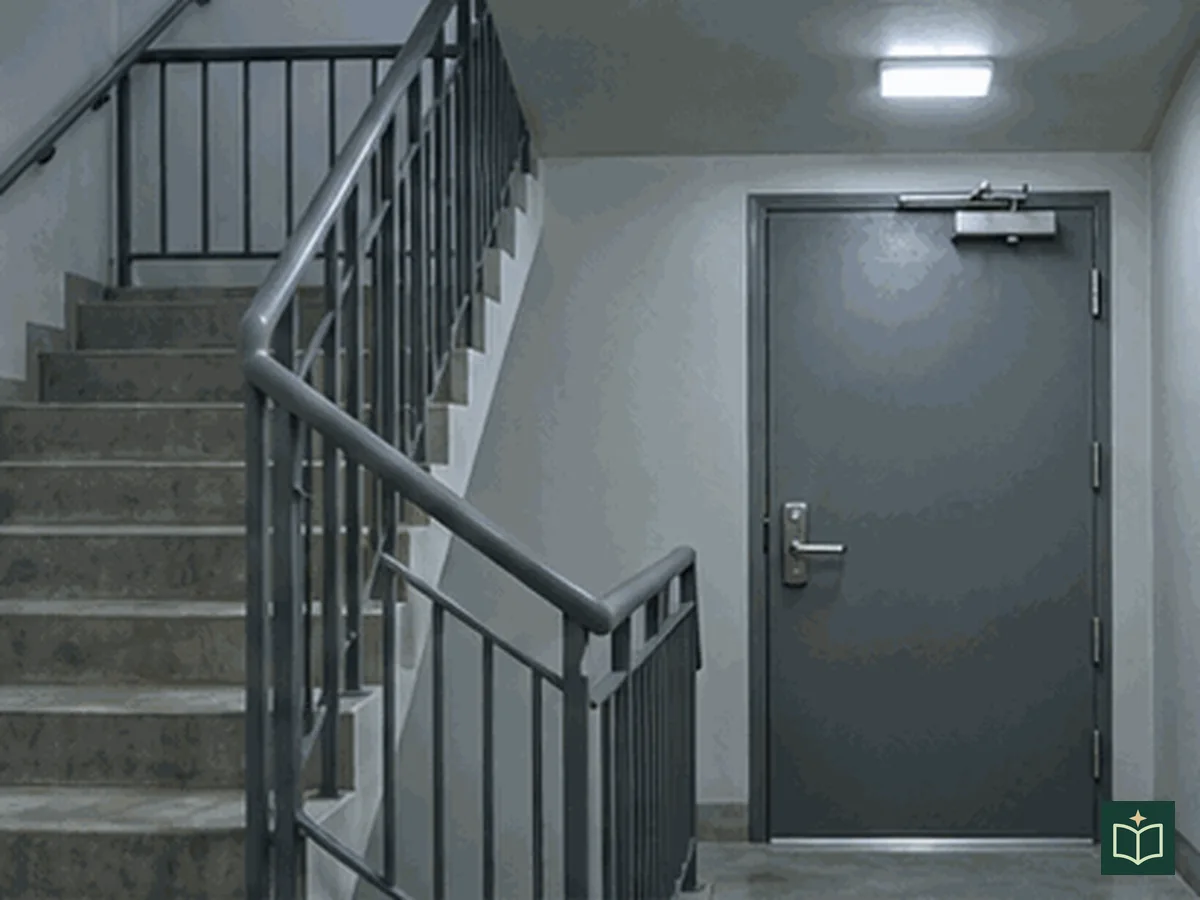
In most building fires, smoke harms more people than flames. Hot smoke rises quickly, carrying toxic gases such as carbon monoxide, and it can fill a corridor in minutes, making it impossible to see the way out. In a tall building, evacuation can take a long time, because people must walk down many flights and some may need help. Fire engineers therefore aim to keep at least one protected route usable throughout. The stairs in a modern tower are not just a convenience: they are an engineered shaft designed to resist fire, keep out smoke and lead directly to a safe exit at ground level, sometimes for an hour or more.
Compartments and fire doors
The first line of defence is compartmentation. Floors and walls are built from materials that resist fire for a set period, often 60, 90 or 120 minutes, so a fire is contained in the space where it starts. Openings for pipes and cables are sealed with fire-stopping materials. The stairwell itself is a protected enclosure, separated from each floor by fire doors that close automatically. These doors have seals that swell in heat to block gaps, and closers that pull them shut after someone passes through. Wedging a fire door open, a common habit in offices and residential corridors, can defeat this protection and let smoke into the stairs.
How pressurisation works
Doors are never perfectly airtight, and they are opened during an evacuation. To deal with this, many tall buildings use stair pressurisation. When the fire alarm activates, fans, often on the roof or at the base of the shaft, blow outside air into the stairwell. This raises the air pressure inside the stairs slightly above that of the floors. Because air flows from higher to lower pressure, any leakage through door gaps runs outwards, away from the stairs, carrying smoke with it. When a door is opened, the system increases airflow so that fresh air rushes out through the doorway, holding back smoke that would otherwise drift in.
Getting the pressure right
The pressure difference is small, typically around 50 pascals, which is about 0.05 per cent of normal atmospheric pressure. Too little and smoke can push past; too much and people cannot open the door. On a door 2.1 metres tall and 0.9 metres wide, a 50-pascal difference creates about 95 newtons of force across its surface. Because the handle is near the far edge from the hinge, the extra force needed at the handle is roughly 52 newtons, before the closer's own resistance is added. Building codes cap the total opening force so that children and older people can still open the door, and relief vents release excess pressure.
The rest of the system
Pressurised stairs work alongside other measures. Sprinklers control or extinguish many fires before smoke becomes severe. Smoke extraction fans or vents on the fire floor release hot gases so they do not build up and push against the stairs. Lifts are usually recalled to the ground floor, while firefighting lifts and lobbies give fire crews protected access. Emergency lighting and signs guide people along the route. In the UAE, the national Fire and Life Safety Code sets requirements for these systems in high-rise buildings, and civil defence authorities inspect them. Each system depends on the others, so a failure in one can weaken the whole design.
Keeping it working
Pressurisation fans may sit idle for years, so regular testing is essential. Maintenance teams check that fans start when the alarm triggers, that pressure sensors respond, that relief vents open and that doors close and latch properly. Measured door-opening forces and airflows are compared with design values. Common failures include fire doors propped open, damaged seals, blocked vents and alterations that create new leaks, such as holes cut for cables. For occupants, the lessons are simple: keep fire doors closed, never store items in stairwells, learn the route to the nearest protected stair and, in an evacuation, use the stairs rather than ordinary lifts unless told otherwise.
Sources & further reading
Figures are rounded and widely published; check the linked organisations for the latest editions. These organisations do not endorse this website.