A moving loop
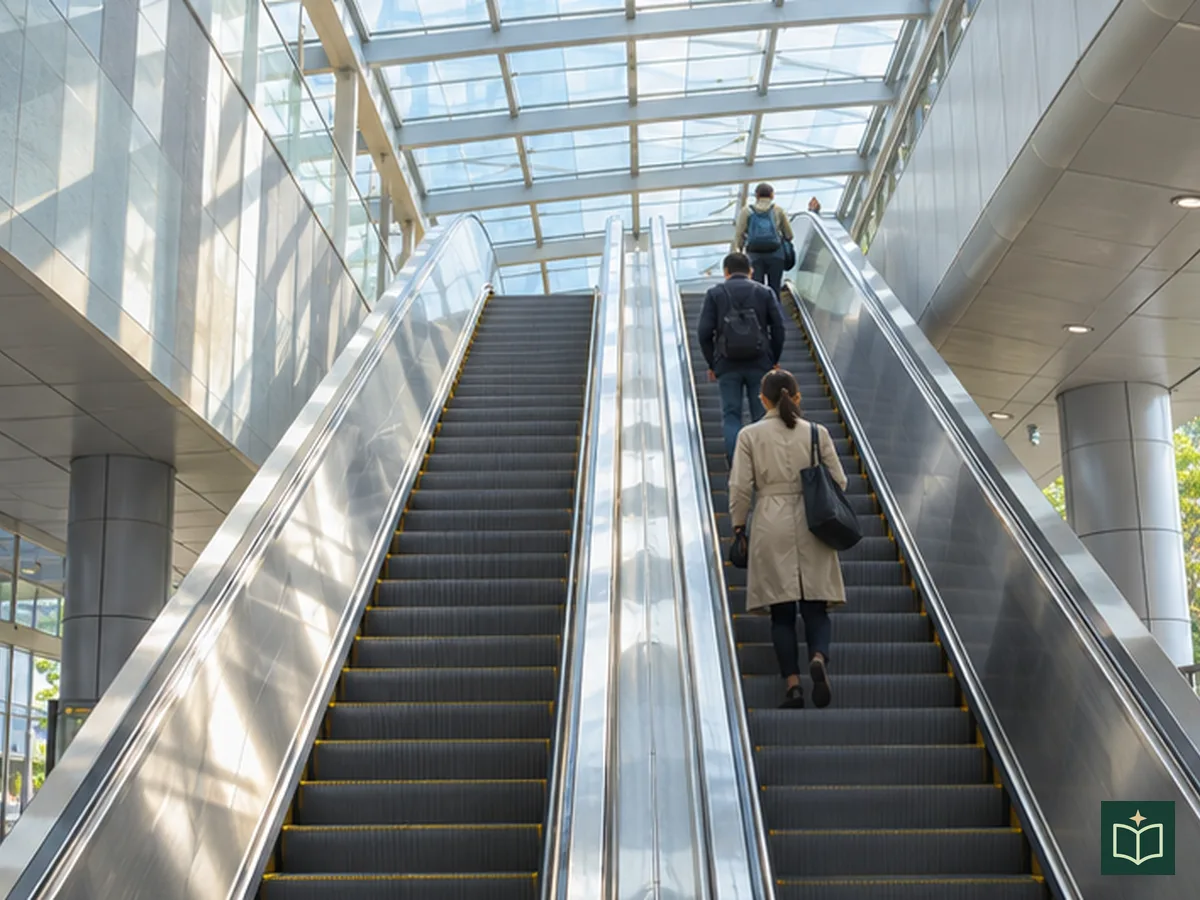
An escalator looks like a staircase, but it works like a conveyor belt. A steel frame called the truss spans from one floor to the next and holds everything. Inside, a continuous loop of steps is linked to two step chains, one on each side. At the top, an electric motor turns a drive shaft with large sprockets that pull the chains, so the steps travel up the visible side and return, upside down, along the underside of the truss. Another set of sprockets at the bottom guides the loop round. Because the loop is closed, the same machine can run up or down simply by reversing the motor.
How steps stay level
The clever part is keeping each step level while the loop changes direction. Every step has two pairs of wheels. The front wheels, attached to the chain, run on one track; the rear wheels, called trailer wheels, run on a second track. Along the incline, the two tracks are set apart vertically, so the rear of each step is held higher or lower than the front by exactly the right amount to keep the tread horizontal and form a stair. Near the top and bottom, the tracks come together, the steps line up at the same height and flatten into a moving platform that lets passengers step on and off safely.
Combs, handrails and skirts
At each landing the step treads, which are grooved, pass beneath a comb plate whose teeth mesh with the grooves. This lifts shoes and objects off the steps instead of letting them be drawn into the gap. Moving handrails run alongside, driven from the same machinery so they keep pace with the steps; a handrail that falls behind would pull riders off balance. The panels beside the steps, called skirts, often carry brushes that discourage feet and loose clothing from touching the narrow gap between step and side. Yellow lines painted on step edges mark where one step ends and the next begins, which helps riders place their feet.
A worked ride
Consider an illustrative escalator connecting two floors 6 metres apart at the common angle of 30 degrees. The length of the incline is the height divided by the sine of 30 degrees, which is 12 metres. At 0.5 metres a second, standing passengers take about 24 seconds to reach the top, plus the flat landing sections. Steps are roughly 0.4 metres deep, so at that speed about 1.25 steps pass each point every second, or 4,500 steps an hour. Even with only one person on each step, the escalator can carry thousands of people an hour, far more than a lift serving the same two floors.
Built-in safety
Modern escalators carry a ring of safety devices that cut power and apply the brake. Switches detect if the comb plate is pushed by a trapped object, if something is drawn into the handrail entry, if a step is missing or sagging, or if a chain breaks or stretches. Speed monitors stop the machine if it runs too fast or begins to reverse unexpectedly, a key protection on loaded escalators heading upward. Red emergency stop buttons sit at the top and bottom for anyone to press. Most accidents involve falls, often while carrying bags, pushing buggies or looking at phones, so holding the handrail remains the simplest advice.
From fairground ride to transit
The escalator began as a novelty. An inclined moving ramp was demonstrated at Coney Island in New York in the 1890s, and the stepped design was developed around the turn of the twentieth century. The word escalator was once a trademark, but became a generic term after a court ruled so in 1950. Today escalators move enormous crowds through metro stations, airports and shopping malls, including the busy stations of Dubai's metro. Many now slow down or pause when nobody is riding, saving energy. Standing on one side and walking on the other is a local custom rather than a rule, and some transport operators have questioned it.
Sources & further reading
Figures are rounded and widely published; check the linked organisations for the latest editions. These organisations do not endorse this website.