Why preserve the body?
Ancient Egyptians believed a person was made of several parts. Two of the most important were the ka, a life force, and the ba, often shown as a bird with a human head, which could travel between the tomb and the world of the living. Both needed a recognisable body to return to. If the body decayed, the person’s existence in the afterlife was at risk. Early Egyptians buried their dead in the hot, dry sand, which sometimes preserved them naturally. As tombs became more elaborate and bodies were placed in coffins away from the sand, they began to rot, and deliberate preservation developed, reaching its most refined form in the New Kingdom.
Washing and removing the brain
Embalming was carried out by specialist priests, close to the desert edge and away from homes. The body was first washed, often with water from the Nile mixed with natron. In many mummies of the New Kingdom and later, embalmers broke through the thin bone at the back of the nose and used long hooks and probes to remove the brain, which liquefies quickly after death. They then poured in resin. The brain was simply discarded, because Egyptians did not think it important; they believed the heart was the seat of thought and feeling. Not every mummy had its brain removed, and practice varied considerably over the centuries.
The organs and the heart
Next, an embalmer cut an opening, usually on the left side of the abdomen, and removed the intestines, stomach, liver and lungs, the parts that decay fastest. These organs were dried separately and often stored in four canopic jars, each protected by one of the four sons of the god Horus: Imsety guarded the liver, Hapy the lungs, Duamutef the stomach and Qebehsenuef the intestines. In some later periods the organs were wrapped and returned to the body instead. The heart was normally left in place, because it was needed in the judgement of the dead, when it was weighed against the feather of truth, Maat.
Forty days in natron
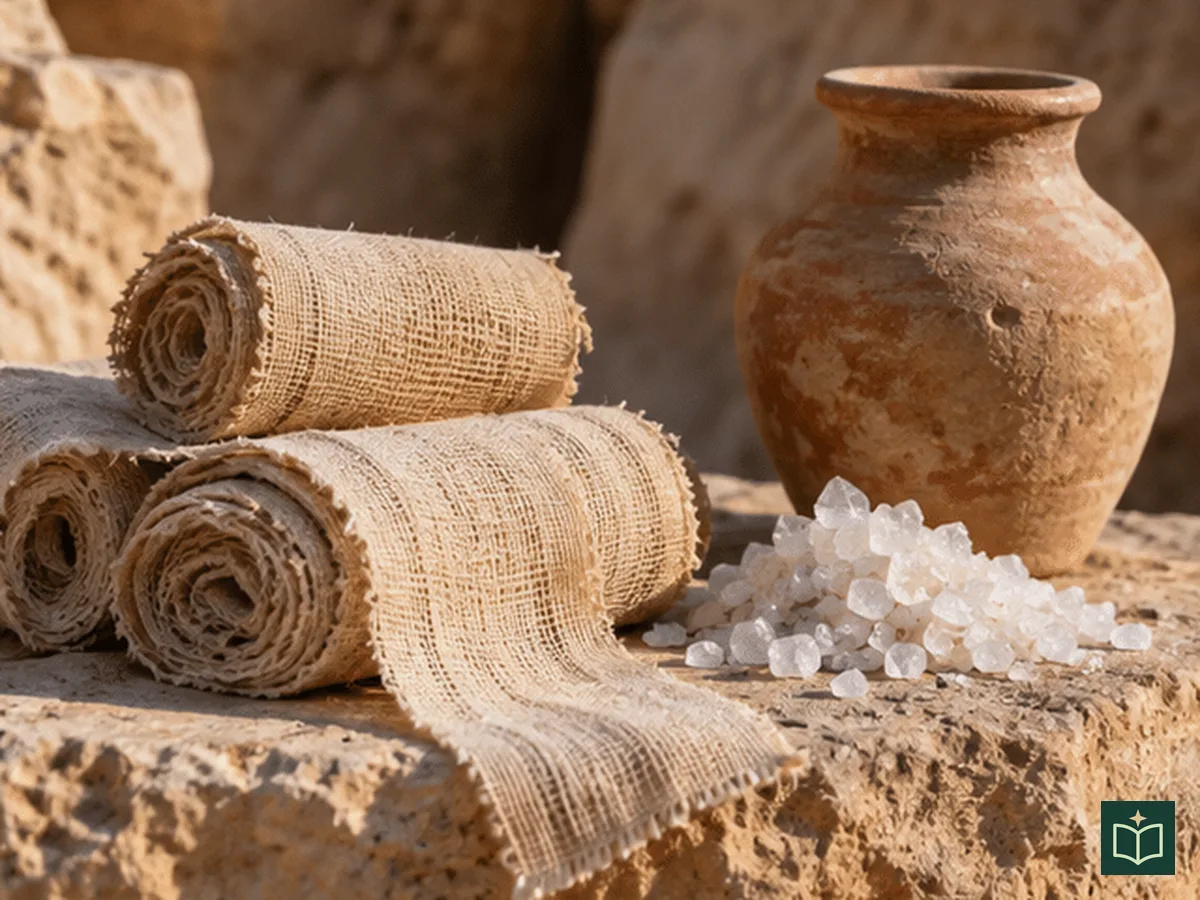
The key step was drying. Natron is a naturally occurring mixture of salts, mainly sodium carbonate and sodium bicarbonate, collected from dry lake beds such as the Wadi Natrun, west of the Nile Delta. Embalmers packed the empty body cavity with bags of natron and covered the body with it, leaving it for about 40 days. Natron draws out water and creates an environment in which bacteria cannot thrive. By the end, the body was dark, shrunken and light. Embalmers then removed the natron and stuffed the body with linen, sawdust, lichen or other materials so that it regained a more lifelike shape.
Oils, resin and linen
The remaining time, around 30 days, went largely on anointing and wrapping. Embalmers rubbed the skin with oils, beeswax and plant resins, which helped to keep it supple and repel insects, and often poured molten resin over the body. Then came the wrapping, which used many layers of linen, sometimes hundreds of square metres for a single high-status burial. Priests placed amulets among the layers, including a heart scarab over the chest, and recited spells as they worked. A mask could be placed over the head before the body went into its coffin. Finally, at the tomb, priests performed the Opening of the Mouth ritual to restore the senses.
Myths and what mummies teach us
Many popular ideas about mummies are misleading. Embalmers rarely used bitumen, despite the word mummy coming, via Arabic, from a Persian word for that substance. Mummification was also expensive; Herodotus describes three price levels, and poorer people often received simpler treatment. Egyptians mummified animals too, in vast numbers, from pet cats and dogs to sacred ibises and crocodiles offered to gods. Today researchers study mummies with CT scanning and DNA analysis rather than unwrapping them. These methods reveal age, diet, diseases such as arthritis and tuberculosis, and family relationships, making mummies a rich, if fragile, record of ancient Egyptian lives.
Sources & further reading
Figures are rounded and widely published; check the linked organisations for the latest editions. These organisations do not endorse this website.