A village in the desert
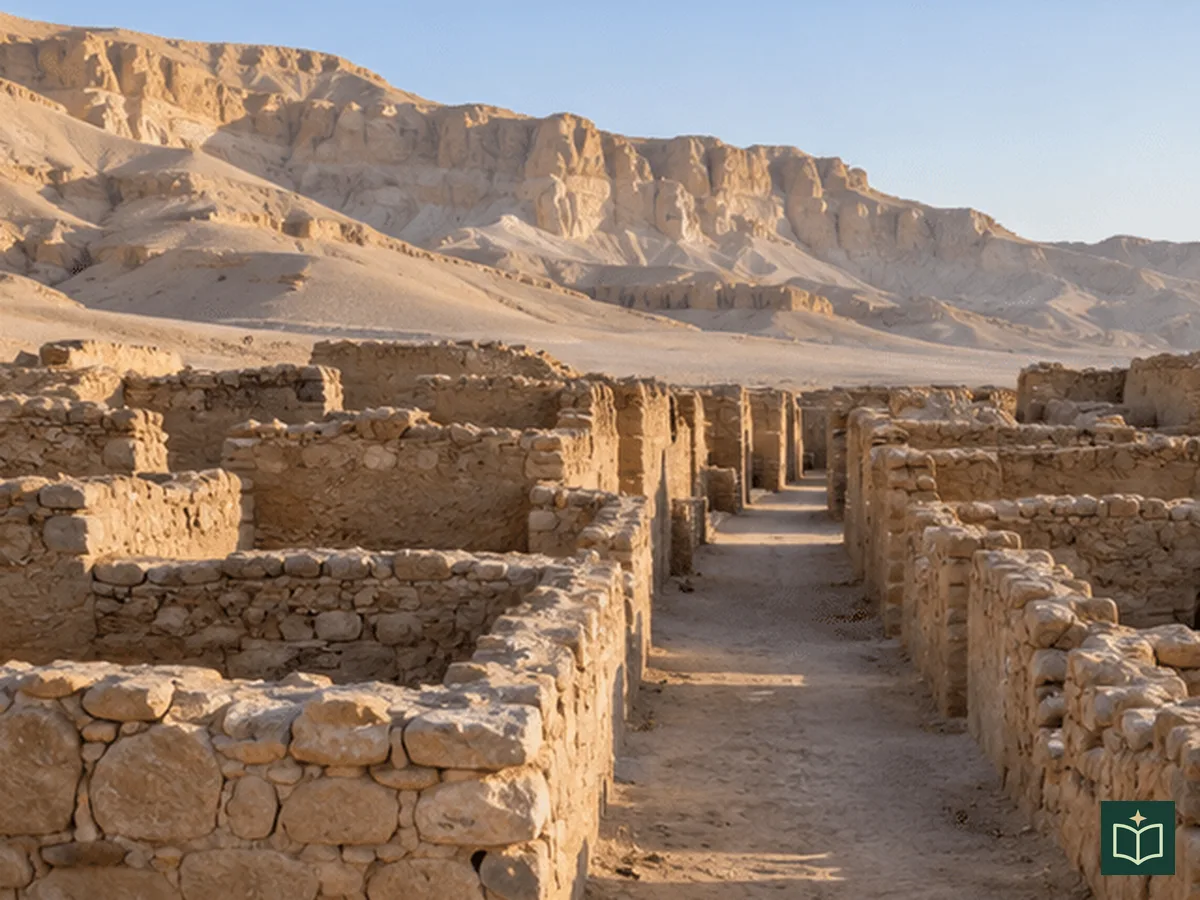
Deir el-Medina lies in a small, dry valley on the west bank of the Nile, opposite modern Luxor, the ancient city of Thebes. It was home to the workmen who cut and decorated the royal tombs of the Valley of the Kings and the Valley of the Queens during the New Kingdom, from about 1550 to 1070 BC. At its height the walled village held around 70 houses lining a single main street, with more homes outside the walls. The Egyptians called the workforce the “servants in the Place of Truth”. Because the community was literate, isolated and continuously occupied for centuries, it left an exceptionally rich record.
How the work was organised
The workforce, known as the gang, was divided into two sides, left and right, like the crew of a boat, each led by a foreman and his deputy. A scribe recorded progress and supplies. Numbers varied, from a few dozen men to around 120 at the busiest times. The Egyptian week was ten days long, and workers typically spent eight days at the tomb, sleeping in simple stone huts on a ridge above the valley, before returning home for rest days and festivals. Inside the tomb, quarrymen cut the corridors, plasterers smoothed the walls, and draughtsmen and painters added the texts and images that would guide the king into the afterlife.
Paid in grain
Egypt had no coins at this time, so wages were paid in kind. Each month, the state delivered rations of emmer wheat, for bread, and barley, for beer. Records suggest an ordinary workman received about four sacks of emmer and one and a half of barley each month, with foremen and scribes receiving more. That was enough to feed a family and have some left over to trade. The state also supplied water, fish, vegetables, firewood and pottery, carried up by a team of support workers. Copper chisels were issued and weighed back in, because metal was valuable, and scribes noted when tools needed repair.
Absent: brewing beer
Much of what we know comes from ostraca, flakes of limestone and broken pottery used as cheap notepaper. Thousands have been found at the site, many from a huge pit dug near the village. A famous register in the British Museum, from year 40 of Ramesses II, lists workmen’s absences and the reasons for them. Excuses include being ill, having eye trouble, being stung by a scorpion, embalming a brother, brewing beer, and attending to a wife or daughter during menstruation. Other ostraca record loans, sales of coffins and donkeys, love poems, school exercises, letters and sketches. Together they show ordinary working lives in remarkable detail.
The first recorded strike
Late in the reign of Ramesses III, Egypt faced economic strain and the delivery of rations began to slip. In his year 29, around 1157 BC, the workmen, unpaid for weeks, laid down their tools. A papyrus now in Turin records how they walked out and sat behind royal temples on the west bank, declaring that they were hungry. Officials eventually brought grain, but the problem recurred, and the strikes were repeated. This is the earliest well-documented labour strike in history. Village records also reveal disputes that went to the local court, as well as tomb-robbery investigations in later decades when royal authority weakened.
Their own tombs, and an end
The workers used their skills for themselves too. On the hillside above the village they carved family tombs with small pyramids and painted burial chambers. The tomb of Sennedjem, with its bright scenes of farming in the afterlife, is one of the best preserved in Egypt. When the royal tombs moved north to Tanis at the end of the New Kingdom, around 1070 BC, the village was abandoned. The French archaeologist Bernard Bruyère excavated it from the 1920s to the 1950s. Deir el-Medina is part of UNESCO’s Ancient Thebes World Heritage Site and shows that Egypt’s monuments were built by paid, skilled and outspoken craftsmen.
Sources & further reading
Figures are rounded and widely published; check the linked organisations for the latest editions. These organisations do not endorse this website.