Reflecting, not glowing
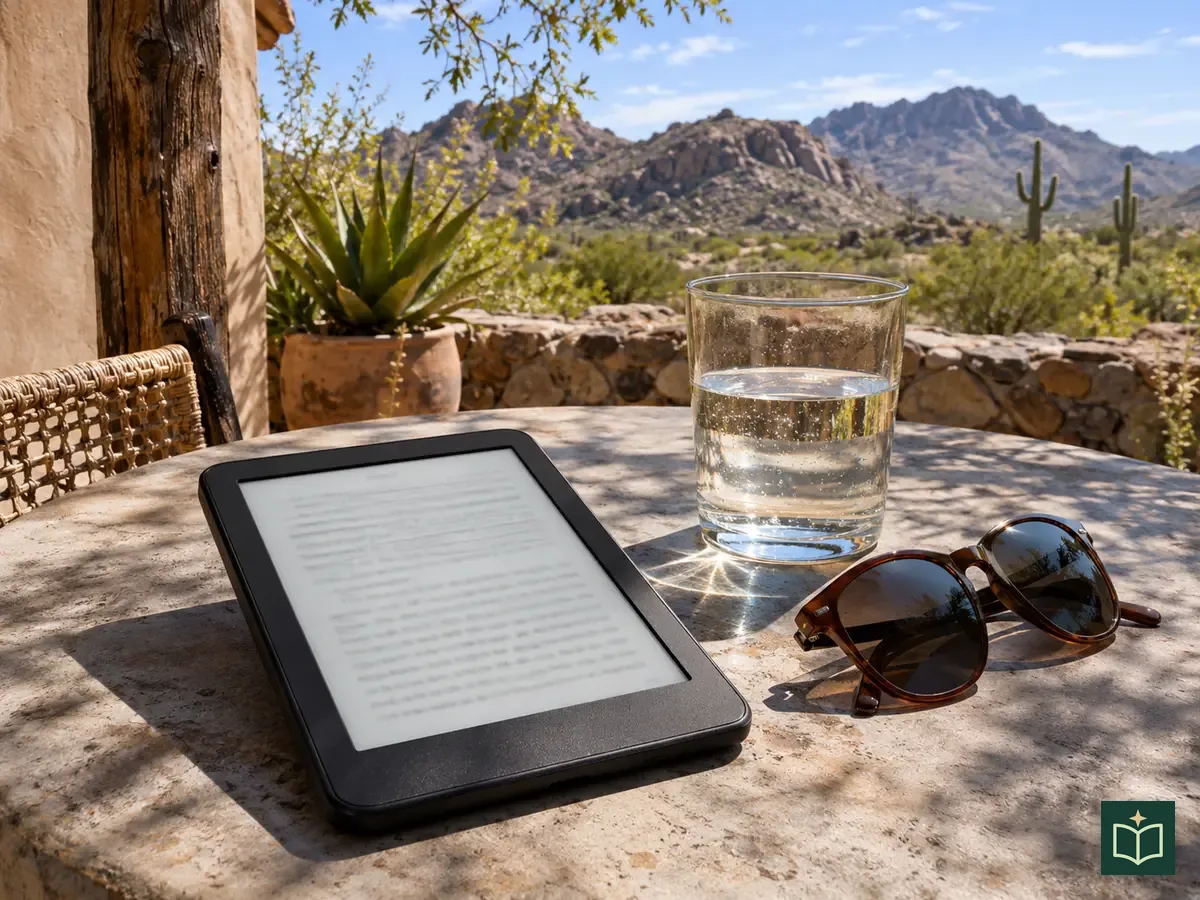
Most screens produce their own light, from a backlight or glowing pixels. Electronic paper works differently: like printed paper, it reflects the light around it. That is why it remains readable in bright sunshine, when a phone screen can wash out, and why many readers find it comfortable for long sessions. The best-known type, used in e-book readers, was developed from research at the Massachusetts Institute of Technology's Media Lab in the late 1990s. Its appeal lies in two properties that conventional displays cannot easily match: a paper-like look, and almost no power use while an image remains unchanged on the screen.
Particles that move
The common form is called an electrophoretic display. Beneath a clear surface lie millions of microscopic capsules or cups, each about the width of a human hair, filled with a clear fluid. Inside float tiny white particles carrying one electric charge and black particles carrying the opposite charge. Electrodes behind each pixel apply a voltage. One polarity pulls the white particles to the top, so the pixel looks white; reverse it and the black particles rise instead. Intermediate patterns create shades of grey. Because the particles are pigment, much like ink, the result has the matte, uniform look of print.
An image without power
The particles stay where they are once moved, a property called bistability. A page of text therefore remains visible indefinitely with no electricity at all, and power is consumed only when the image changes. That is why an e-reader can last weeks on one charge, and why electronic shelf labels in supermarkets can run for years on small batteries while prices are updated wirelessly. E-paper signs at bus and tram stops can be powered by small solar panels. Some e-readers add a front light that shines gently across the surface for reading in the dark, which uses extra power, but far less than a backlit screen.
The trade-offs
Moving physical particles through fluid takes time, so e-paper refreshes far more slowly than an LCD or OLED. Turning a page takes a fraction of a second, and video is impractical. To clear faint ghost images left by previous pages, displays periodically flash black and white, the familiar blink of an e-reader. Colour is harder still. Some designs place a colour filter over a black-and-white layer, which dims the image; others use particles of several colours, which give richer colour but update even more slowly. Performance also suffers in cold temperatures, when the fluid thickens, and very high heat can affect the materials.
Where it is used
E-paper suits jobs where content changes occasionally and visibility and battery life matter more than speed. Beyond e-readers, it appears in electronic shelf labels, conference badges, airport and transport information signs, warehouse tags, some smartwatches and writing tablets that mimic a paper notebook. Its strong sunlight readability is an advantage in bright climates such as the Gulf, where outdoor screens must compete with intense glare, although high temperatures require careful design. Because it draws little power, it can also reduce the energy use of signs that would otherwise be lit around the clock, a useful saving across thousands of displays.
Myths and perspective
E-paper is sometimes described as completely harmless to the eyes while other screens are harmful. The comfort difference is real for many people, largely because there is no glare-prone glowing surface, but sensible habits, such as breaks and good lighting, still matter, and persistent eye discomfort deserves professional advice. E-paper is also not a replacement for conventional screens: it cannot play video smoothly and its colour remains muted. Instead, it fills a niche that suits it well. Its story shows that the 'best' display technology depends on the task, and that a slow screen can sometimes be exactly the right one.
Sources & further reading
Figures are rounded and widely published; check the linked organisations for the latest editions. These organisations do not endorse this website.