Two pieces, not three
Older food cans were often made from three parts: a flat sheet rolled into a tube and seamed down the side, plus a top and a bottom. Most drinks cans today are two-piece. The body, including the base, is formed from a single disc of aluminium alloy, and only the lid is added after filling. This design uses less metal, has no side seam to leak and is easier to print on. Aluminium suits it because it is light, does not rust, is easy to shape and can be recycled repeatedly without losing quality. The lid uses a slightly stronger alloy than the body to hold the ring-pull.
From coil to cup
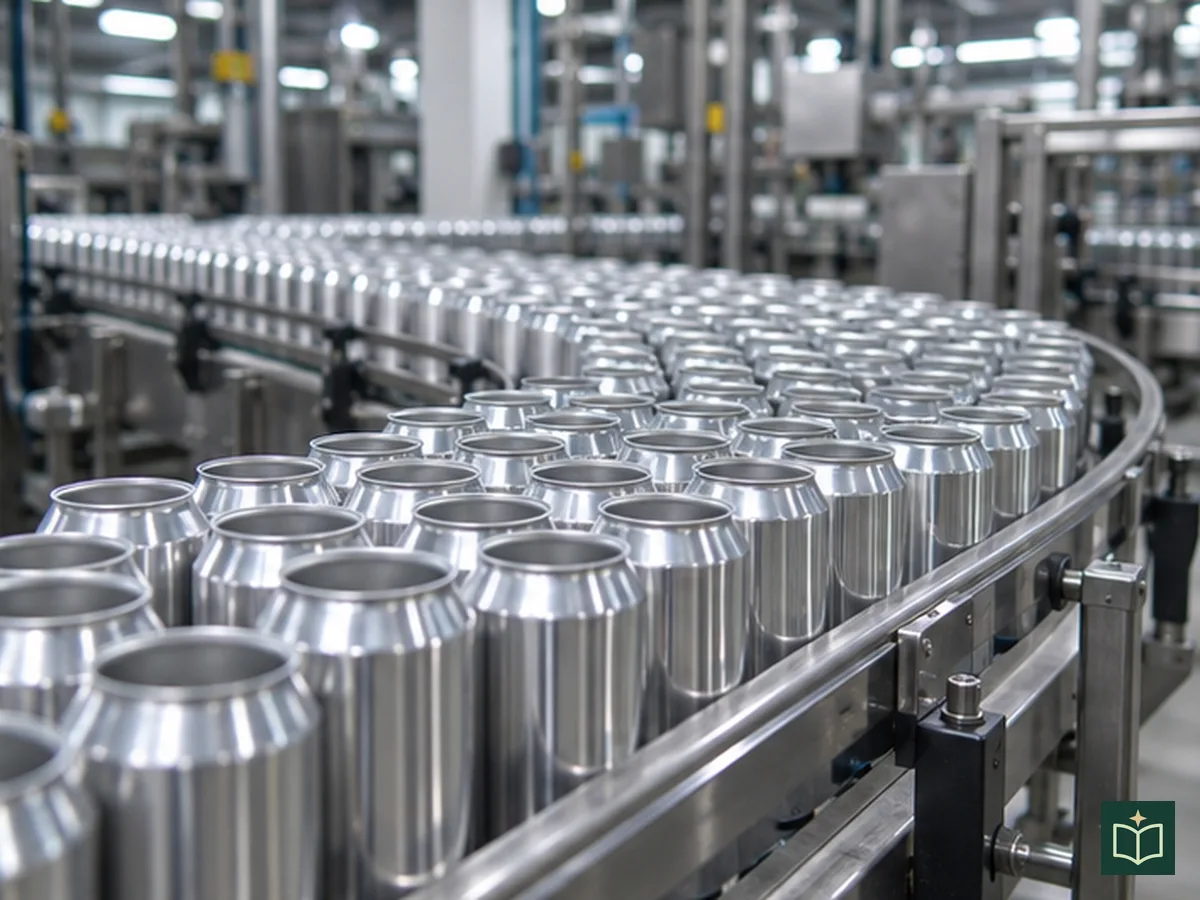
The process begins with a huge coil of thin aluminium sheet, lightly lubricated and fed into a cupping press. The press punches out discs and, in the same stroke, draws each one into a shallow cup, a little like pressing pastry into a tin. Many cups are made per stroke. The leftover sheet between the circles is collected and recycled. At this stage the cup is wider and much shorter than a finished can, and its walls are still about as thick as the original sheet. Cups then travel by conveyor to the bodymakers, the machines that turn them into the familiar tall cylinder.
Drawing and ironing
In the bodymaker a punch pushes each cup through a series of tight rings. The first redraws it to a narrower diameter; the following ironing rings squeeze the walls so the metal flows upward, making the can taller while thinning the sides to around a tenth of a millimetre. At the end of the stroke the punch presses the base against a shaped tool to form the inward dome, which helps it resist the pressure of a carbonated drink. The whole action takes a fraction of a second. The top edge comes out ragged, so a trimmer cuts every can to exactly the same height before washing removes the lubricant.
Printing and lining
Clean cans are coated on the outside and then decorated. In a printing machine each can spins on a mandrel against a blanket carrying all the colours of the design at once, so a full label is applied in a single rotation. Ovens cure the ink. Inside, a thin protective lining is sprayed on so the drink never touches bare metal, which matters for acidic colas and juices. Next the necking machines squeeze the top of the can inward in several small steps, reducing its diameter so a smaller, cheaper lid can be fitted, and a flange is formed to receive it. Every can is tested for pinhole leaks with light.
Filling at full speed
Empty cans are shipped to a bottling plant, often on large pallets, open end down. There they are rinsed, filled from a rotary filler and sealed almost immediately to limit contact with air. For fizzy drinks the liquid is cold and carbonated, and the dissolved gas pressurises the can once it is closed. A seamer folds the lid's edge and the can's flange together into a tight double seam, the joint that keeps the drink in. Modern can lines can form and fill well over a thousand cans a minute. Filled cans are date-coded, checked for fill level and packed for distribution, many to hot markets such as the Gulf.
Strength, weight and recycling
An empty can crushes easily in the hand, yet a sealed fizzy drink can is surprisingly stiff. The internal pressure pushes outward on the thin walls, and the domed base and necked top add shape strength, so a pallet of filled cans can be stacked high. Engineers have spent decades shaving metal from cans, saving material across billions of units. Recycling completes the loop: a used can can be melted and rolled into new sheet with far less energy than producing aluminium from ore. Collection rates vary widely between countries, so the real environmental benefit depends on whether empty cans reach a recycling stream or a landfill.
Sources & further reading
Figures are rounded and widely published; check the linked organisations for the latest editions. These organisations do not endorse this website.