What desertification means
The word desertification conjures images of dunes swallowing villages, but its official meaning is broader and subtler. The United Nations Convention to Combat Desertification defines it as land degradation in arid, semi-arid and dry sub-humid areas resulting from climatic variations and human activities. In other words, it is the decline of the land’s ability to grow plants and support people, in places that are already dry. The land may still look like savanna, scrub or farmland, but its soil is thinner, its plant cover sparser and its capacity to hold water reduced. True deserts can expand, but most damage happens well away from their edges.
How land degrades
In drylands, plant cover is precious. Grasses, shrubs and trees shade the soil, slow the wind, hold soil with their roots and help rainwater soak in. Overgrazing, especially around water points, removes that cover. Clearing woodland for fuel or farming does the same. On cultivated land, ploughing and continuous cropping without fallow can exhaust nutrients and loosen soil. Bare ground forms a crust under raindrop impact, so water runs off instead of soaking in, carrying topsoil with it. Wind strips fine particles, the most fertile part of the soil. Poorly managed irrigation adds a different problem, leaving salt behind as water evaporates.
Drought and feedback
Climate plays a major role. Drylands experience long dry spells, and drought can kill vegetation even where land is well managed. The danger is a feedback loop: when plant cover is lost, the ground reflects more sunlight and releases less moisture, which may reduce local rainfall further, while bare soil absorbs less of the rain that does fall. Heavy grazing during drought can push land past a threshold from which it does not easily recover. The great Sahel droughts of the 1970s and 1980s, which caused famine and mass migration, brought global attention to these interactions and led to the UN convention adopted in 1994.
The Great Green Wall
The best-known response is Africa’s Great Green Wall, launched by the African Union in 2007. The original idea was a belt of trees roughly 8,000 kilometres long across the Sahel, from Senegal to Djibouti. It has since evolved into a mosaic of restoration projects, including community farming, grazing management and water harvesting, with a goal of restoring around 100 million hectares by 2030. Progress has been uneven. A UN status review in 2020 found that only a small fraction of the target had been met, held back by funding gaps, insecurity and the difficulty of keeping planted trees alive in harsh conditions.
What works on the ground
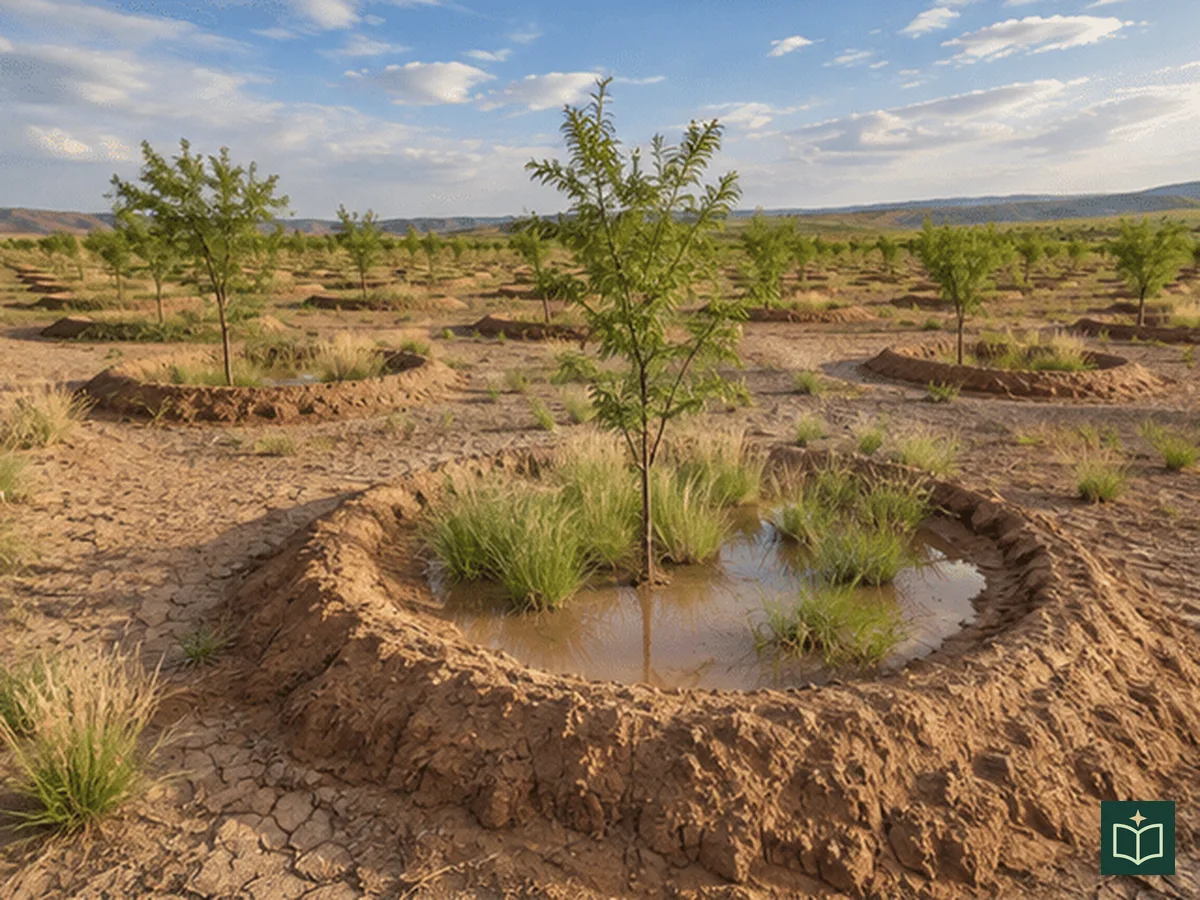
Some of the most successful restoration has come from farmers rather than large planting schemes. In Niger, farmers began protecting and pruning tree stumps that sprouted naturally in their fields, a practice called farmer-managed natural regeneration, and millions of hectares have been re-greened as a result. In Burkina Faso and Niger, farmers dig zaï pits and half-moon shaped embankments that trap rainwater and compost around each plant. Rotational grazing, stone lines along contours and protecting areas from livestock for a few seasons can also help. Such methods are cheap and locally controlled. The common thread is keeping water in the soil and keeping the ground covered.
Why it matters
Drylands cover around 41 per cent of Earth’s land and support roughly two billion people, many of them farmers and herders with few alternatives. Degraded land produces less food and income, which can fuel poverty and migration, and dust from bare soil affects health and air quality far away. Restoring land also stores carbon in soil and vegetation. In the Arabian Peninsula, where natural rainfall is very low, the key issues include overgrazing near settlements, groundwater depletion and the salinisation of irrigated farmland. Desertification is not inevitable: research shows that degraded drylands often recover when pressure is eased and water is managed carefully.
Sources & further reading
- UNCCD · United Nations Convention to Combat Desertification ↗
- UNCCD · Great Green Wall initiative ↗
- Britannica · Desertification ↗
Figures are rounded and widely published; check the linked organisations for the latest editions. These organisations do not endorse this website.