Naming the sky
In 1802 an English pharmacist and amateur meteorologist, Luke Howard, proposed naming clouds with Latin words describing their form: cirrus for wisps of hair, cumulus for heaps, stratus for layers and nimbus for rain clouds. Combined, these roots still name the clouds today. The World Meteorological Organization’s International Cloud Atlas recognises ten main types, or genera, grouped by the height of their base. In mid-latitudes, high clouds typically form above about 5 to 6 kilometres, middle clouds between about 2 and 7 kilometres, and low clouds below about 2 kilometres. In the tropics, including the Gulf, all these levels sit somewhat higher.
The high clouds
Three types live high in the troposphere, where temperatures are far below freezing and clouds are made of ice crystals. Cirrus forms delicate white streaks and hooks, sometimes called mares’ tails, often stretched by strong winds aloft. Cirrocumulus appears as tiny ripples or grains, the classic mackerel sky. Cirrostratus is a thin, milky veil that can cover the whole sky and often produces a halo, a ring of light around the Sun or Moon, as light bends through its ice crystals. High clouds rarely bring rain themselves, but a steady thickening of cirrus into cirrostratus often means a warm front, with rain perhaps within a day.
The middle clouds
Middle clouds are usually made of water droplets, sometimes mixed with ice. Altocumulus forms grey or white patches, rolls or rounded masses, larger than the grains of cirrocumulus. Tall, turret-shaped altocumulus seen on a summer morning, known as castellanus, signals unstable air and a good chance of thunderstorms later in the day. Altostratus is a grey, featureless sheet through which the Sun looks as if seen through frosted glass, often arriving as a front draws closer. Nimbostratus is the thick, dark layer of steady rain or snow. It can extend through several levels, and its base often sinks low enough to hide hills.
The low and towering clouds
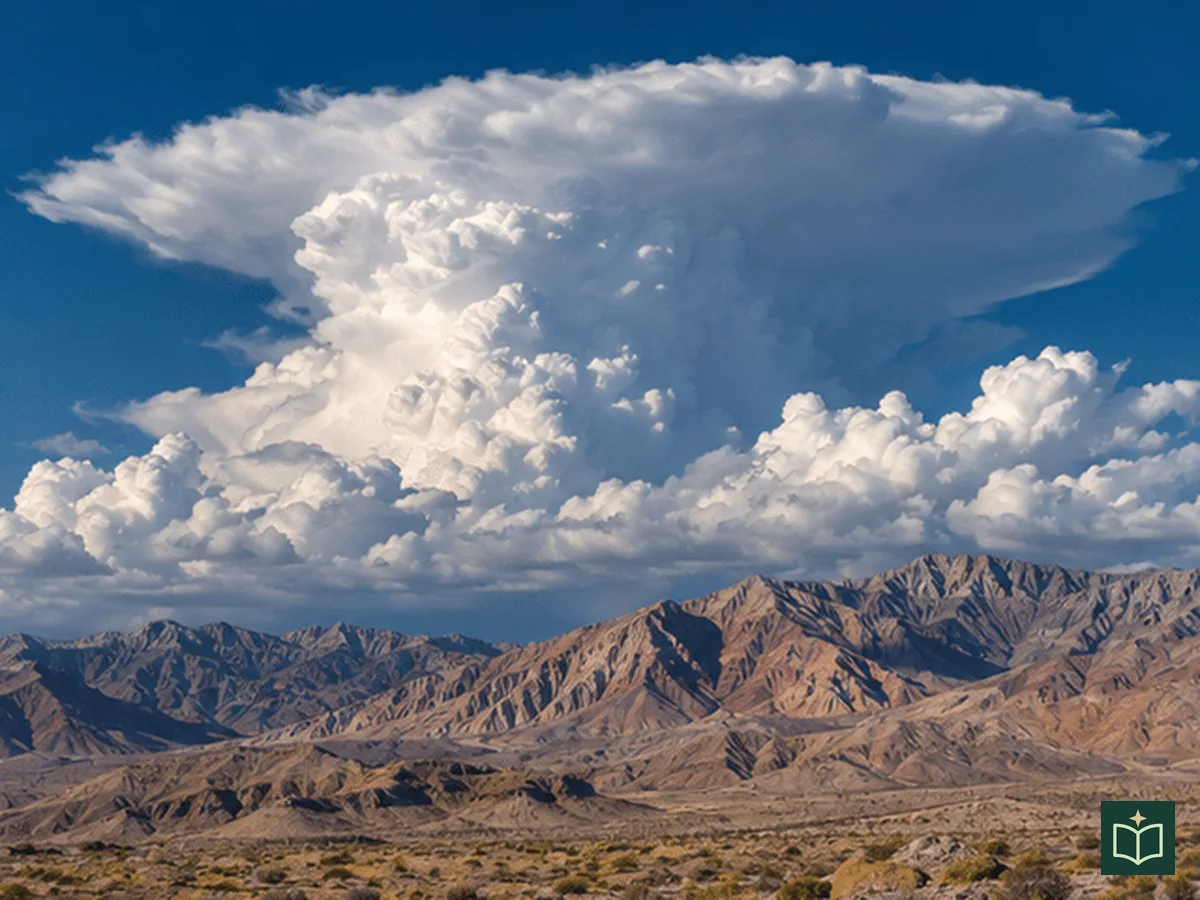
Stratus is a flat grey blanket close to the ground, bringing drizzle or simply gloom, and it can form fog when it touches the surface. Stratocumulus, the most common cloud on Earth, forms lumpy grey patches or rolls with gaps of blue between them. Cumulus clouds are the white, cotton-wool heaps of fair weather, formed by rising bubbles of warm air. If the air is unstable, cumulus can grow upwards into cumulonimbus, the towering thunderstorm cloud, which may reach the top of the troposphere and spread into an anvil. It is the only cloud that produces thunder. Cumulonimbus brings heavy rain, lightning, hail and sudden gusts.
A worked example: the cloud base
Observers can estimate the height of a cumulus cloud base from a simple rule of thumb. Rising air cools faster than its dew point falls, and the gap between them closes at roughly 8°C for every kilometre of ascent. So the base of a convective cloud lies at roughly 125 metres for every degree between the surface temperature and the dew point. On an afternoon at 30°C with a dew point of 18°C, the gap is 12 degrees, and the cloud base should form about 1,500 metres up. In the very dry air over inland deserts, the gap is wider and cloud bases sit higher.
Clouds over the Gulf
In the UAE, the most dramatic clouds tend to appear in two seasons. In winter, passing troughs bring layers of altostratus and nimbostratus, sometimes with embedded thunderstorms, and these deliver much of the year’s rain on the coast. In summer, sea breezes and hot ground push moist air up the slopes of the Hajar mountains, building towering cumulus and occasionally cumulonimbus by afternoon, while the lowlands nearby stay clear. These convective clouds are the ones targeted by the country’s cloud seeding programme. Learning their shapes helps anyone in the region judge when a mountain drive or a desert trip might meet a sudden storm.
Sources & further reading
- WMO · International Cloud Atlas ↗
- Met Office (UK) · Types of clouds ↗
- NOAA National Weather Service · Cloud classification ↗
Figures are rounded and widely published; check the linked organisations for the latest editions. These organisations do not endorse this website.