A very old ambition
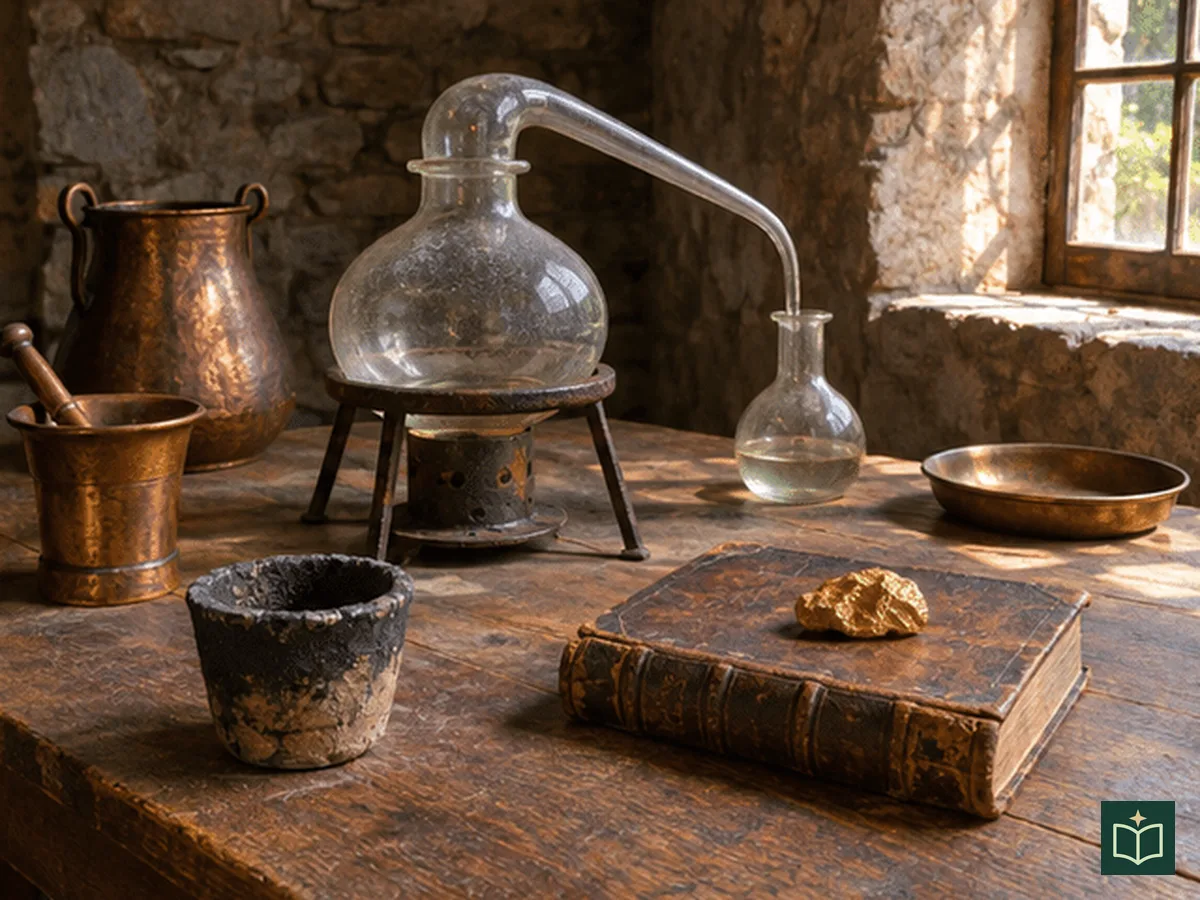
For more than a thousand years, scholars in Alexandria, Baghdad and medieval Europe tried to turn ordinary metals into gold. The dream was not only greed. Many alchemists saw the change as a kind of perfection, in which a base metal was healed into the noblest one, and they linked it with medicine and spiritual purification. Their work was secretive and wrapped in symbols, yet it was also practical. In pursuit of gold, alchemists built furnaces, stills and balances, and learned to make acids, salts and alloys that later chemists would rely on. The search failed, but the workshop it created became the starting point for laboratory chemistry.
Jabir and the mercury-sulphur idea
A large body of Arabic writings attributed to Jabir ibn Hayyan, usually dated to the 8th to 10th centuries, set out an influential theory. All metals, it held, were formed underground from two principles, mercury and sulphur, mixed in different proportions. Gold was the perfect balance; lead and tin were imperfect mixtures. If the balance could be corrected with the right agent, later called the philosopher's stone or elixir, a base metal should become gold. Scholars such as Abu Bakr al-Razi added careful descriptions of substances and apparatus. Latin translations from the 12th century carried these ideas to Europe, where they shaped alchemy for five hundred years.
Newton's secret notebooks
Alchemy was not a fringe pursuit of cranks. Robert Boyle, a founder of modern chemistry, believed transmutation possible, and Isaac Newton wrote an enormous quantity of private notes on alchemy, far more than he published on gravity. He copied old texts, ran furnace experiments in his Cambridge rooms and searched for the hidden principles of matter. Most of these papers stayed unknown to the public until they were sold at auction in 1936. The economist John Maynard Keynes, who bought many of them, concluded that Newton was less the first scientist of the age of reason than one of the last great alchemists.
Why chemistry closed the door
In the late 18th century Antoine Lavoisier and others defined chemical elements as substances that could not be broken down further, and gold, lead and mercury all proved to be elements. John Dalton's atomic theory then explained why: each element is made of its own kind of atom, and chemical reactions only rearrange how atoms bond. In the 20th century the reason became precise. An element is defined by the number of protons in its nucleus. Chemistry works with electrons, the outer shell of the atom, and leaves the nucleus untouched. No mixture, furnace or elixir can therefore turn lead, with 82 protons, into gold with 79.
Gold from reactors and colliders
Nuclear physics can change the nucleus. In 1941 researchers at Harvard bombarded mercury with neutrons and produced radioactive isotopes of gold. In 1980 a team including Glenn Seaborg used a particle accelerator in California to knock protons off bismuth nuclei, leaving a few thousand gold atoms. In 2025 CERN's ALICE experiment reported that near-miss collisions between lead nuclei in the Large Hadron Collider had stripped away three protons, creating about 86 billion gold nuclei between 2015 and 2018. That is roughly 29 trillionths of a gram, and each nucleus smashed into the machine or broke apart within a fraction of a second.
The price of a philosopher's stone
A single gram of gold contains about three thousand billion billion atoms, some 35 billion times the number ALICE created over several years. Running a collider or reactor costs vastly more than the gold it could ever make, so transmutation will never trouble the bullion market. Reactors can turn one stable form of mercury into stable gold, but it is rare in natural mercury, and the gold comes mixed with radioactive by-products. The alchemists' real legacy lies elsewhere: distillation, careful weighing and a habit of experiment. Their dream is now a footnote in physics, a reminder that the most stubborn barriers in nature sit inside the atom.
Sources & further reading
Figures are rounded and widely published; check the linked organisations for the latest editions. These organisations do not endorse this website.