Fibre to yarn
Every garment starts as fibre. Cotton is grown in countries such as India, China, the United States and Brazil, then ginned to separate the fibre from seeds. Polyester, now the most widely used fibre, is made from oil-derived chemicals melted and extruded through fine nozzles. Wool, viscose and nylon fill other niches. Spinning mills clean, align and twist fibres into yarn, controlling thickness and strength. The yarn is then woven on looms into fabrics such as denim and shirting, or knitted into stretchy fabrics used for T-shirts and sportswear. Dyeing and finishing give the fabric its colour, softness and properties such as crease resistance, often using large amounts of water and energy.
Cutting in stacks
At the garment factory, the pattern pieces for each size are arranged by software into a layout called a marker, nesting them as tightly as possible to waste little fabric. Long tables are covered with dozens of layers of fabric, spread smoothly by machine. A computer-controlled knife or a skilled cutter with a powered blade then slices through the whole stack at once, producing identical bundles of sleeves, fronts and backs. Each bundle is tagged with size, colour and lot number, because pieces from different rolls can vary slightly in shade and must not be mixed. A single cut can produce enough parts for hundreds of shirts in a few minutes.
The sewing line
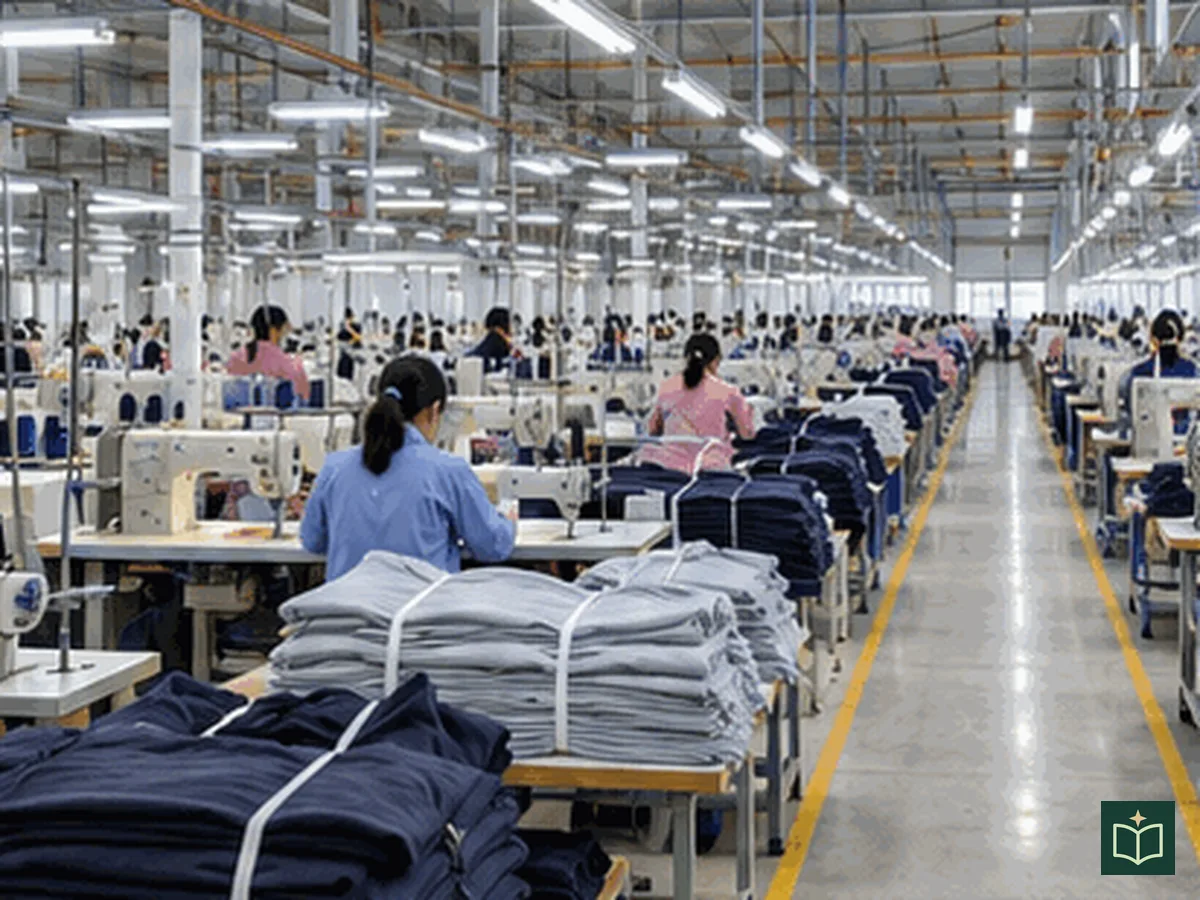
Sewing is still largely done by people at machines, because soft fabric is hard for robots to handle. Most factories use a production line in which each worker performs one operation, such as attaching a collar, setting a sleeve or hemming, then passes the piece on. Engineers measure how long each step should take in standard minutes. Suppose a shirt requires 15 standard minutes of work, and a line of 40 operators works an eight-hour day at 70 per cent efficiency. Multiplying 40 workers by 480 minutes by 0.7 and dividing by 15 gives about 896 shirts a day. Buttons, labels and trims are added, then garments are pressed and inspected.
Why so many countries
A single garment may involve cotton from one country, spinning and weaving in a second, sewing in a third and design and sales in a fourth. Labour-intensive sewing has moved to countries with lower wages, such as Bangladesh, Vietnam and Cambodia, while China remains the largest producer and exporter of textiles and clothing. Trade agreements, tariffs and quotas also shape where garments are made. Re-export hubs such as Dubai play a role in distributing clothing to the Middle East, Africa and beyond. The country printed on a label is usually where the garment was last substantially transformed, often the sewing stage, not where all its materials came from.
Why fast fashion is fast
Traditional fashion planned collections many months ahead and produced them in large batches. Fast-fashion retailers shortened that cycle dramatically. They track sales data daily, release small batches of many designs, and reorder quickly whatever sells. Some keep part of their production close to their main markets, in countries such as Turkey, Morocco or Portugal for Europe, so that a new style can reach shops in a few weeks rather than months. Others rely on huge networks of suppliers that can switch production quickly. Online-only brands go further, testing designs with tiny initial runs and scaling up only the winners, sometimes within days.
The costs behind cheap clothes
Speed and low prices have consequences. Garment work is often poorly paid, and safety failures have been deadly: the collapse of the Rana Plaza building in Bangladesh in 2013 killed more than 1,100 workers and led to new safety agreements. Textile production uses large amounts of water, dyes and energy, and synthetic fibres shed microplastics during washing. Much clothing is worn only a few times before being discarded, and only a small fraction of textile waste is recycled into new fibre. Brands, governments and campaigners are pushing for better wages, safer factories, traceability and recycling, but making clothes cheaply and quickly remains the industry's dominant model.
Sources & further reading
Figures are rounded and widely published; check the linked organisations for the latest editions. These organisations do not endorse this website.