Cement is not concrete
Cement and concrete are often confused. Cement is the fine grey powder that acts as glue. Concrete is the finished material made by mixing cement with water, sand and gravel, and cement usually makes up only about a tenth to a seventh of it by weight. Yet cement is the expensive and carbon-heavy part. The most common type, Portland cement, was patented by the English bricklayer Joseph Aspdin in 1824 and named after the pale stone of the Isle of Portland, which hardened concrete resembled. Today it is one of the most produced materials on Earth, with China making over half of the world's supply.
From quarry to raw meal
Cement plants are usually built next to a limestone quarry, because limestone, mostly calcium carbonate, is the main ingredient and transporting it far is costly. Limestone is blasted, crushed and blended with smaller amounts of clay or shale, which supply silica, alumina and iron. Sand, iron ore or other materials may be added to fine-tune the chemistry. The mixture is ground in large mills into a fine powder called raw meal. Its composition is checked constantly, often with automated X-ray analysers, because small changes affect how the kiln behaves and the strength of the final cement. The meal is then fed into a tall preheater tower.
Inside the kiln
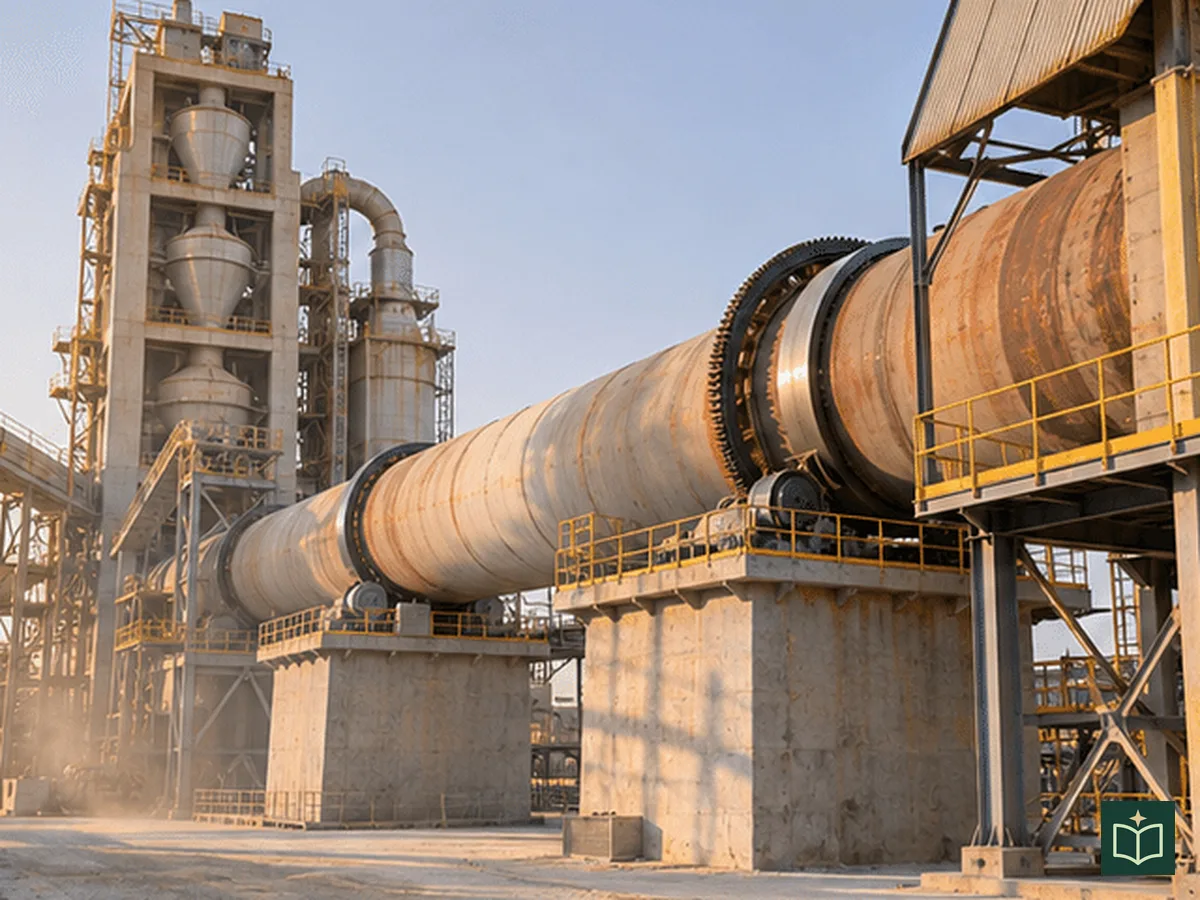
In the preheater, hot gases rising from the kiln warm the falling meal. Here and in a precalciner, most of the limestone breaks down into lime, calcium oxide, releasing carbon dioxide. This step is called calcination. The meal then enters the rotary kiln, a steel tube lined with heat-resistant brick, often more than 50 metres long, tilted slightly and turning slowly. A flame at the lower end, fuelled by coal, gas, oil or waste-derived fuels, raises the material to about 1,450°C. The lime combines with silica, alumina and iron to form new minerals, and the material fuses into hard grey lumps called clinker, which are then rapidly cooled.
Where the carbon comes from
Calcination releases carbon dioxide directly from the rock. By weight, every 100 tonnes of pure calcium carbonate leaves 56 tonnes of lime and gives off 44 tonnes of carbon dioxide. Clinker contains about 65% lime, so each tonne of clinker releases roughly 0.65 × 44 ÷ 56, or about 0.51 tonnes of carbon dioxide from chemistry alone. Fuel burned to heat the kiln adds more, as does electricity for grinding. Overall, producing a tonne of cement typically emits around 0.6 tonnes of carbon dioxide, depending on how much clinker it contains. Multiplied by billions of tonnes a year, that is why cement accounts for around 7% of global emissions.
Grinding and blending
Clinker is not yet cement. It is ground in ball mills or vertical roller mills with a few per cent of gypsum, which controls how quickly the cement sets once water is added. Many modern cements also replace part of the clinker with other materials that react in a similar way, such as fly ash from coal power stations, ground slag from steelmaking, calcined clay or ground limestone. These blended cements lower emissions because less clinker is needed. In the Gulf, where large construction programmes drive demand, plants in the UAE, Saudi Arabia and elsewhere produce both ordinary Portland cement and blended products, plus sulphate-resistant types suited to salty soils.
Cutting cement's footprint
Because so much carbon dioxide comes from the limestone itself, cleaner fuels alone cannot solve the problem. The main options are using less clinker per tonne of cement, using less cement per tonne of concrete through better design, recycling and alternative binders, and capturing carbon dioxide from kiln exhaust and storing or using it. Several carbon-capture projects at cement plants are being tested or built in Europe and elsewhere. Some newer cements absorb carbon dioxide as they cure. A common misconception is that concrete simply releases carbon once; in reality, it slowly reabsorbs a portion over decades through carbonation, though far less than was emitted during production.
Sources & further reading
Figures are rounded and widely published; check the linked organisations for the latest editions. These organisations do not endorse this website.