The energy hill
Most chemical reactions do not happen the instant ingredients meet. Molecules must collide with enough energy to stretch and break existing bonds before new ones can form. Chemists picture this as a hill that reactants must climb before rolling down to become products; its height is called the activation energy. A mixture of hydrogen and oxygen can sit unchanged for years because few molecules have enough energy to get over the top, yet a spark sets it off. Heating speeds reactions by giving more molecules enough energy. A catalyst works differently: it leaves the temperature alone and instead provides a route over a lower hill.
Why it is not used up
A catalyst takes part in a reaction but is regenerated at the end. On a metal surface, for example, reacting molecules stick to the metal, their bonds are weakened, they react, and the products drift away, leaving the surface free for the next molecules. A single catalyst particle can therefore handle enormous numbers of reactions. Crucially, a catalyst does not change the energy difference between the starting materials and the products, so it cannot make an impossible reaction possible or change how much product is present at equilibrium. It speeds the forward and reverse reactions alike, helping a system reach its natural balance sooner.
Enzymes: life's catalysts
Living cells depend on enzymes, mostly large proteins folded into precise shapes. Each has an active site, a pocket that fits particular molecules in the way a lock fits a key, holding them in positions that make reaction easy. Enzymes can accelerate reactions by factors of millions or more, which lets digestion and metabolism proceed at body temperature. Amylase in saliva begins breaking starch into sugars as you chew bread. Pepsin in the stomach cuts proteins, working best in strong acid. Lactase splits milk sugar, and people who make little of it after childhood may find dairy uncomfortable. Because enzymes depend on shape, high fever or extreme acidity can disable them.
Cleaning car exhaust
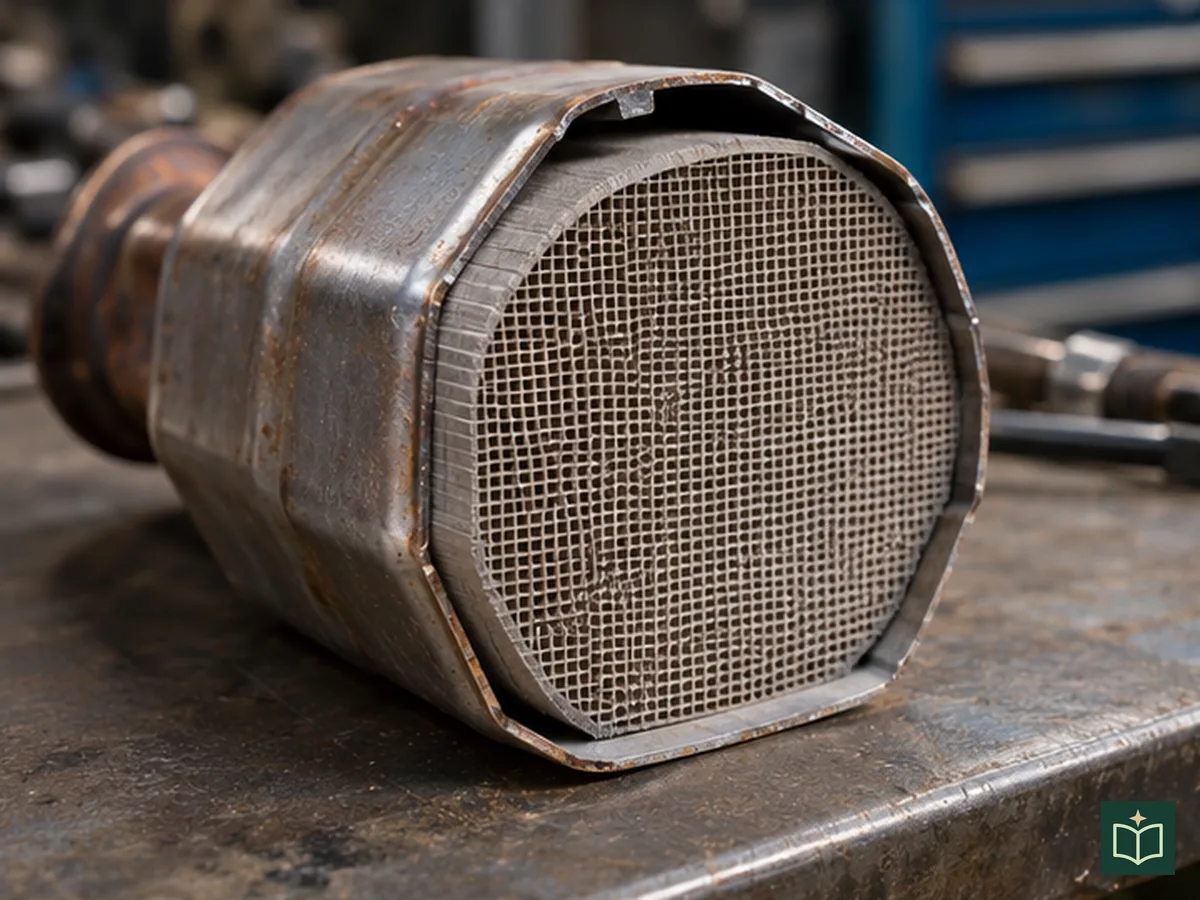
A petrol car's catalytic converter is a ceramic honeycomb coated with tiny amounts of platinum, palladium and rhodium. As hot exhaust flows through its thousands of narrow channels, the metals help three reactions happen in a fraction of a second. Toxic carbon monoxide is converted to carbon dioxide, unburnt fuel is turned into carbon dioxide and water, and nitrogen oxides are split back into nitrogen. Without a catalyst these reactions would be far too slow at exhaust temperatures. The converter must warm up to work properly, which is why emissions are highest in the first minutes after a cold start, and why short trips pollute more per kilometre.
Catalysts in industry
Most industrial chemical processes rely on catalysts at some stage. The Haber–Bosch process uses an iron-based catalyst to combine nitrogen from the air with hydrogen to make ammonia, the basis of most nitrogen fertilisers that help feed the world. Refineries use catalysts to crack heavy oil fractions into petrol and diesel, and to remove sulphur from fuels. Plastics such as polyethylene are made with catalysts that link small molecules into long chains. Gulf petrochemical complexes, which turn natural gas and oil into fertilisers and plastics, depend on them heavily. Designing catalysts that work at lower temperatures saves large amounts of energy, which is why research into them is intense.
Limits and misconceptions
Catalysts are not magic. They can be slowed or ruined by poisons, substances that cling to active sites and block them; lead in old petrol, for example, destroyed catalytic converters, one reason leaded fuel was phased out. Surfaces also wear, clog or clump together over time. A catalyst also cannot supply energy: if a reaction needs energy overall, as splitting water into hydrogen and oxygen does, that energy must still come from somewhere, even if the catalyst makes the process more efficient. Finally, a faster reaction is not always desirable. In the body, controlling exactly which enzymes are active, and when, is as important as their speed.
Sources & further reading
Figures are rounded and widely published; check the linked organisations for the latest editions. These organisations do not endorse this website.