Why cars are crashed on purpose
Before a new car model is sold, it must meet legal safety standards, and many are also tested by independent rating programmes. The only reliable way to know how a car protects its occupants is to crash it under controlled conditions and measure the result. Laboratories do this hundreds of times a year. Each test destroys a new vehicle, so it is expensive, and the conditions are tightly defined so that results can be compared across models. The aim is not to recreate every possible accident but to reproduce the most common and most dangerous types, such as head-on collisions, side impacts and rollovers, in a repeatable way.
The standard impacts
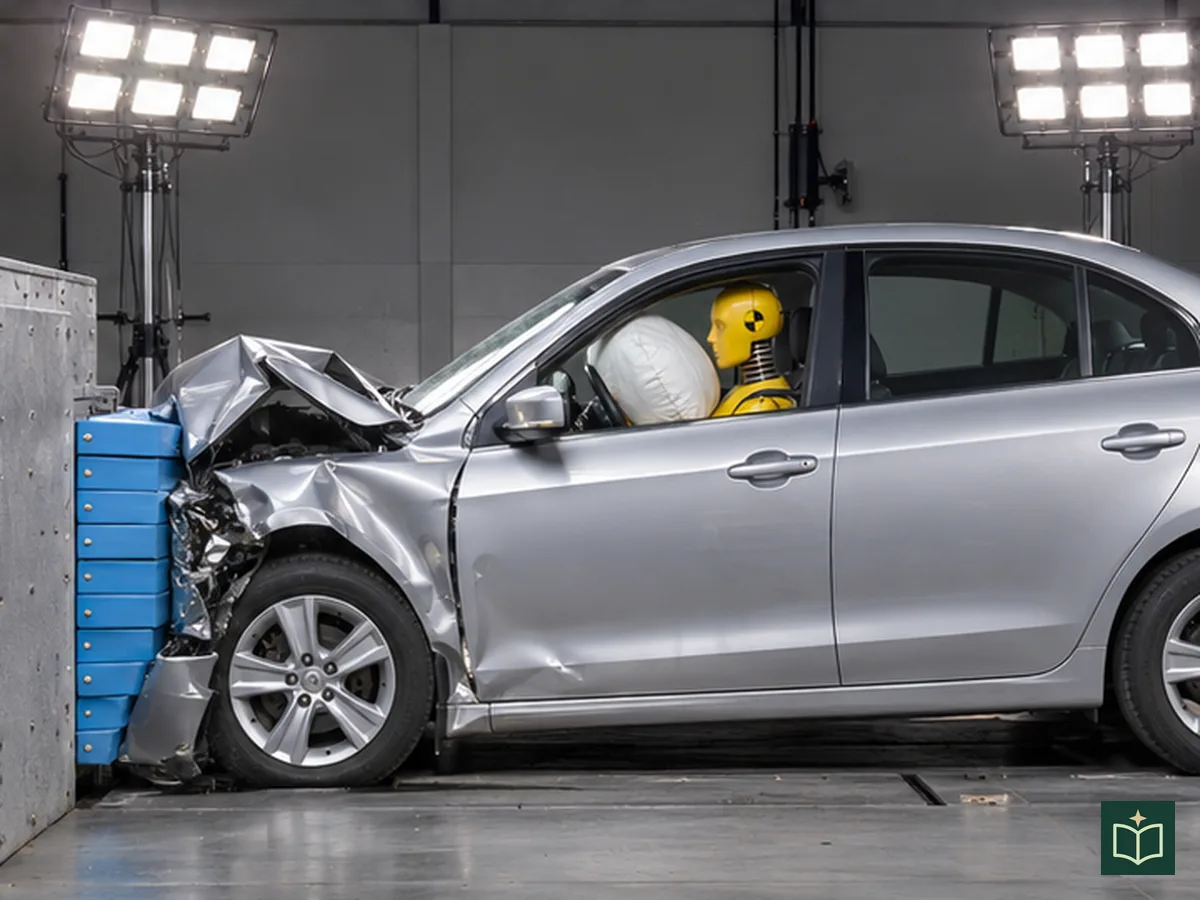
A frontal test typically sends the car into a barrier, either a rigid wall or a deformable block that mimics another vehicle. Offset tests strike only part of the front, because many real crashes do not hit squarely and concentrate force on one side. Side tests drive a heavy trolley into the door, or swing the car sideways into a pole, which is especially harsh because the force is focused on a narrow area. Other tests check whether the roof resists crushing, how seats protect against whiplash in rear impacts and whether the bonnet and bumper reduce injuries to pedestrians. Speeds and angles are set to within very fine limits.
Inside the dummy
Crash-test dummies are precision instruments shaped and weighted like people. They come in several sizes, including an average adult man, a smaller woman and children of different ages. Inside are accelerometers, load cells and displacement sensors that measure how hard the head is jolted, how far the chest is compressed and what forces travel through the neck, pelvis and legs. A crash lasts roughly a tenth of a second, so the sensors sample thousands of times a second. High-speed cameras film the event, and engineers compare the readings with injury limits drawn from decades of medical research on how much force the human body can tolerate.
From readings to stars
Rating programmes turn these measurements into scores. In the United States, the government's New Car Assessment Program and the insurance-funded IIHS publish ratings, while Euro NCAP covers Europe and similar programmes operate in Australia, Latin America, Japan and elsewhere. Each awards points for adult occupant protection, child protection and, in many cases, pedestrian safety and driver-assistance systems such as automatic emergency braking. Those points are combined into an overall rating, commonly shown as one to five stars. Because each programme uses its own tests and weighting, a car's stars in one region cannot be compared directly with another programme's results, and protocols are tightened every few years.
What the stars do not say
A star rating is a useful guide, but it has limits. It describes performance in specific tests at specific speeds, and real crashes vary enormously. Physics also matters: in a collision between a small car and a heavy one, the occupants of the lighter car usually fare worse, even if both have five stars, because ratings largely compare vehicles of similar size. Older ratings are not directly comparable with newer ones once protocols change. Researchers have also pointed out that dummies have long been based mainly on an average male body, and newer dummies are being developed to represent women, older people and a wider range of body shapes.
Why it matters
Crash testing has transformed car design. Crumple zones that absorb energy, rigid passenger cells, airbags, seatbelt pretensioners and stronger side structures all spread because tests showed what worked and ratings rewarded it. Many countries, including those in the Gulf, require new vehicles to meet recognised safety standards before they can be sold. For buyers, checking a car's rating from the programme that covers their market is one of the simplest ways to compare safety. The next challenge is testing systems that try to prevent crashes altogether, from emergency braking to lane-keeping, which means laboratories increasingly assess software and sensors as well as steel.
Sources & further reading
Figures are rounded and widely published; check the linked organisations for the latest editions. These organisations do not endorse this website.