Why seconds matter
For most homes, a power cut is an inconvenience. In a hospital it can be dangerous. Ventilators, anaesthesia machines, infusion pumps, operating lights and monitors all depend on electricity, as do the fridges that store blood and vaccines. Data centres face a different risk: even a fraction of a second without power can crash thousands of servers and corrupt data. Electricity grids are generally reliable, but faults, storms, equipment failures and maintenance errors mean no grid is perfect. Critical facilities therefore design their electrical systems on the assumption that the mains supply will fail at some point, and plan for the moment it does.
The battery bridge
The first line of defence is the uninterruptible power supply, or UPS. In its most robust form, the equipment it protects runs constantly through the UPS, which converts incoming alternating current to direct current, keeps a bank of batteries charged, and converts the power back again. When the mains disappears, the batteries are already in the circuit, so there is no gap at all. Batteries are expensive and heavy, so they are usually sized to last minutes rather than hours. Their job is not to run the building through a long outage but to hold the most sensitive loads steady while the generators start.
Generators take over
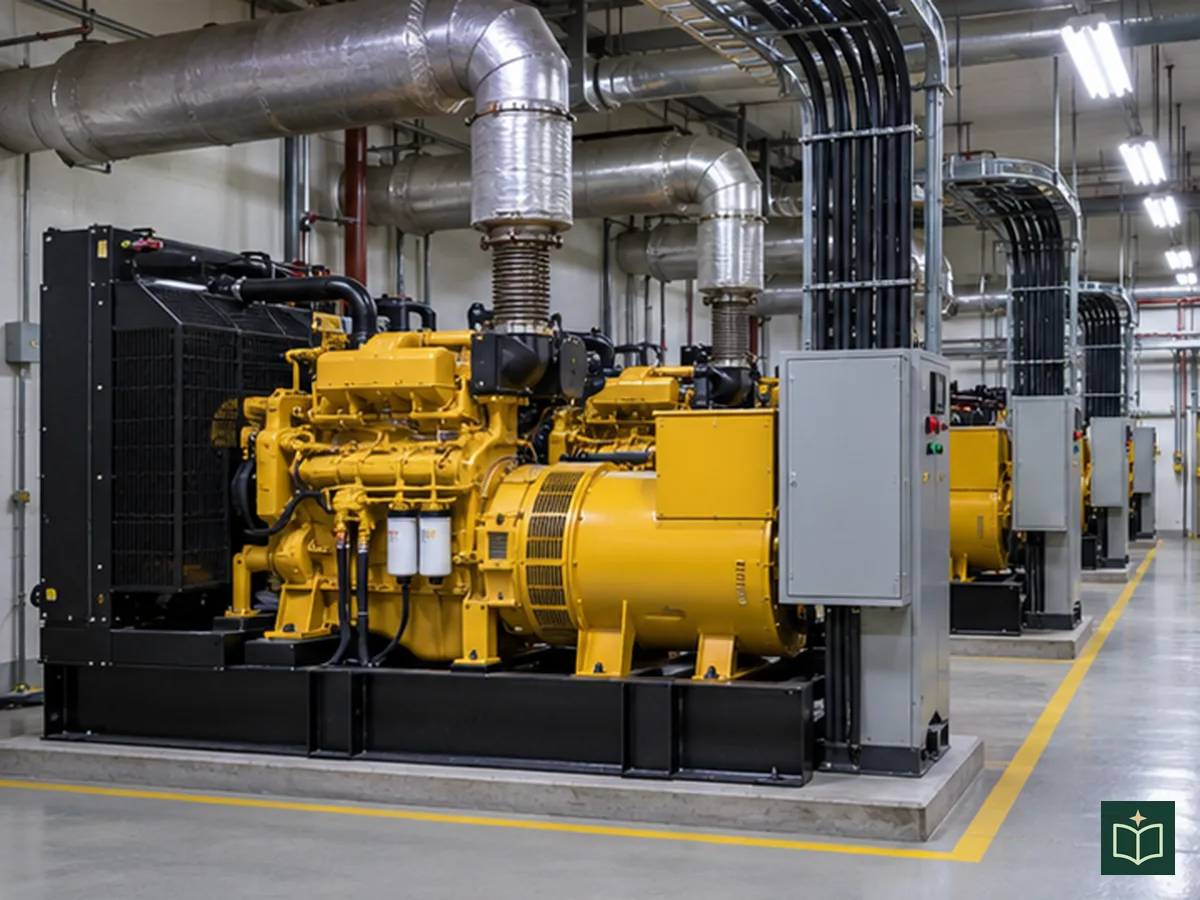
Standby generators, usually diesel engines coupled to alternators, provide longer-term power. Sensors watch the incoming supply, and when voltage or frequency falls outside safe limits, they signal the generators to start. Once a generator is up to speed, an automatic transfer switch disconnects the building from the failed grid and connects it to the generator instead. In hospitals, the most critical circuits must be restored within seconds. Large sites often run several generators in parallel, so that one can fail or be serviced without loss of supply. Fuel tanks on site hold enough for a defined period, often a day or more, with contracts in place for resupply.
Testing the plan
A backup system that has never been tested is a hope rather than a plan. Hospitals and data centres usually run their generators regularly under real load, often monthly, to make sure engines start, switches operate and fuel is in good condition. Diesel can degrade if stored for long periods, so fuel is checked and treated. UPS batteries wear out over a few years and are monitored and replaced. Some sites deliberately cut the mains supply during scheduled drills. In the Gulf, extreme summer heat adds strain, so generator rooms need careful ventilation and cooling, and equipment is often rated for higher temperatures than in cooler climates.
Common misconceptions
It is easy to assume that a building with a generator is immune to power cuts. In practice, failures often occur at the joins: a transfer switch that sticks, a battery bank that has quietly aged, or a fuel pump that was itself left on an unprotected circuit. Major outages at hospitals and data centres are frequently traced to such details rather than to the grid alone. Another misconception is that backup systems keep everything running normally. Most are designed to protect essential functions, so lifts, lighting and comfort cooling may be reduced. Designers decide in advance which loads matter most, because generator capacity is finite and expensive.
Why it matters
As hospitals use more electronic equipment and services from banking to air traffic control move into data centres, the cost of even brief outages has grown. Backup systems are also changing. Large battery installations can now cover longer gaps and help the grid at other times, and some facilities are trialling gas engines, fuel cells or on-site solar paired with storage to reduce reliance on diesel. The principle stays the same: layers of protection, each able to take over from the one before, and regular testing to prove they work. For patients on an operating table, the result should be that a blackout outside is never noticed inside.
Sources & further reading
Figures are rounded and widely published; check the linked organisations for the latest editions. These organisations do not endorse this website.