Not much water at all
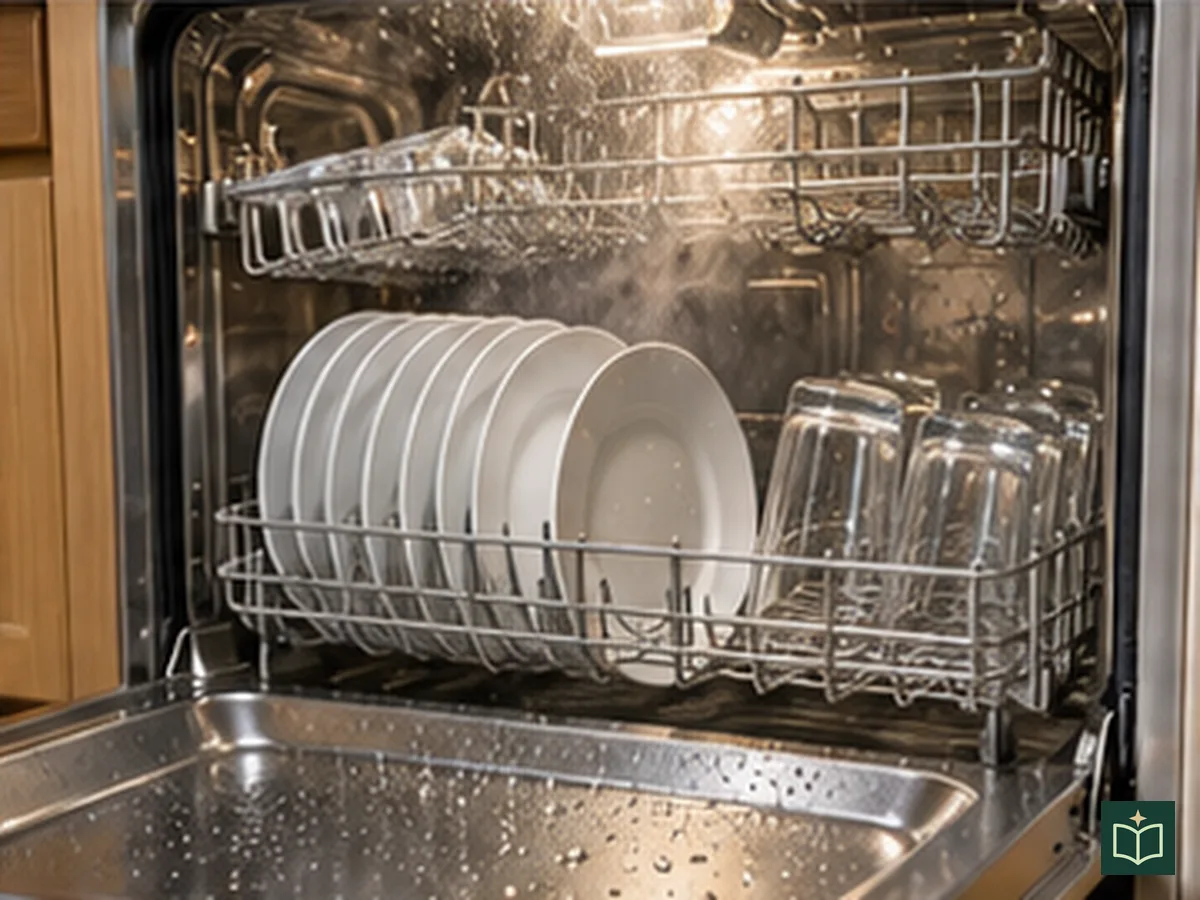
Open a dishwasher mid-cycle and you will find only a shallow pool of water in the bottom. That small volume, often just a few litres per stage, does all the work. A pump drives it at pressure through rotating spray arms, it falls back, passes through a filter and is sprayed again, hundreds of times in a cycle. Efficient models use roughly 13 litres for an entire wash, rinse included. Washing the same load under a running tap can use several times as much, though careful hand-washers using a filled basin narrow the gap. The machine's advantage comes from recirculation, consistent temperatures and chemistry rather than raw force.
Spray arms and filters
The spray arms spin because water leaves through angled nozzles, pushing them round like a garden sprinkler. Usually there is one arm beneath each rack, sometimes with a third near the top, so jets reach plates, glasses and cutlery from below and above. The cleaning depends on water reaching every surface, which is why loading matters: large dishes blocking an arm or bowls stacked face down on each other leave dirty patches. Food particles washed off the dishes are trapped by a fine mesh filter at the base of the tub so they are not sprayed back. Cleaning that filter regularly keeps water flowing and prevents smells.
Detergent does the scrubbing
Dishwasher detergent is very different from washing-up liquid, which would foam and overflow the machine. It is strongly alkaline, which helps break down grease. Enzymes do much of the heavy lifting: amylases digest starch from rice, pasta and potato, while proteases break down egg, meat and dairy residues. Oxygen-based bleaches remove tea and coffee stains. Other ingredients bind minerals in hard water and stop food redepositing. Enzymes work best within a temperature range, so many programmes hold water at moderate heat for a long time rather than blasting it as hot as possible. That is why eco programmes often last two or three hours.
The cycle, step by step
A typical programme starts with a short cold or warm pre-rinse that removes loose food, then drains. Fresh water fills the base and a heating element warms it, usually to somewhere between 45 and 65 degrees Celsius depending on the programme, as the detergent dispenser opens. The main wash circulates for a long period. After draining, one or more rinses remove detergent. The final rinse is hotter and includes rinse aid, a surfactant that helps water sheet off surfaces in a thin film instead of leaving droplets that dry into spots. Some machines in hard-water areas also run water through a built-in softener regenerated with special salt.
How dishes get dry
Drying is often the weakest part of a dishwasher's performance. Many machines rely on residual heat: the hot final rinse warms the dishes, water evaporates and condenses on the cooler stainless-steel walls, then drains away. Some open the door automatically at the end so steam escapes. Others use fans, heating elements or minerals such as zeolite, which absorb moisture and release heat as they do so. Plastics stay wetter than glass and ceramics, because they hold less heat. Rinse aid makes a large difference, since thin films of water evaporate much faster than droplets. Leaving the door ajar briefly after a cycle also helps.
Limits and common myths
Pre-rinsing every plate under a tap is usually unnecessary with modern machines and detergents; scraping off food is enough, and enzymes need some residue to work on. Running a half-empty machine wastes water and energy per dish, while overloading blocks sprays. Not everything belongs inside: wooden boards, cast iron, some non-stick pans, crystal and insulated mugs can be damaged. In the Gulf, desalinated tap water is often soft, but where water is hard, limescale builds up on glasses and the heating element unless softener and salt are used. A dishwasher is not a steriliser, though its hot rinses do reduce bacteria considerably on clean dishes.
Sources & further reading
Figures are rounded and widely published; check the linked organisations for the latest editions. These organisations do not endorse this website.