A slow-motion saw
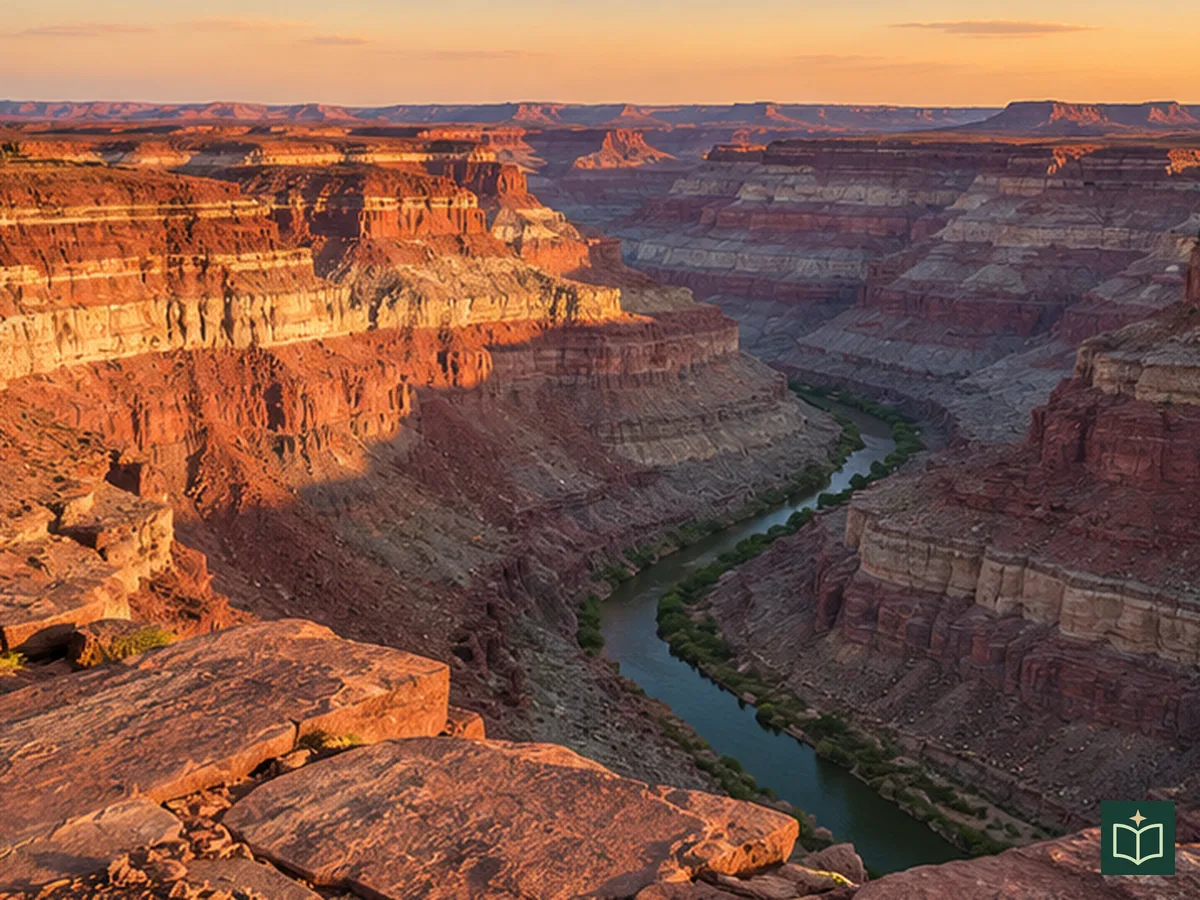
A canyon forms where a river cuts down faster than its walls are worn back. The Grand Canyon in Arizona is the classic example: about 446 kilometres long, up to 29 kilometres wide and roughly 1.8 kilometres deep. Its builder is the Colorado River, which carries sand, gravel and boulders that grind its bed like sandpaper, especially during floods. The key ingredient, though, is not the water alone. It is uplift. A river can only cut down as far as the level it flows towards, ultimately the sea. Raise the land, and the river gains fresh cutting power. The canyon is what happens when that continues for millions of years.
How the plateau rose
The Grand Canyon slices through the Colorado Plateau, a high block of crust now standing around two kilometres above sea level. Starting roughly 70 million years ago, plate movements along the western edge of North America pushed the region upward. Unusually, the plateau rose as a fairly coherent block, so its rock layers stayed close to horizontal. That is why the canyon walls show neat, stacked bands rather than folded ones. Most geologists think the canyon itself was largely carved in the past five to six million years, after the Colorado River established its route to the Gulf of California, although some segments may be older and the timing is still debated.
A worked example in patience
The numbers show how gentle the process can be. If the river cut about 1,800 metres over roughly six million years, the average rate is 1,800 divided by 6,000,000, or 0.0003 metres a year: about 0.3 millimetres, thinner than a fingernail. In reality the cutting was uneven, with fast spells during floods and wetter climates and slow ones in between. But the arithmetic makes a point: given enough time, even a barely measurable rate can open one of the deepest gorges on Earth. No single human generation would ever notice the canyon floor drop, yet the result is clearly visible from space.
Reading the walls as a timeline
Each band in the canyon wall records a past environment. Near the rim, the Kaibab Limestone, about 270 million years old, formed in a shallow sea and contains marine fossils. Below it, the Coconino Sandstone preserves the slanting layers of ancient desert dunes. Further down are shales from muddy coasts and limestones from deeper seas. At the bottom lies the dark Vishnu Schist, rock that was buried, heated and transformed around 1.7 to 1.8 billion years ago. Between some layers are gaps, called unconformities, where hundreds of millions of years of rock were eroded away. The most famous is the Great Unconformity, a missing chapter in the record.
Why the walls are stepped
The canyon's profile is a staircase, not a smooth V. Hard layers such as limestone and sandstone resist weathering and stand as vertical cliffs. Softer shales crumble more easily and form gentler slopes between them. As the soft rock wears back, it undercuts the hard layer above, which breaks off in blocks, keeping the cliffs steep. The dry climate helps too. With little rain to soften the slopes, the river's downcutting outpaces the widening of the walls. In wetter regions, rivers more often carve broad valleys with rounded sides. Side streams and flash floods add their own notches, creating the maze of buttes and amphitheatres seen from the rim.
What canyons tell us
Canyons are some of geology's most valuable textbooks, because they expose rock that is normally hidden. The Grand Canyon helped scientists work out the principle that lower layers are generally older, and it remains a place to study ancient climates, seas and life. The same logic applies elsewhere. In Arabia, the Hajar Mountains are cut by deep wadis where flash floods have exploited rising rock, and Oman's Wadi Ghul is often called the Grand Canyon of Arabia. Canyons also remind us that landscapes are not fixed. The Colorado River is still at work, though dams upstream now trap much of the sediment it once used to cut.
Sources & further reading
Figures are rounded and widely published; check the linked organisations for the latest editions. These organisations do not endorse this website.