Why buildings come down
Buildings are demolished when they become unsafe, outdated or simply worth less than the land beneath them. A tower built forty years ago may have poor insulation, small floor plates or services that no longer meet modern codes, and rebuilding can be cheaper than renovating. Fire, earthquakes or abandoned construction can also leave structures that must be removed. Whatever the reason, demolition is a branch of structural engineering in its own right. The demolition team has to understand how a building carries its loads, because taking it down means deliberately removing that support in a controlled order, without endangering workers, neighbours or the buildings next door.
Surveys before machines
Work starts long before the first wall falls. Engineers study the original drawings, if they exist, and check how the structure has been altered over the years. A hazardous materials survey looks for asbestos, lead paint, chemicals and fuel tanks, which must be removed by specialists first. The building is then stripped out: glass, furniture, ceilings, cables, pipes and machinery are taken away, much of it for recycling or reuse. Utilities such as gas, water and electricity are disconnected and capped. Only when the shell is bare and its structure fully understood does the team decide whether to dismantle it piece by piece or to bring it down in a single event.
Taking it apart by machine
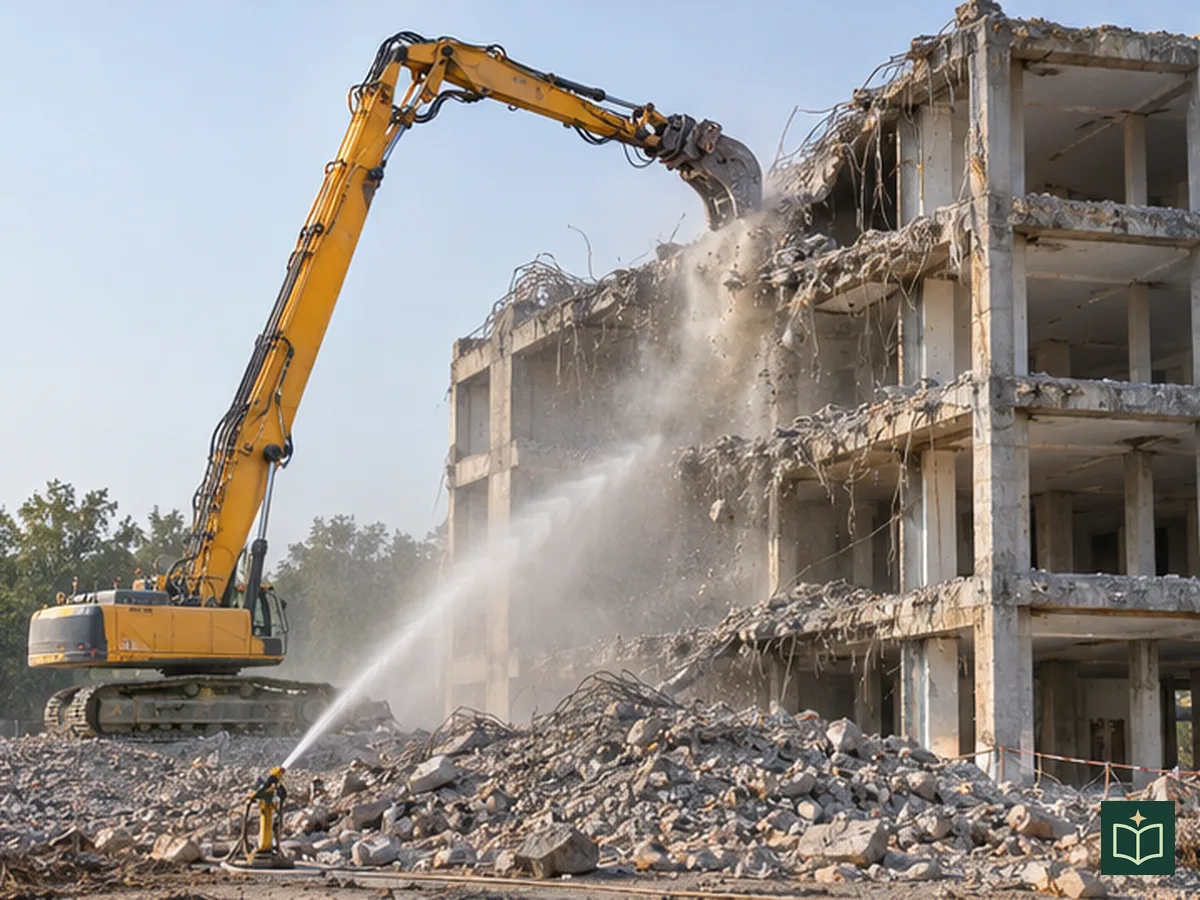
Most buildings, especially in crowded cities, are demolished mechanically. High-reach excavators fitted with hydraulic shears and crushers can bite through concrete and steel many storeys above the ground, while smaller machines are lifted onto the roof to break the structure down floor by floor. Debris falls through openings cut in the slabs and is removed at ground level. Dust is controlled with water sprays and screens wrapped around the building. The classic wrecking ball is now rare because it is hard to control and sends debris in unpredictable directions. Mechanical demolition is slower than explosives, but it gives engineers fine control and allows close neighbours to stay in place.
How an implosion works
Where there is enough space, explosives can bring a large building down in seconds. Engineers drill holes in chosen columns and load them with small charges, often after cutting some steel members and removing non-structural walls in advance. Columns are wrapped in fabric and fencing to contain flying fragments. The charges are wired to fire in a precise sequence, separated by fractions of a second. Removing supports at the centre first makes the building fall inward, and staggering the timing from one side can fold it in a chosen direction. The explosives do not destroy the structure; they remove its legs, and gravity pulls the rest into its own footprint.
A Gulf example
In November 2020, the four unfinished towers of Mina Plaza in Abu Dhabi were brought down by controlled explosion in about ten seconds, and the event was recognised as a record for the tallest building demolished with explosives. The project shows the scale of planning involved. Engineers had to keep debris away from the nearby port and roads, set a wide exclusion zone and schedule the blast for a time when the area could be cleared. Afterwards, much of the rubble was processed on site. Concrete can be crushed into aggregate for roads and fill, while steel reinforcing bars are separated with magnets and sent for recycling.
Why it matters
Demolition is becoming as much about recovery as destruction. Construction and demolition waste is one of the largest waste streams in many countries, and governments increasingly expect most of it to be recycled. Some contractors now speak of deconstruction, taking buildings apart carefully so that steel beams, facade panels and fittings can be reused rather than crushed. In Japan, contractors have developed methods that dismantle tall towers from the top down inside an enclosed working level, reducing noise and dust. As cities replace older towers more often, the way buildings are brought down will matter for safety, air quality and the amount of material that ends up in landfill.
Sources & further reading
Figures are rounded and widely published; check the linked organisations for the latest editions. These organisations do not endorse this website.