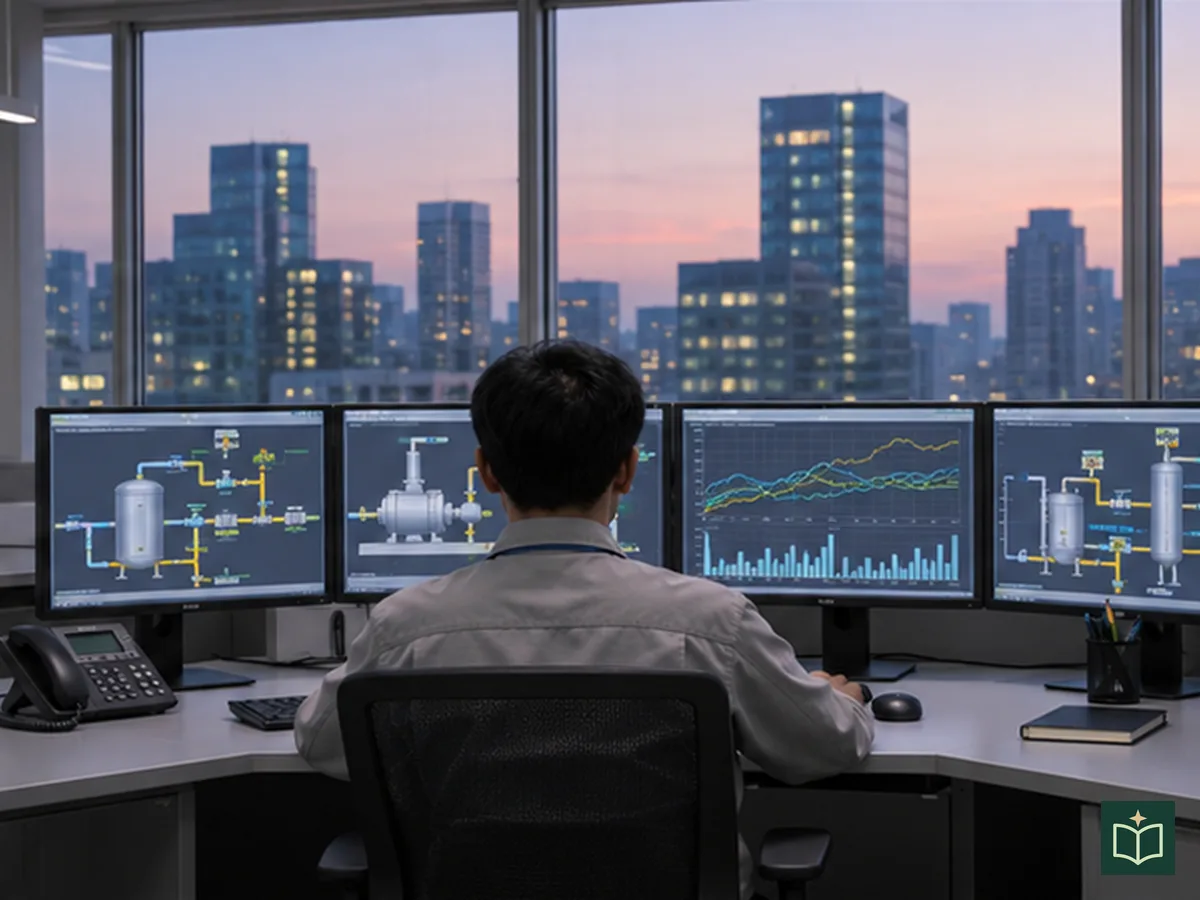
The building's control room
A large office tower, mall or hospital contains hundreds of pieces of equipment: chillers, cooling towers, pumps, air-handling units, fans, valves, lights and lifts. A building management system, or BMS, ties them together. Sensors throughout the building measure temperature, humidity, carbon dioxide, occupancy and equipment status. Controllers use those readings to start and stop machines, open and close valves and adjust fan speeds. Facility staff watch it all from a central screen, often called the head end. Most systems speak open communication protocols such as BACnet, so equipment from different makers can work together. In a Gulf building, where cooling dominates the electricity bill, the BMS is effectively the brain of the air-conditioning plant.
How it cuts waste
Much of the energy a building wastes comes from equipment running when nobody needs it, or running harder than necessary. A BMS attacks both. Schedules switch air handlers and lights off at night and at weekends. Occupancy sensors cool and light meeting rooms only when people are in them. Carbon dioxide sensors let ventilation fans bring in only as much hot outdoor air as occupants need, which matters greatly in a desert climate where every cubic metre must be cooled and dried. Chilled-water temperatures and pump speeds can be reset as loads change through the day. Alarms flag faults, such as a stuck valve or a fan running at full speed, before they quietly add to the bill.
A worked example
Consider an office building whose air-handling fans draw a combined 200 kilowatts and run around the clock, 8,760 hours a year. If the BMS schedules them to run 12 hours on weekdays only, that is 12 × 5 × 52, or 3,120 hours. The fans now avoid 5,640 hours of running, saving about 1.13 million kilowatt-hours a year. At an illustrative commercial tariff of AED 0.40 per kilowatt-hour, that is roughly AED 450,000. The chillers would save energy too, since less air needs cooling. Real savings are smaller where some areas must run all night, but the example shows why schedules are among the first things energy auditors check.
Commissioning: the hidden half
A BMS is only as good as its programming. Commissioning is the process of checking that every sensor reads correctly, every valve moves as commanded and every control sequence does what the designers intended. It is often rushed at the end of construction, when budgets are tight and tenants are waiting. Over time, performance drifts as sensors lose calibration, temporary overrides become permanent and spaces change use. Retro-commissioning revisits an existing building to find and fix these problems. A widely cited review by Lawrence Berkeley National Laboratory found median savings of around 16 per cent in existing buildings, often with payback in about a year, mostly from fixing controls rather than buying new equipment.
What a BMS does not do
A control system cannot make inefficient equipment efficient. An old chiller, leaky ducts or single-glazed façades limit what any software can achieve. Nor does installing a BMS guarantee savings: many buildings have sophisticated systems that are largely left on manual or run with factory defaults. Too many alarms can also overwhelm staff, who then ignore them. Cyber security has become a concern, since networked building controls can be an entry point for attackers if poorly protected. The best results come when a capable operator uses the data, reviews trends and adjusts settings regularly. In that sense, a BMS is less a product than a practice that continues for the life of the building.
Where it is heading
Newer systems add analytics that sift sensor data automatically to spot faults and suggest fixes, sometimes called fault detection and diagnostics. Some respond to signals from the grid, easing cooling for an hour during peak demand or pre-cooling a building before a price spike, so the building becomes a flexible participant in the power system. Dubai and other Gulf cities encourage such upgrades through green building codes and retrofit programmes, often delivered by energy service companies. As more equipment becomes connected, the challenge shifts from collecting data to acting on it. The buildings that save most will be those where people, not just software, keep paying attention.
Sources & further reading
Figures are rounded and widely published; check the linked organisations for the latest editions. These organisations do not endorse this website.