Why ships need bunkers
The word bunker once meant the coal store of a steamship, and the name stayed when ships switched to oil. Today bunkers are the fuels that power merchant vessels, and bunkering is the business of supplying them. Large cargo ships use slow-turning diesel engines that can burn heavy, viscous residual fuel left over from refining, which is cheaper per tonne than lighter fuels. A big container ship or tanker can carry thousands of tonnes in its tanks and travel for weeks between refuelling stops. Ships therefore choose where to bunker carefully, balancing price, quality, convenience and how far out of their way a port lies on their route.
The main fuel grades
For decades the workhorse was high-sulphur heavy fuel oil, a thick residue that must be heated before it can be pumped and burnt. Lighter marine gasoil and marine diesel, refined like road diesel, are used in auxiliary engines, in port and in coastal areas with strict limits. Since 2020 the most common grade has been very low sulphur fuel oil, a blended product that meets the new global limit. Ships fitted with exhaust scrubbers may still burn high-sulphur fuel, because the scrubber removes sulphur oxides from the exhaust. Newer options include liquefied natural gas, methanol and, in trials, ammonia, each needing different tanks, engines and supply chains.
How bunkering works
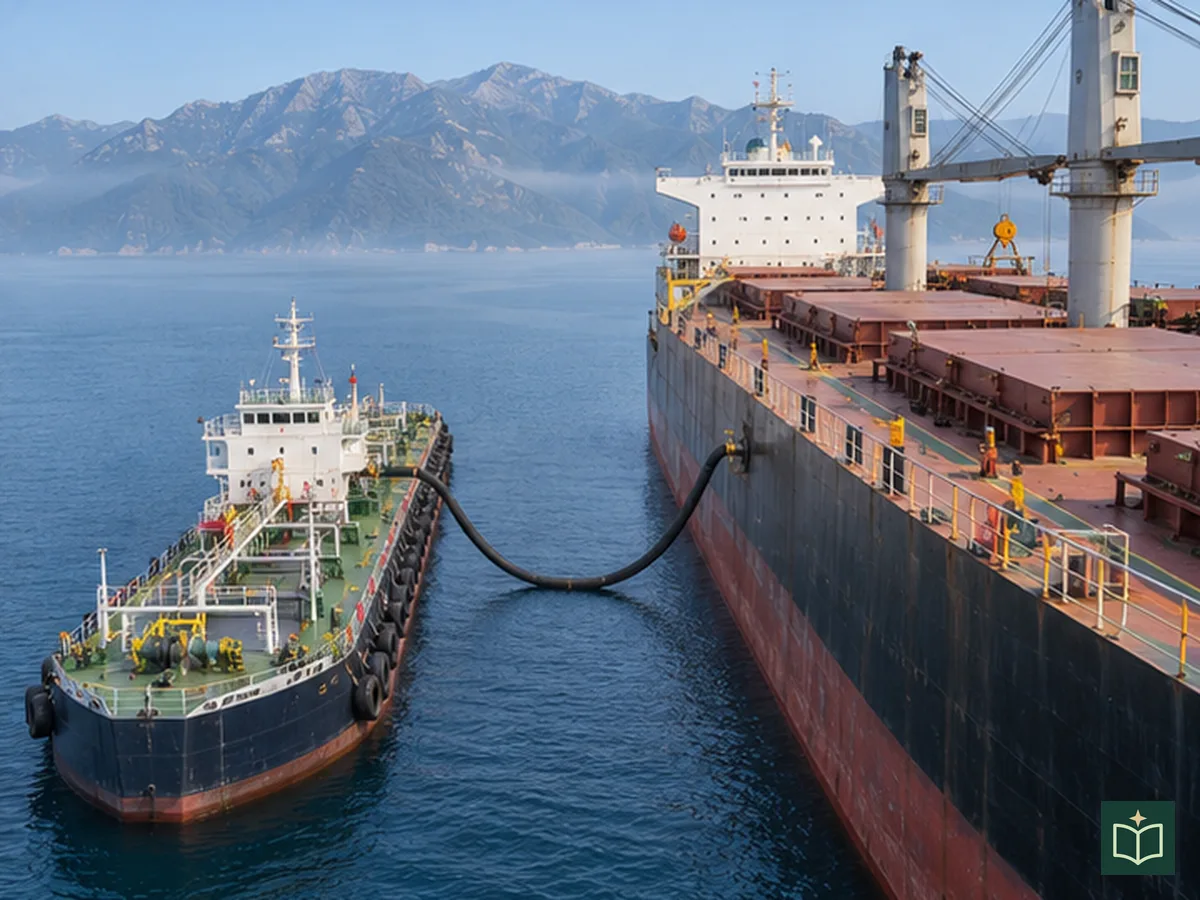
Most deliveries happen not at a quay but at anchorage. A bunker barge, essentially a small tanker, loads fuel from a terminal and sails out to a waiting ship. The crews moor the two vessels together, connect hoses and agree pumping rates and safety checks. Fuel quantity is measured, increasingly by mass flow meters, which Singapore made mandatory to curb disputes over short deliveries. Samples are drawn throughout the transfer and sealed, so the fuel's quality can be tested later if problems arise. A bunker delivery note records the grade, quantity and sulphur content, as required under international pollution rules. Larger ports also offer pipeline deliveries at berth and ship-to-ship transfers offshore.
A worked example
Consider a cargo ship that burns 60 tonnes of fuel a day on a 20-day voyage. It needs about 1,200 tonnes, plus a safety reserve. Marine fuel oil carries roughly 41 gigajoules of energy per tonne, so the voyage consumes around 49,000 gigajoules. Burning a tonne of heavy fuel oil releases a little over three tonnes of carbon dioxide, so the trip emits roughly 3,700 tonnes. Slowing down helps a great deal: because the power needed rises steeply with speed, a modest reduction in speed can cut daily fuel use by a large fraction, which is why many operators adopted slow steaming when fuel prices rose.
Why Fujairah grew
Fujairah sits on the UAE's east coast, on the Gulf of Oman just outside the Strait of Hormuz. Ships entering or leaving the Gulf, and those passing between Asia, the Middle East, Africa and Europe, can call without a long detour. Over several decades the emirate built extensive storage terminals, a deep-water port, a large anchorage and refining capacity, and a pipeline from Abu Dhabi's oilfields reached the coast in 2012, allowing crude to bypass the strait. Together with Singapore and Rotterdam, Fujairah is regularly ranked among the world's largest bunkering locations. Its sales figures are watched as an indicator of shipping activity and fuel demand in the wider region.
Pressures on the trade
Bunkering faces two big changes. The first is environmental. The 2020 sulphur limit cleaned up exhaust but required new blends whose stability and compatibility sometimes caused engine problems. Spills during transfers, though usually small, are closely regulated. The second is decarbonisation. The International Maritime Organization has set goals to cut shipping's greenhouse gas emissions towards net zero around mid-century, which means future bunker hubs may need to supply LNG, methanol, ammonia or hydrogen-based fuels alongside oil. Ports that invest early in storage, safety rules and trained crews for these fuels may keep their place on global routes; those that do not may see ships refuel elsewhere.
Sources & further reading
Figures are rounded and widely published; check the linked organisations for the latest editions. These organisations do not endorse this website.