Two plants, one sugar
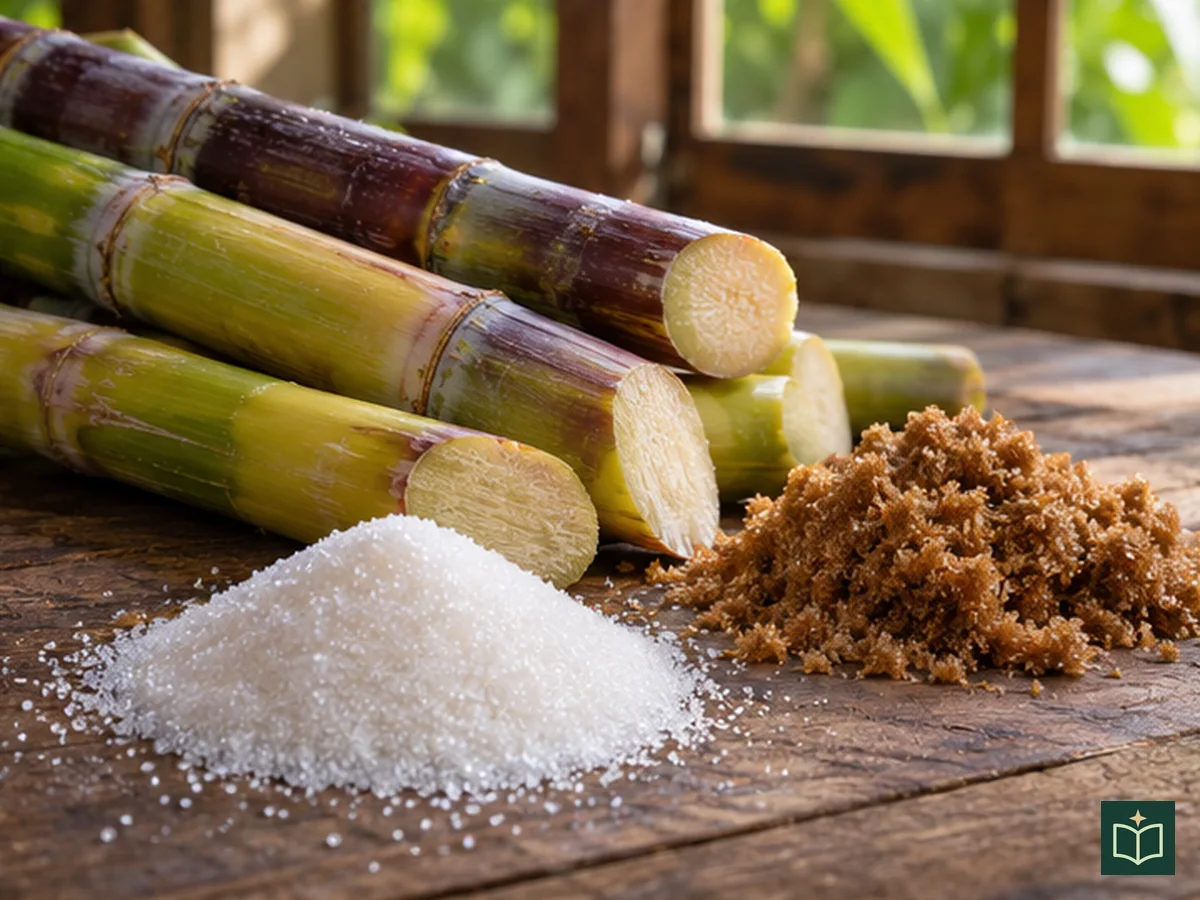
Table sugar is sucrose, a molecule that plants make through photosynthesis and store as an energy reserve. Two crops supply almost all of it. Sugar cane, a tall tropical grass, stores sucrose in its stems and grows in countries such as Brazil, India and Thailand. Sugar beet, a root crop grown in cooler climates including Europe, the United States and Russia, stores it underground. Cane accounts for roughly four-fifths of world production. Once refined, sugar from the two sources is chemically identical: pure sucrose. The differences lie in the farming, the processing route and the by-products, not in the white crystals that end up in a kitchen.
From field to juice
Cane must be processed quickly after harvesting, because its sugar begins to break down within a day or so. At the mill, the stalks are chopped and shredded, then passed through heavy rollers that squeeze out the juice while water is sprayed on to wash out more sugar. The fibrous residue, called bagasse, is usually burned in the mill's boilers to make steam and electricity, so many cane mills are largely self-powered. Beet is handled differently. The roots are washed and sliced into thin strips called cossettes, which are soaked in hot water in a diffuser so the sugar dissolves out, leaving pulp that is often sold as animal feed.
Growing the crystals
Crystallisation takes place in vacuum pans, large vessels in which the syrup boils at a lower temperature because the pressure is reduced. That protects the sugar from scorching and darkening. Operators add tiny seed crystals, and as more water evaporates, sucrose builds up on them layer by layer. The result is a thick mixture of crystals and syrup called massecuite. It is fed into centrifuges, perforated drums spinning at high speed, which fling the liquid out through the holes and leave the crystals behind, often rinsed with a spray of water. The crystals are then dried, cooled and sorted by size into granulated, caster and other grades.
Molasses and brown sugar
The dark liquid spun from the crystals is molasses. Mills usually boil it again to extract more sugar, and each round leaves a darker, less sweet syrup, until the final molasses is no longer worth processing for sugar. It is used in animal feed, for fermentation into ethanol and yeast, and in cooking. Many cane mills produce raw sugar, light brown crystals with a thin film of molasses, which is shipped to refineries for further purification. Brown sugar sold in shops is often white sugar with some molasses added back, or a less refined sugar. The flavour and colour come from molasses, not from any extra nutritional value.
Common misconceptions
White sugar is sometimes described as bleached, but its colour comes from removing impurities through clarification, filtering and crystallisation, not from bleaching agents. In some refineries, activated carbon or bone char has been used as a decolourising filter, which matters to some vegetarians and to buyers checking how their sugar was processed. Another common belief is that brown or raw sugar is much healthier than white. The small amounts of minerals in molasses make little difference in normal portions; nutritionally, all these sugars are mainly sucrose. Health authorities, including the World Health Organization, recommend limiting free sugars of every kind, whatever their colour or source.
Why it matters
Sugar is one of the world's most traded food commodities, and the Gulf plays a notable role. Large refineries in the region import raw cane sugar and refine it for local use and re-export, making the area a significant hub in the global sugar trade. The industry also links to energy, because bagasse fuels mills and cane juice or molasses can be fermented into ethanol, a major vehicle fuel in Brazil. Understanding how sugar is refined helps explain its labels, its by-products and its economics. It also shows that a familiar household staple is the end point of heavy industry, combining agriculture, chemistry and engineering at enormous scale.
Sources & further reading
Figures are rounded and widely published; check the linked organisations for the latest editions. These organisations do not endorse this website.