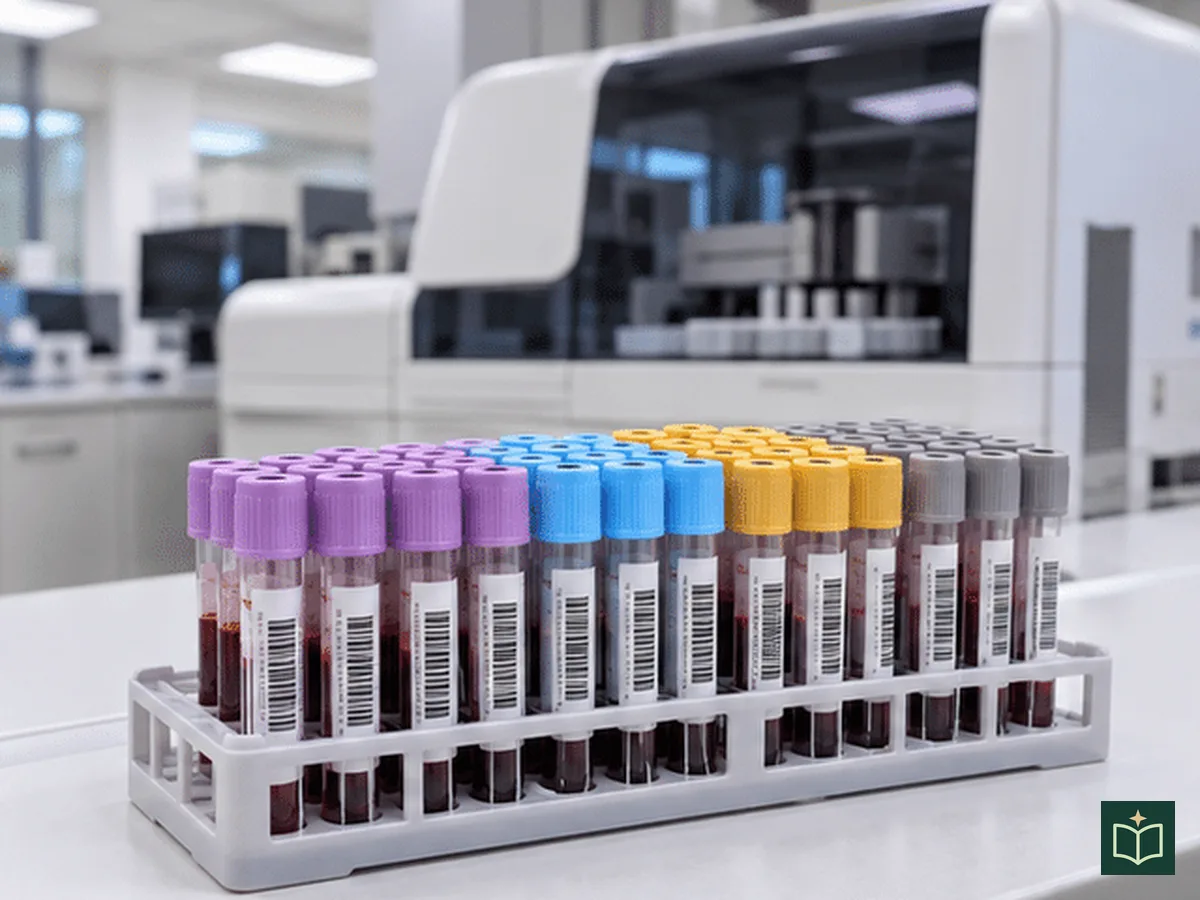
Colour-coded tubes
The process starts with choosing the right tube. Each cap colour signals a different additive, chosen for the tests requested. Lavender tubes contain EDTA, which prevents clotting and preserves blood cells for a full blood count. Light blue tubes contain citrate, used for clotting tests. Gold or red tubes allow the blood to clot so the clear serum can be separated for many chemistry tests, such as cholesterol, kidney and liver markers. Grey tubes contain fluoride, which stops cells consuming glucose, keeping sugar measurements accurate. Phlebotomists fill them in a set order of draw, so additives from one tube do not contaminate the next and distort results.
Labels and transport
Every tube is labelled at the bedside with the patient's details and a barcode linked to the electronic test order. Identification errors are among the most serious risks in laboratory medicine, so many hospitals scan the patient's wristband and the tube together. Samples are then sent to the laboratory, sometimes through pneumatic tubes that shoot carriers through pipes across a hospital, sometimes by courier from clinics in temperature-controlled boxes. Timing matters. Some substances change if blood sits too long, potassium can rise as cells leak, and glucose can fall. On arrival, the laboratory scans each barcode, logs the time and checks that the sample is the right type and volume.
Spinning and analysing
Many tests need plasma or serum rather than whole blood, so tubes go into centrifuges. Spinning heavier red cells to the bottom leaves the lighter fluid on top. Force depends on speed and rotor size: a rotor with a 15-centimetre radius spinning at 3,000 revolutions a minute produces about 1,500 times the force of gravity. In large laboratories, automated track systems carry tubes from loading to centrifuges, uncap them and route them to chemistry, immunoassay and haematology analysers. These instruments use colour-changing reactions, light-scattering, electrodes and antibody-based tests to measure substances, and they can process hundreds or thousands of tests an hour with tiny sample volumes.
Quality checks before release
Before any patient result is released, the analyser must pass quality control. Laboratories run samples with known values several times a day; if those results drift outside accepted limits, testing stops until the problem is fixed. Software checks each patient result too, flagging values that are physiologically unlikely, that changed sharply from the patient's previous test, or that suggest a damaged sample, such as one where red cells burst. Critical results, such as dangerously high potassium, are telephoned to a clinician immediately. Accredited laboratories, including many in the UAE, follow international standards such as ISO 15189 and take part in external schemes that compare their results with other laboratories.
What a reference range means
A report lists each result beside a reference range, often taken to mean normal. In fact, most ranges are defined to cover the middle 95% of results from healthy people, so about 1 in 20 healthy people will fall outside the range on any single test purely by chance. If 20 independent tests are run, the probability that all are within range is only about 36%, even for a perfectly healthy person. That is why doctors interpret results in context, considering symptoms, history, medicines and trends over time. A result slightly outside the range is not automatically a problem, and a result inside it does not rule out every condition.
Why it matters
Laboratory testing sits behind a large share of medical decisions, from diagnosing infections and diabetes to monitoring medicines and screening newborns. Yet most errors happen not inside the analysers but before and after them: wrong patient labels, wrong tubes, delays or results that are misread. That is why so much effort goes into barcodes, automation and checks. For patients, simple steps help, such as fasting when asked, mentioning medicines and supplements, and confirming name and date of birth at the draw. Questions about what a specific result means should go to the doctor or laboratory that ordered the test. This article provides general information, not medical advice.
Sources & further reading
Figures are rounded and widely published; check the linked organisations for the latest editions. These organisations do not endorse this website.