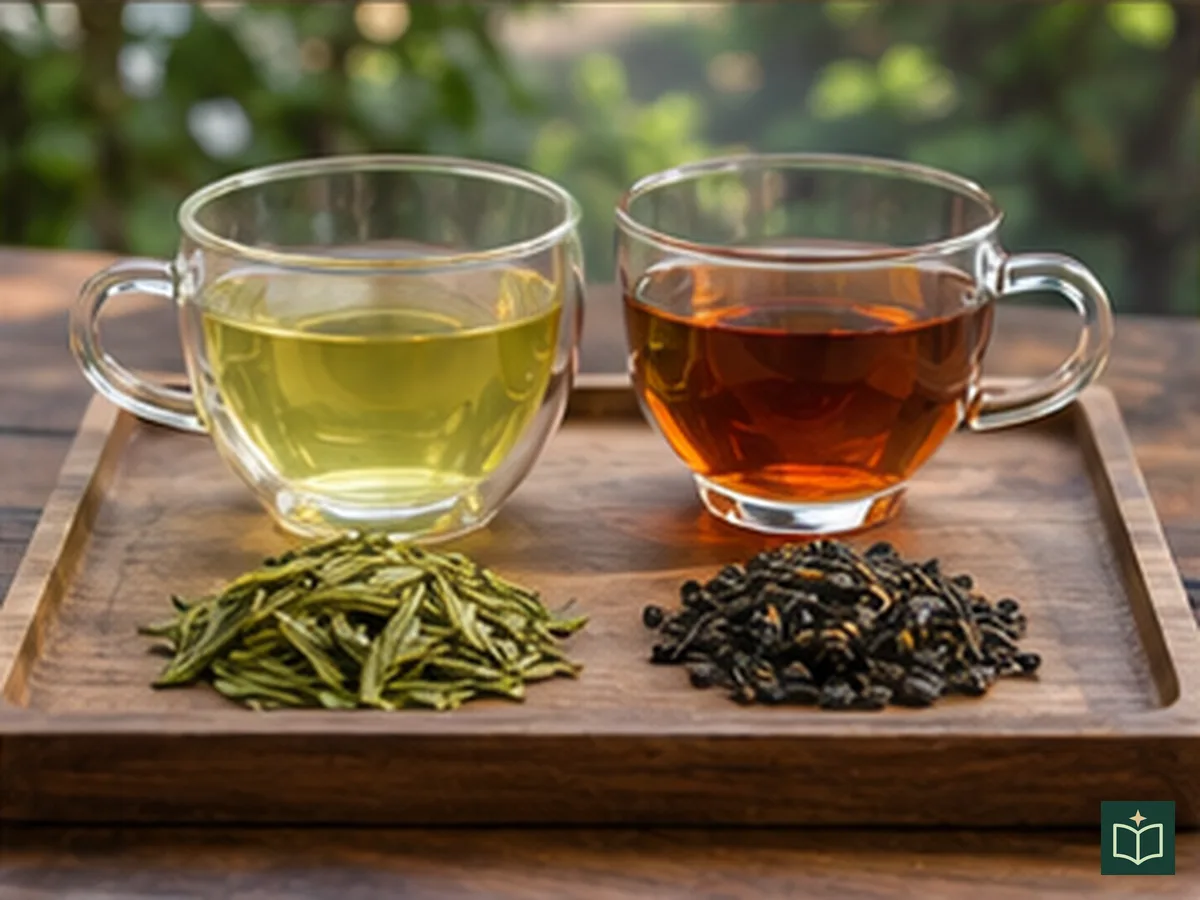
The same plant
It is natural to assume green and black tea come from different bushes, but both are made from the leaves of one species, Camellia sinensis, an evergreen shrub native to southern China and neighbouring regions. White, oolong and pu-erh teas come from the same plant too. There are two main varieties: the smaller-leaved Chinese type, var. sinensis, and the larger-leaved Assam type, var. assamica, found in north-east India. Growers tend to favour one or the other for particular teas, but either variety can in principle be made into green or black tea. What separates the two in the cup is not where the leaf grows but what happens to it after picking.
Oxidation is the key
When a fresh tea leaf is bruised or cut, enzymes inside it react with oxygen in the air, just as a sliced apple turns brown. This process is called oxidation, although the tea trade often calls it fermentation, which is misleading because no microbes are involved. To make green tea, producers heat the leaves soon after picking, by steaming, as is traditional in Japan, or by pan-firing, as is common in China. The heat deactivates the enzymes, so the leaf stays green. To make black tea, producers wither, roll or crush the leaves to break their cells, then leave them to oxidise fully before drying, which turns them dark.
What changes in the cup
Oxidation transforms the chemistry of the leaf. Fresh tea is rich in compounds called catechins, which give green tea its pale colour, grassy or vegetal flavour and slight bitterness. During oxidation, many catechins combine into larger molecules called theaflavins and thearubigins. These give black tea its reddish-brown colour, fuller body and the brisk, malty flavour that stands up to milk and sugar. Oolong sits in between, partly oxidised, which is why it ranges from floral to toasty. Brewing differs too. Green tea is usually brewed with water below boiling, around 70 to 80°C, for a short time, because hotter water draws out bitterness. Black tea tolerates water at or near boiling.
The caffeine question
Black tea is often said to contain more caffeine than green, and on average that is true: typical figures for a 240 ml cup are around 47 milligrams for black tea and 28 for green. Coffee usually contains much more, often around 95 milligrams in a similar cup. But the difference between teas owes more to how they are made and brewed than to oxidation itself. Leaf grade, the amount of tea used, water temperature and steeping time all matter, and some green teas, such as powdered matcha, where the whole leaf is consumed, can contain more caffeine than a typical black tea. Anyone limiting caffeine should check strength rather than colour.
Tea in the Gulf
In the UAE and wider Gulf, black tea dominates daily life. Karak chai, brewed strong with milk, sugar and cardamom and sometimes saffron, became a staple through ties with South Asia and is sold at roadside cafeterias around the clock. Black tea is also served plain and sweet in small glasses in many Arab homes, while Arabic coffee, gahwa, keeps its central place in hospitality. Green tea has gained popularity more recently, often promoted for its health image, and mint or ginger is sometimes added. The preference for black tea reflects history: Britain's tea trade, centred on India and Sri Lanka from the nineteenth century, shaped tastes across the region.
Health claims and limits
Both teas contain antioxidant compounds, and green tea has attracted particular attention because of its catechins. Many observational studies link regular tea drinking with modest benefits, but such studies cannot easily prove cause and effect, and claims for weight loss or disease prevention are often overstated in marketing. Concentrated green tea extract supplements have been linked to rare cases of liver harm, so food safety authorities advise caution with high doses. Tea also reduces the absorption of iron from plant foods when drunk with meals. For most people, a few cups a day of either tea is a pleasant, low-calorie drink. Anyone with a medical condition should ask a doctor about caffeine.
Sources & further reading
- Britannica · Tea ↗
- US NCCIH · Green tea ↗
- Mayo Clinic · Caffeine content for coffee, tea, soda and more ↗
Figures are rounded and widely published; check the linked organisations for the latest editions. These organisations do not endorse this website.