Two names, one time of day
For most purposes, GMT and UTC show the same time, and they are often used interchangeably. Yet they are different kinds of thing. Greenwich Mean Time is a time zone, the civil time used in Britain in winter and in several West African countries all year. Coordinated Universal Time, known as UTC, is a time standard: the reference against which every time zone on Earth is defined. Dubai is UTC+4, New York is UTC−5 in winter and Tokyo is UTC+9. GMT began with the Sun and astronomers' telescopes. UTC is built from atomic clocks. The difference between them never exceeds about a second, which is why the confusion is harmless.
The story of GMT
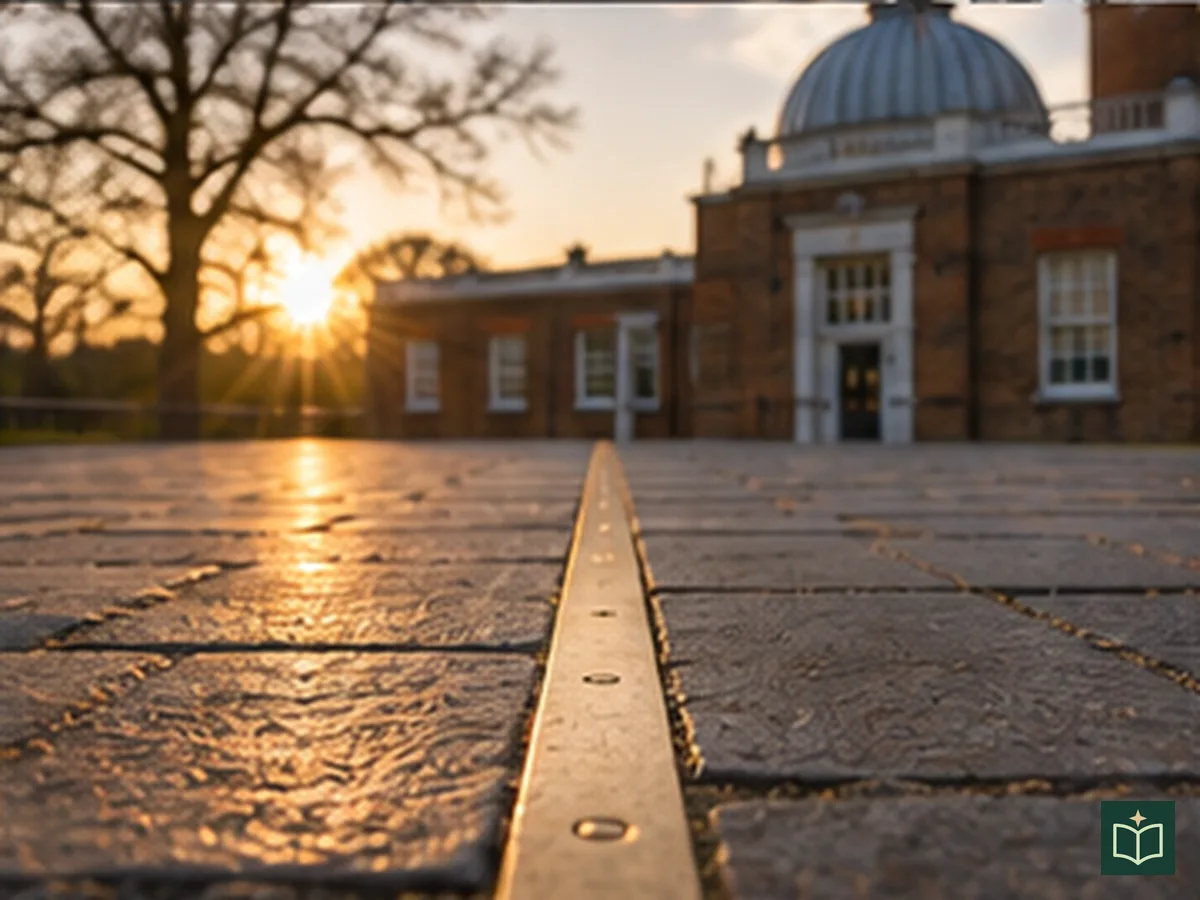
Greenwich Mean Time began at the Royal Observatory in Greenwich, on the River Thames in London. Astronomers there timed the Sun crossing the meridian, the north–south line overhead. Because the Sun's apparent motion varies slightly through the year, they used the average, or mean, which is where the name comes from. Britain's railways adopted Greenwich time in the 1840s to make timetables consistent, and in 1884 the International Meridian Conference in Washington chose the Greenwich meridian as the world's zero line of longitude. Time zones were then defined as offsets from Greenwich. For much of the twentieth century, GMT effectively served as the world's time reference, especially for navigation and radio.
Why atomic time took over
Earth turns out to be an imperfect clock. Its rotation is gradually slowing and wobbles slightly from year to year. Atomic clocks, which count the vibrations of caesium atoms, are vastly steadier. Since 1967 the second has been defined as 9,192,631,770 cycles of radiation from a caesium-133 atom. International Atomic Time is calculated from hundreds of atomic clocks in laboratories around the world, coordinated by the International Bureau of Weights and Measures near Paris. UTC is atomic time adjusted to stay within 0.9 seconds of Earth's rotation. Since 1972 that has been done by adding leap seconds, 27 so far, which is why UTC now runs 37 seconds behind atomic time.
How the UAE sets its clocks
The UAE's official time, Gulf Standard Time, is defined as UTC plus four hours, and the country does not use daylight saving time, so the offset never changes. When it is 08:00 UTC, it is noon in Abu Dhabi and Dubai. In winter that is 08:00 in London, which uses GMT, but in summer London switches to British Summer Time, UTC+1, so it is 09:00 there. Because the UAE lies about 55 degrees east of Greenwich, the Sun's mean noon falls about 3 hours 41 minutes after Greenwich. With clocks set four hours ahead, average solar noon in Dubai arrives around 12:19 local time, varying through the year by up to about a quarter of an hour.
Where the name comes from
The abbreviation UTC looks odd because it matches neither the English nor the French word order. English speakers proposed CUT, for Coordinated Universal Time, and French speakers proposed TUC, for temps universel coordonné. The compromise adopted in the early 1970s was UTC, which favours neither language. Pilots, sailors and the military often call it Zulu time, from the letter Z used to mark the zero time zone, so a flight plan may show a departure at 0800Z. Computers, smartphones and the internet keep time in UTC internally and simply convert to the local zone for display, which is why a phone adjusts automatically on landing in another country.
The end of leap seconds
Leap seconds have caused trouble. Because they are announced only months ahead and can disrupt software that assumes every minute has 60 seconds, they have crashed websites and complicated systems in finance, telecoms and satellite navigation. In 2022 the General Conference on Weights and Measures decided that leap seconds will be abandoned by 2035, allowing UTC and Earth's rotation to drift apart by a larger amount before any correction. That means UTC will move slightly further from its solar origins, while GMT, as a time zone, simply follows UTC. For ordinary life the change will be invisible: the drift amounts to something like a minute over a century.
Sources & further reading
Figures are rounded and widely published; check the linked organisations for the latest editions. These organisations do not endorse this website.