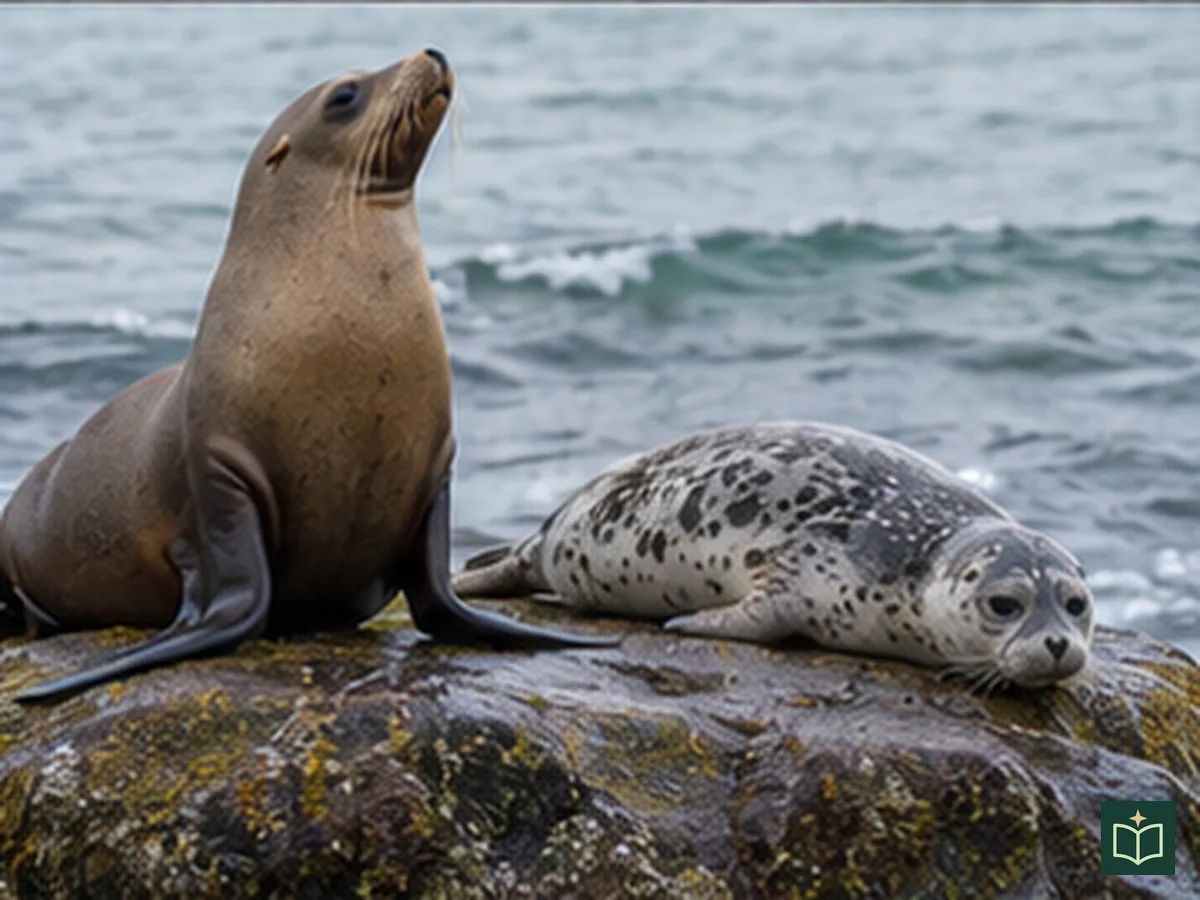
Fin-footed relatives
Seals and sea lions belong to a group of marine mammals called pinnipeds, meaning 'fin-footed'. The group has three families. The true seals, or earless seals, number around 18 species, including harbour seals, grey seals and elephant seals. The eared seals include the sea lions and their close relatives, the fur seals, around 15 species in all. The third family contains just one living species, the walrus. All pinnipeds spend most of their lives in the sea but come ashore or onto ice to rest, breed and moult. In everyday speech any of them may be called a seal, but biologists draw a firm line between the true seals and the eared seals.
Ears and flippers
The easiest difference to spot is the ear. Sea lions and fur seals have small external ear flaps on the sides of their heads. True seals have no ear flaps at all, only small openings that close underwater. Their front flippers also differ. A sea lion's fore-flippers are long, smooth and mostly hairless, like paddles. A true seal's are shorter and furred, with visible claws. The biggest difference is in the hind flippers. A sea lion can rotate its hind flippers forward underneath its body. A true seal cannot; its hind flippers always point backwards, trailing behind like a tail. That single feature shapes how each animal moves on land and in water.
How they move
On land, a sea lion props itself up on its front flippers, tucks its hind flippers forward and walks or even gallops on all four limbs, surprisingly fast over rocks. A true seal cannot walk. It hauls itself forward on its belly in a caterpillar-like motion, using its front flippers and body muscles, which looks clumsy on a beach. In water the roles reverse. True seals swim by sweeping their hind flippers and lower body from side to side, like a fish, which is efficient for long, steady swimming. Sea lions swim mainly with their large front flippers, beating them like wings, which gives them great agility and sharp turns while chasing prey.
Why they evolved apart
Pinnipeds descend from land-dwelling carnivores related to bears and weasels, and the eared seals and true seals went separate ways more than 20 million years ago. Each line adapted to a different way of life. True seals specialised in efficiency and endurance. They have thick blubber, can dive deep and long, and many live in cold polar or sub-polar waters; a southern elephant seal can dive beyond 1,500 metres and stay down for over an hour. Eared seals kept more mobility on land and specialised in agile, shallower hunting. They tend to gather in noisy, crowded breeding colonies on rocky shores, where the ability to walk helps males defend territories.
Noise, behaviour and captivity
Their behaviour reflects these differences. Sea lions are loud and sociable, barking constantly in colonies, and they are curious and easy to train. The animals that balance balls in marine shows or appear in aquariums are usually California sea lions. True seals are generally quieter in air, though many are highly vocal underwater, and they tend to be more solitary at sea. Body sizes vary widely in both groups. The largest pinniped is the southern elephant seal, whose males can weigh several tonnes. The largest sea lion, the Steller sea lion of the North Pacific, can reach around a tonne, while some fur seals are much smaller.
Where they live, and where not
Pinnipeds live along coasts from the Arctic to Antarctica, especially where cold, nutrient-rich waters support abundant fish. Sea lions are found mainly in the Pacific and around the Southern Hemisphere, but not in the North Atlantic, while true seals dominate polar waters and both sides of the Atlantic. Neither group lives naturally in the warm Arabian Gulf, whose marine mammals are dolphins, porpoises and dugongs instead. Visitors to the UAE are most likely to see pinnipeds in aquariums. Several species are threatened, including the Mediterranean monk seal and some sea lion populations, while others, such as grey seals in Britain, have recovered strongly after protection.
Sources & further reading
- NOAA Fisheries · Pinnipeds: seals, sea lions and walruses ↗
- Britannica · Pinniped ↗
- Britannica · Sea lion ↗
Figures are rounded and widely published; check the linked organisations for the latest editions. These organisations do not endorse this website.