Fuel is the limit
Rockets carry only so much propellant, and every extra kilogram of fuel needs more fuel to lift it. Reaching the outer planets directly would demand enormous rockets, and getting close to the Sun is harder still, because a spacecraft leaving Earth carries our planet's orbital speed and must shed most of it to fall inwards. Mission designers therefore use a technique that costs almost nothing: the gravity assist, often called a slingshot. By flying carefully past a planet, a spacecraft can gain or lose speed, or change direction, using the planet's motion around the Sun. Many of the most famous missions in space history would have been impossible without it.
The trick is the moving frame
At first it seems the idea should not work. Seen from the planet, a passing spacecraft speeds up as it falls in and slows down by the same amount as it climbs away, leaving at the speed it arrived with, only in a new direction. The gain appears when you view the encounter from the Sun, because the planet itself is moving at many kilometres per second. If the spacecraft swings around behind the planet in the direction of its orbit, its new direction lines up more with the planet's motion, and it leaves with extra speed relative to the Sun. Passing in front of the planet does the opposite and slows the craft down.
A tennis ball and a train
A simplified comparison helps. Imagine a train moving at 50 kilometres per hour and a tennis ball thrown at it head-on at 30 kilometres per hour. From the train's point of view, the ball approaches at 80 and bounces straight back at 80. Add the train's own speed and, to someone standing beside the track, the ball now flies away at 130 kilometres per hour, its original 30 plus twice the train's 50. A planet does not bounce a spacecraft, but its gravity can turn the craft's path in a similar way, and in the ideal head-on case the gain approaches twice the planet's speed. Real flybys bend the path less sharply, so gains are smaller.
Nothing is free, almost
The energy comes from the planet. When a spacecraft gains speed, the planet loses an equal share of momentum and slows down along its orbit. But because a planet is trillions of trillions of times more massive than a probe, the change is far too small to measure. Gravity assists can also reduce speed, which is just as valuable. NASA's MESSENGER probe used flybys of Earth, Venus twice and Mercury three times to slow down enough to orbit Mercury in 2011. The Parker Solar Probe uses repeated passes of Venus to shrink its orbit and dive ever closer to the Sun, reaching speeds faster than any other human-made object.
From a summer job to Voyager
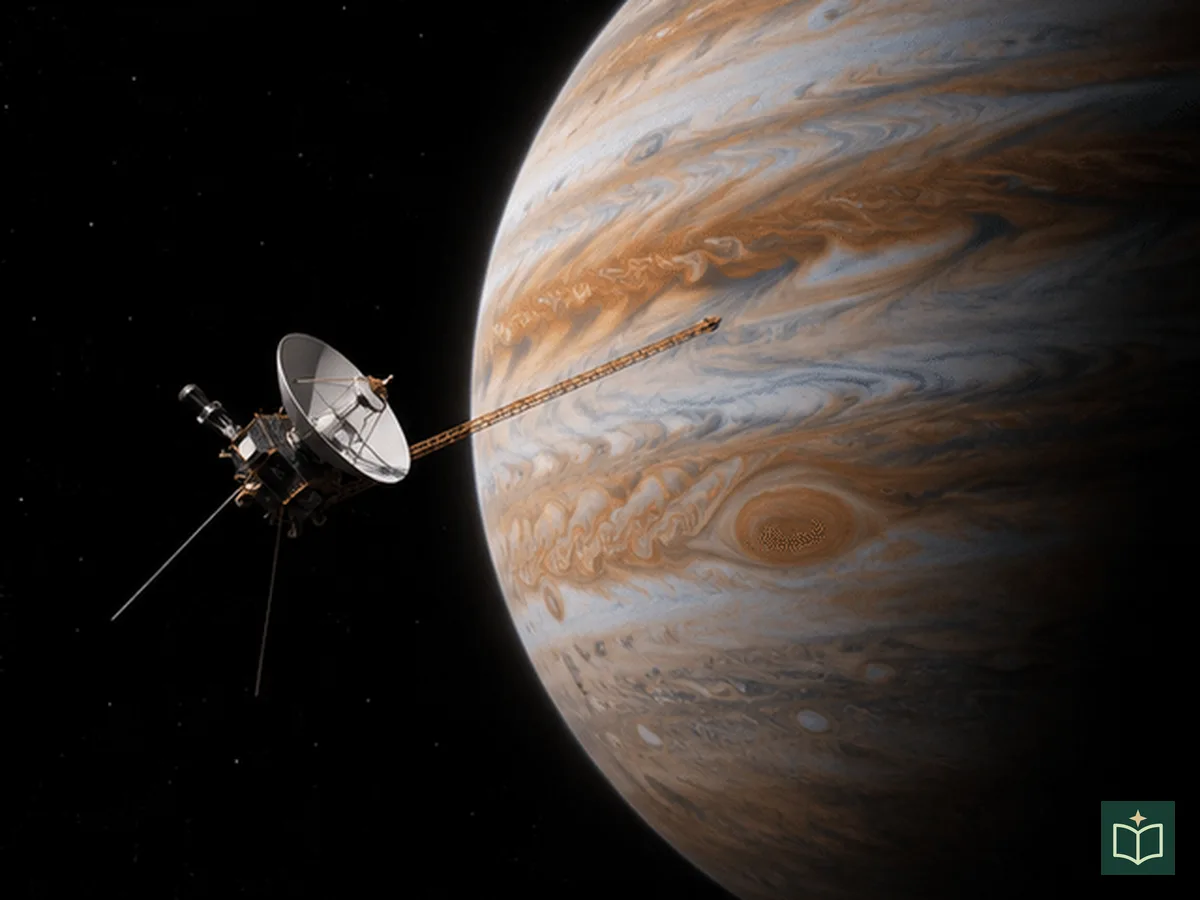
The mathematics was worked out in the early 1960s, notably by Michael Minovitch, then a graduate student working at NASA's Jet Propulsion Laboratory, who showed how flybys could be chained to reach distant planets. The first spacecraft to rely on one was Mariner 10, which flew past Venus in 1974 to reach Mercury. The most celebrated use came with the Voyagers, launched in 1977 to exploit a rare line-up of the outer planets. Voyager 2 swung from Jupiter to Saturn, Uranus and Neptune, a route that would otherwise have taken far longer. Cassini later passed Venus twice, Earth and Jupiter to gain enough speed to reach Saturn.
Timing is everything
Gravity assists come with conditions. Planets must be in the right places at the right time, so launch windows can be narrow and rare, and missing one may mean waiting years. Routes that use several flybys often take longer than a direct path would if enough fuel were available. Navigation must be extremely precise, since a pass that is slightly too close or too far sends the spacecraft in the wrong direction, and engineers make small course corrections along the way. Close passes of Earth also require careful safety analysis. Even so, the technique remains one of the most powerful tools in spaceflight, turning the Solar System's motion into a free source of speed.
Sources & further reading
Figures are rounded and widely published; check the linked organisations for the latest editions. These organisations do not endorse this website.